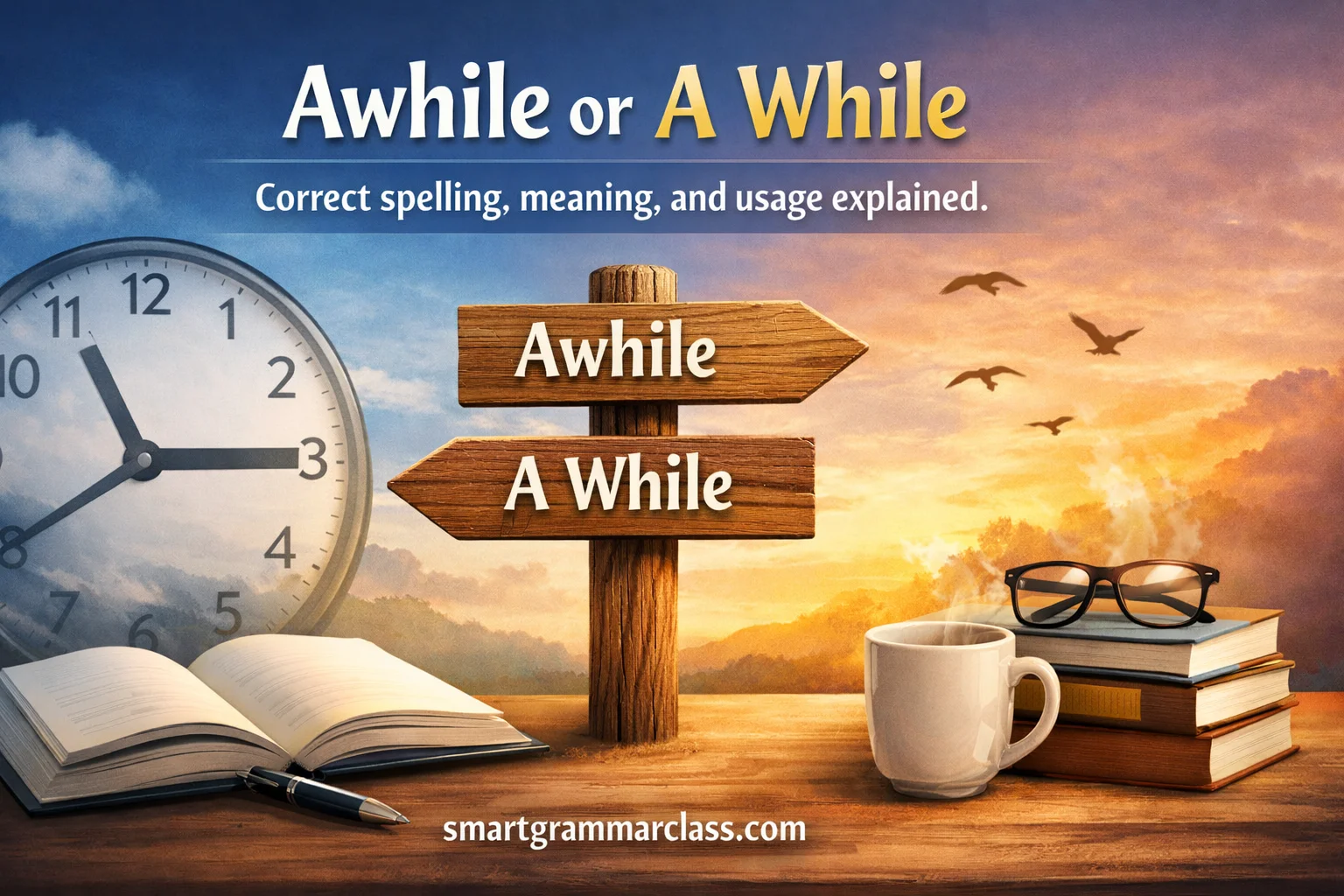
When I first typed a sentence using awhile and a while, I was unsure which one fits, and that small confusion led to a common mistake many learners make. This tricky difference often appears in English writing, whether you are a student or a blogger trying to avoid errors. In this guide, I will walk through some simple tricks so you don’t hesitate or feel paused, mid-sentence again. The key is noticing a pattern that helps even confident writers rely less on guesswork.
Awhile works as an adverb, while a while is a noun phrase that refers to a short time or period of time, like taking a rest. You will often see prepositions such as for, in, or after before a while, because it needs support, while awhile can directly modify verbs. These small language subtleties cause people to mix up the two, even though they serve distinctly different purposes in both writing and speech.
From my experience, misusing them can create confusion or even embarrassing moments in daily conversations, so it helps to dispel doubts by learning their definitions, uses, and key differences. If you want to master this, you don’t need to be among hardcore grammar enthusiasts, just understand the right contexts and follow basic advise. Think of adverb meaning as action-focused, and noun phrase meaning as time-focused. In general usage, remember that a while often comes following preposition, while awhile can stand alone, similar to words like read, ago, or back because it directly modifies actions.
This article shows that learning this small expression takes little time and effort, but it’s truly worth your while. Even though they are pronounced similarly, their grammatical roles and distinct meanings matter, making them homonyms, or words pronounced same. One is written without space, the other with space, and while some people treat them as interchangeable in informal writing, most style guides clearly distinguish between the two.
Also read this : Tomatoes or Tomatos: Correct Spelling and Meaning 2026
Awhile vs A While The Straight Answer You Came For
If you want the quick version, here it is:
- “Awhile” is an adverb
- “A while” is a noun phrase
That sounds technical. Don’t worry. There’s an easier way to think about it.
- Use “awhile” when no extra word is needed
- Use “a while” when a preposition like for or after comes before it
Quick examples
- Sit awhile. ✅
- Sit for a while. ✅
- Sit for awhile. ❌
If you remember that one pattern, you’ll already be ahead of most writers.
What Does “Awhile” Mean and How Do You Use It?
Let’s start with “awhile.”
At its core, it simply means “for a short time.” Simple and clean.
What makes it unique is how it behaves. It acts as an adverb, which means it modifies a verb. In plain terms, it describes how long something happens.
Example in action
- Stay awhile.
- Rest awhile before you leave.
- Come sit awhile and talk.
Notice something? There’s no extra word like for. The sentence flows naturally without it.
Why this matters
“Awhile” already carries the meaning of time. So adding another time-related word creates clutter.
Think of it like seasoning food. A pinch works. Too much ruins the dish.
What Does “A While” Mean and When Is It Correct?
Now let’s look at “a while.”
This version is a noun phrase. That means it behaves like a thing. Specifically it refers to a period of time.
Because it’s a noun, it often needs a little support from a preposition.
Common prepositions used with “a while”
- for
- after
- in
- quite
Example breakdown
- Sit for a while.
- I haven’t seen her in a while.
- Wait here for a while.
Each sentence includes a preposition before “a while.” That’s your clue.
The Core Difference That Solves Most Confusion
Let’s simplify everything into one clear comparison.
| Feature | Awhile | A While |
| Type | Adverb | Noun phrase |
| Needs preposition | No | Yes |
| Example | Stay awhile | Stay for a while |
| Function | Describes action | Names time period |
This table does most of the heavy lifting.
If you ever feel stuck, just ask yourself:
Do I need a preposition here?
If yes, go with a while. If not, use awhile.
The One Rule You Can Rely On Every Time
Here’s a practical trick that works in real writing.
The substitution test
Try replacing the phrase with “for a short time.”
- Sit awhile → Sit for a short time ✅
- Sit for a while → Sit for a short time ✅
Now try this:
- Sit for awhile → Sit for for a short time ❌
That double “for” sounds off. That’s your signal something is wrong.
Simple rule to remember
- No preposition → awhile
- Preposition present → a while
Keep it in your back pocket. It works almost every time.
Real-World Examples That Actually Make It Click
Let’s move beyond theory. Real examples make patterns stick.
Everyday conversation
- Can you stay awhile?
- I’ll call you in a while.
- Let’s rest awhile before continuing.
- We talked for a while after dinner.
Workplace examples
- Take a break awhile.
- Let’s pause for a while and review.
- Stay awhile after the meeting.
Writing examples
- The character waited awhile before speaking.
- She hadn’t written in a while.
You’ll notice the rhythm changes slightly. “Awhile” feels quicker. “A while” feels more structured.
Common Mistakes That Make Writing Look Off
Even strong writers slip here. Let’s clean up the usual errors.
Using “awhile” after a preposition
- ❌ Wait for awhile
- ✅ Wait for a while
This is the most common mistake.
Overcorrecting everything to “a while”
Some writers try to play it safe.
- ❌ Sit a while
- ❌ Stay a while
These sound incomplete. They need a preposition.
Mixing both forms incorrectly
- ❌ Stay for awhile and rest a while
That sentence creates inconsistency.
Correct version
- ✅ Stay for a while and rest awhile
Now it flows smoothly.
Awhile vs A While in Questions and Commands
Tone matters more than you might expect.
Commands often favor “awhile”
- Sit awhile.
- Stay awhile.
- Rest awhile.
Commands feel direct. “Awhile” matches that tone.
Questions often use “a while”
- Have you been here for a while?
- Did you wait for a while?
Questions tend to include prepositions. That naturally leads to “a while.”
British vs American Usage Is There Any Difference?
Here’s something that surprises people.
Unlike words such as color and colour, there is no major spelling difference between British and American English here.
Both forms:
- Exist in both dialects
- Follow the same grammatical rules
- Appear in formal and informal writing
What actually changes?
Tone and frequency.
- “Awhile” feels slightly more conversational
- “A while” appears more often in formal contexts
Still both are widely accepted.
How Native Speakers Use These in 2026
Language evolves. Usage patterns shift with time.
Current trends
- “A while” appears more frequently in formal writing
- “Awhile” shows up more in casual tone and dialogue
- Search queries often include both forms interchangeably
Why this matters for you
If you write online content or blogs, clarity wins over strict preference.
Readers care about flow. They want writing that feels natural.
Awhile vs A While in Digital Writing and SEO
Let’s talk strategy.
If you’re writing for search engines, you’ll notice something interesting.
People often type:
- “awhile or a while”
- “difference between awhile and a while”
- “is it awhile or a while”
What that means for your content
You should:
- Use both forms naturally
- Include variations in headings
- Avoid keyword stuffing
Example keyword variations
- awhile vs a while
- awhile or a while grammar
- difference between awhile and a while
This helps your content stay visible while still sounding human.
Quick Practice Section (Test Yourself Fast)
Let’s lock this in.
Fill in the blanks:
- Stay ___ and listen.
- I haven’t seen him in ___ .
- Wait here for ___ .
- Sit ___ and relax.
Answers
- Stay awhile and listen
- I haven’t seen him in a while
- Wait here for a while
- Sit awhile and relax
If you got those right, you’ve nailed the concept.
Case Study: Fixing Real Sentences
Let’s take messy sentences and clean them up.
Example 1
- ❌ I stayed for awhile at the café
Fix
- ✅ I stayed for a while at the café
Example 2
- ❌ Come sit for awhile
Fix
- ✅ Come sit awhile
Example 3
- ❌ It’s been awhile since we talked
This one is tricky.
Both can work depending on structure. Still the safer version is:
- ✅ It’s been a while since we talked
Why? Because the phrase acts like a noun here.
A Deeper Look: Why This Rule Exists
This isn’t random. It comes from how English evolved.
“Awhile” originally formed as a shortened version of “a while.” Over time it became an adverb.
Think of it like:
- Already
- Today
- Sometimes
These words also compress phrases into single units.
Language loves efficiency.
Practical Writing Tips You Can Use Daily
Let’s bring this into your everyday writing.
When writing emails
- Use “a while” in professional tone
- Use “awhile” in relaxed communication
When writing blog content
- Mix both naturally
- Prioritize readability
When editing your work
- Scan for prepositions
- Apply the rule quickly
- Read the sentence out loud
If it sounds awkward, it probably is.
A Simple Memory Trick That Works
Here’s a trick you won’t forget.
If you see a preposition, give “while” some space.
That space turns it into a while.
No preposition? Keep it tight. Use awhile.
FAQs
What is the main difference between awhile and a while?
Awhile is an adverb, so it modifies a verb and does not need a preposition. A while is a noun phrase, so it usually comes after words like for, in, or after and refers to a period of time.
Can I use awhile and a while interchangeably in writing?
They are often used interchangeably in informal writing, but proper grammar rules and style guides distinguish between them, so it’s better to use each one correctly in formal contexts.
How can I quickly decide which one to use in a sentence?
A simple trick is to check if a preposition is needed. If your sentence sounds correct with “for a while,” then use a while. If not, then awhile is likely the right choice.
Why do people commonly confuse awhile and a while?
The confusion happens because both words are pronounced similarly and have close meanings related to time, making them easy to mix up, especially when writing quickly.
Is “It’s Been Awhile” grammatically correct?
Grammatically, it should be “It’s been a while” because “a while” follows the verb phrase. However, the song title by Staind uses “awhile,” which is widely accepted in informal or creative contexts.
Conclusion
In the end, understanding awhile and a while comes down to knowing their correct spelling, meaning, and usage in everyday English writing. While the difference may seem small, using them properly helps you avoid confusion and write with more clarity and confidence. By remembering that one is an adverb and the other is a noun phrase, and by practicing their use in real sentence examples, this once tricky choice becomes easy and natural over time.

Emma Brooke is a dedicated grammar expert and language educator with a strong passion for helping learners master the English language with clarity and confidence. With years of hands-on experience in teaching grammar, writing, and communication skills, she specializes in breaking down complex language rules into simple, practical explanations.
At Smart Grammar Class, Emma focuses on creating accurate, easy-to-understand, and well-researched content that supports students, professionals, and everyday learners in improving their writing and speaking skills. Her approach combines real-world usage, clear examples, and structured guidance to ensure learners not only understand grammar rules but can apply them effectively.
Emma is committed to maintaining high editorial standards, ensuring every piece of content is reliable, up-to-date, and aligned with modern English usage. Her work reflects a deep understanding of language learning challenges and a mission to make grammar accessible to everyone.