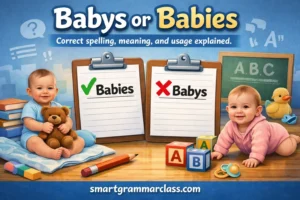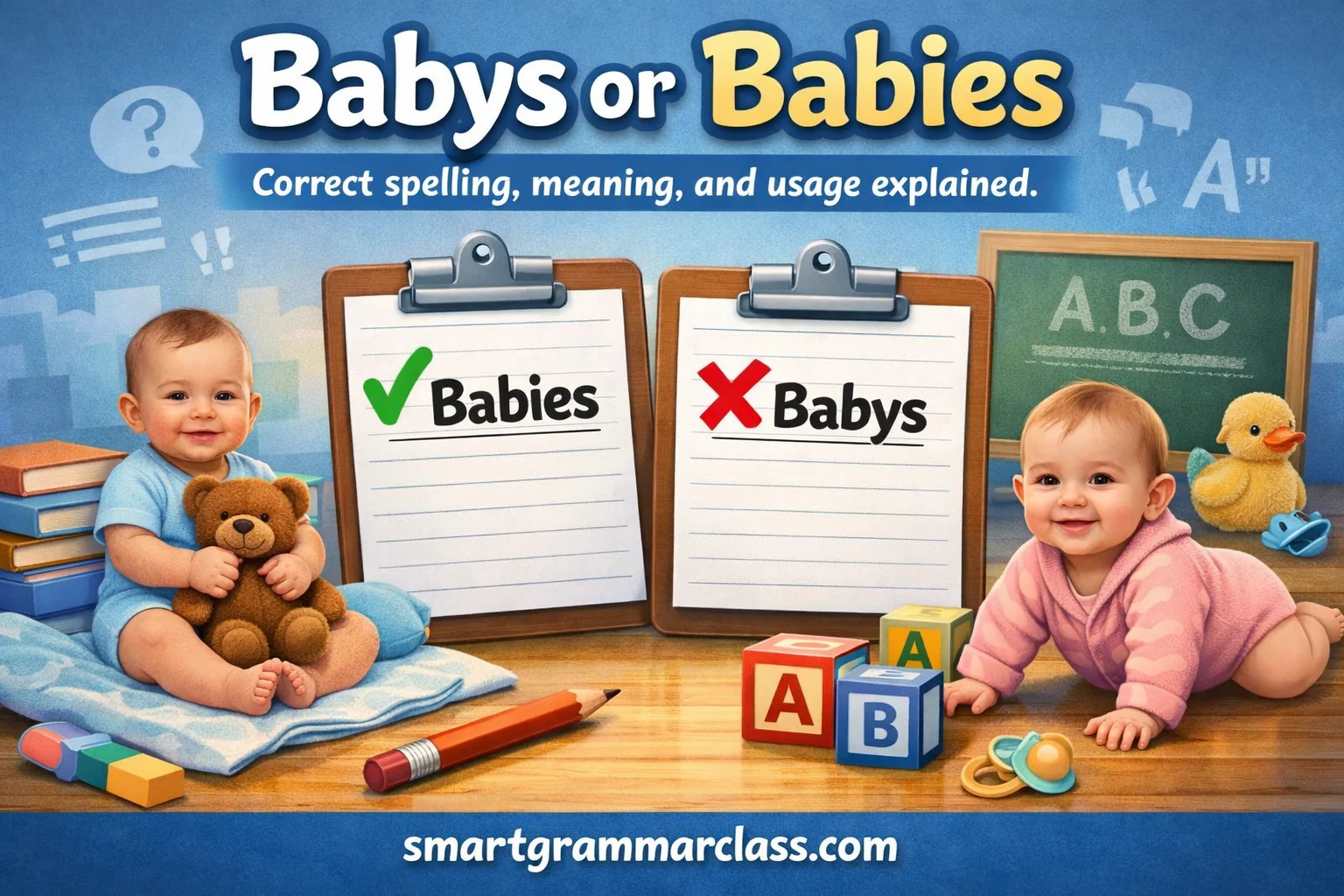
In English grammar, the difference between babys and babies is simple but often creates confusion for learners, students, and even professionals. The correct spelling is babies, which is the plural form of the singular noun baby. According to plural rules, when a word ends in a consonant + y ending, we change y to ies, not just add -s.
Writing babys is an incorrect usage and a common spelling mistake seen in emails, social media posts, and even school assignments. I’ve noticed during my own writing and content writing work that even experienced writers sometimes make this grammar mistake when typing quickly or feeling rushed.
Understanding this small rule improves clarity in writing, consistency, and overall professionalism, especially in business communication, formal writing, and professional emails. The difference also matters in possessive forms like baby’s and babies’, where the apostrophe changes the meaning to show ownership.
In real-life examples, whether you’re posting Instagram captions about college life, sharing Insta-worthy pictures from late-night study sessions, or writing a blog, using the correct form builds credibility and sends a clear message. Many native speakers and language learning users rely on style guides, dictionaries, and standard English rules from US English and UK English to avoid common mistakes. With practice, choosing between forms becomes easier, boosting your confidence and eliminating second-guessing in everyday communication.
Also read this : Yea or Nay: Correct Spelling Meaning Usage and Modern Relevance in 2026
Babys or Babies Quick Answer That Ends the Debate
If you only remember one thing from this guide, make it this:
- Babies = correct
- Babys = incorrect
That’s it. No exceptions. No regional differences. No stylistic alternatives.
Still, knowing the answer isn’t enough. You need to understand why “babies” works so you never second-guess yourself again.
What Does “Babies” Actually Mean
The word babies is the plural form of baby. You use it when you’re talking about more than one infant.
Simple on the surface. But context matters.
Here’s how it shows up in everyday writing:
- The babies are sleeping peacefully
- Those babies need feeding every two hours
- The hospital welcomed five new babies today
Each example reflects multiple infants. No confusion. No awkward phrasing.
Now compare that with “babys.” It looks similar. It feels close. But it’s not a real word in standard English.
Why “Babys” Looks Right but Isn’t
Let’s be honest. “Babys” looks like it should work. You just add an “s” to make something plural, right?
That instinct works for many words:
- dog → dogs
- car → cars
- book → books
So why not baby → babys?
Because English has rules. Not always logical rules. But consistent ones.
The mistake happens because:
- People rely on sound instead of spelling patterns
- Fast typing leads to shortcuts
- Autocorrect doesn’t always catch context
It’s a classic trap. And once it becomes a habit, it sticks.
The Real Rule Behind It (Explained Simply)
Here’s the rule that clears everything up:
If a word ends in a consonant + “y”, change the “y” to “ies” to make it plural.
That’s the backbone of this entire topic.
Let’s break it down visually:
| Singular | Rule Applied | Plural |
| baby | y → ies | babies |
| city | y → ies | cities |
| story | y → ies | stories |
| lady | y → ies | ladies |
Now contrast that with words ending in a vowel + “y”:
| Singular | Rule Applied | Plural |
| boy | + s | boys |
| toy | + s | toys |
| key | + s | keys |
See the difference? The letter before “y” decides everything.
That’s why “babys” breaks the rule. It ignores the pattern completely.
Correct vs Incorrect Examples You Can Learn From Fast
Sometimes the fastest way to learn is through contrast. Let’s put both forms side by side.
Correct usage
- The babies are laughing loudly
- All the babies were vaccinated on time
- Those babies belong in the neonatal unit
Incorrect usage
- The babys are laughing loudly
- All the babys were vaccinated
- Those babys are adorable
The incorrect examples feel off once you train your eye. That’s the goal. You want instant recognition.
Why This Mistake Happens So Often
This isn’t just a beginner mistake. Even experienced writers slip up.
Here’s why it keeps happening:
Fast typing culture
People write quickly. Speed beats accuracy in chats and comments. That leads to shortcuts.
Autocorrect limitations
Autocorrect focuses on common words. It doesn’t always catch grammatical context.
Confusion with possessives
“Baby’s” looks similar to “babies.” That overlap creates errors.
Informal writing habits
Texting and social media lower attention to detail. Bad habits carry over into formal writing.
Possessive Forms That Trip People Up
Now this is where things get interesting.
You’ve got three similar-looking forms:
- baby’s
- babies
- babies’
Each one means something different.
Clear breakdown
| Form | Meaning | Example |
| baby’s | One baby owns something | The baby’s blanket is soft |
| babies | More than one baby | The babies are crying |
| babies’ | Multiple babies own something | The babies’ toys are scattered |
Quick tip
If you can replace the word with “one baby,” use baby’s.
If you mean more than one, use babies.
If those multiple babies own something, use babies’.
It’s like a small puzzle. Once you see the pattern, it becomes second nature.
“Babies” in Real-Life Writing Situations
Let’s move beyond theory. Real-world usage matters more than rules.
Email example
- The babies will be discharged tomorrow morning
Clear. Professional. Easy to read.
Social media example
- These babies just melted my heart ❤️
Casual tone. Still correct spelling.
News writing example
- Doctors reported a rise in premature babies this year
Precise and credible.
Formal writing example
- Care for premature babies requires specialized equipment
Clean structure. No ambiguity.
Casual message example
- Look at those babies 😄
Short. Natural. Correct.
British vs American English: Any Difference
Some words change between British and American English. This one doesn’t.
- Americans write babies
- Brits write babies
No variation. No debate.
That’s rare in English. Usually there’s at least some difference. Not here.
Common Mistakes People Keep Making
Even after learning the rule, people still slip. Let’s call out the usual suspects.
Adding “s” instead of “ies”
This is the biggest one. It ignores the spelling rule entirely.
Mixing plural with possessive
People write “babys toys” instead of “babies’ toys.”
Overthinking simple words
Sometimes the simplest words cause the most hesitation.
Skipping proofreading
A quick reread would catch most of these mistakes.
Why People Search “Babys or Babies”
This keyword gets searched more than you’d expect.
Here’s what drives that curiosity:
- Students double-checking grammar rules
- Writers trying to sound professional
- Non-native speakers learning English patterns
- Content creators avoiding embarrassing mistakes
It’s not just about spelling. It’s about confidence.
Usage Trends and Search Behavior
Search data shows something interesting.
- “Babies” dominates written content
- “Babys” appears mainly in errors
- Searches spike during school terms
You’ll see how often people question this simple word.
Side-by-Side Comparison for Instant Clarity
Let’s make it crystal clear with a clean comparison.
| Aspect | Babys | Babies |
| Correct spelling | ❌ No | ✅ Yes |
| Grammar rule | Broken | Follows rule |
| Usage | Incorrect | Standard |
| Seen online | Mistakes | Everyday use |
| Professional use | Never | Always |
This table alone can save you from future mistakes.
Case Study: How One Small Mistake Hurts Credibility
Imagine this scenario.
A parenting blog publishes an article titled:
“How to Care for Newborn Babys”
Right away, something feels off.
Readers might not consciously analyze it. Still the error creates doubt.
Now compare that with:
“How to Care for Newborn Babies”
Same message. Completely different impact.
What changed?
- Trust increased
- Professional tone improved
- Reader confidence went up
That’s the power of correct spelling. It’s subtle but powerful.
Practical Tips to Never Get It Wrong Again
Let’s make this stick.
Use this quick checklist
- Does the word end in consonant + y?
- If yes, change “y” to “ies”
- Double-check possessive forms
- Read the sentence out loud
Memory trick
Think of it this way:
“If it ends in y, let it fly… into ies.”
It’s simple. A bit playful. And it works.
Advanced Insight: Why English Uses “ies”
This goes deeper than memorization.
English evolved through layers of influence. Germanic roots mixed with Latin patterns. Over time certain spelling rules became standardized.
The “y to ies” shift helps maintain pronunciation clarity.
For example:
- “Babys” would look like “bab-iss”
- “Babies” clearly signals “bay-beez”
So the rule isn’t random. It protects how words sound.
Mistakes to Watch in Professional Writing
If you write for work, this matters even more.
Common places errors show up
- Blog posts
- Product descriptions
- Emails
- Academic writing
One small mistake can lower perceived expertise.
Quick Practice Section
Try these yourself.
Choose the correct form
- The ___ are sleeping
- The ___ toys are missing
- That ___ blanket is blue
Answers
- babies
- babies’
- baby’s
If you got those right, you’re locked in.
FAQs
What is the correct spelling: babys or babies?
The correct spelling is babies, which is the plural noun form of baby. The word babys is an incorrect usage and is not accepted in standard English. Following proper spelling helps avoid a grammar mistake and improves clarity in communication.
Why does baby change to babies in plural form?
In English grammar rules, when a word ends with a consonant + y ending, the y changes to ies to form the plural. This rule is part of basic pluralization and is taught to students, learners, and even used by writers in professional writing.
What is the difference between baby’s and babies’?
The form baby’s shows possessive meaning for one singular baby, while babies’ shows ownership for more than one baby. The apostrophe changes the meaning, so correct usage is important for clarity in writing and avoiding confusion.
Is using babys considered a serious mistake?
Yes, using babys is a clear spelling error and can look careless or unprofessional, especially in emails, business communication, or formal writing. It may affect your credibility and send the wrong message in both school work and professional emails.
Where do people commonly make mistakes with babies spelling?
People often make this common mistake while typing quickly, posting social media captions, writing Instagram captions, or doing school assignments. Even in blogging, SEO writing, and content writing, mixing up correct usage and incorrect usage can impact consistency in writing and overall writing skills.
Conclusion
In English grammar, choosing between babys and babies comes down to knowing the right plural rules and applying the correct spelling. Using babies instead of the incorrect usage babys improves clarity in writing, builds confidence, and maintains professionalism in everything from emails to social media posts. Paying attention to small details like y ending changes, apostrophe use in baby’s and babies’, and overall word usage helps avoid common mistakes. Whether you are a student, writer, or working in business communication, mastering this simple rule strengthens your writing skills and ensures clear, effective communication every time.

mma Rose is a skilled grammar expert and language educator dedicated to helping learners improve their English with clarity and confidence. With extensive experience in teaching grammar, writing, and communication, she specializes in simplifying complex language rules into easy, practical explanations.
At Smart Grammar Class, Emma creates well-researched, accurate, and user-friendly content designed for students, professionals, and everyday learners. Her teaching approach focuses on real-life examples, clear structure, and actionable guidance, enabling readers to apply grammar rules effectively in both writing and speaking.
Emma is committed to maintaining high editorial standards, ensuring every article is trustworthy, up-to-date, and aligned with modern English usage. Her goal is to make grammar simple, accessible, and useful for everyone.