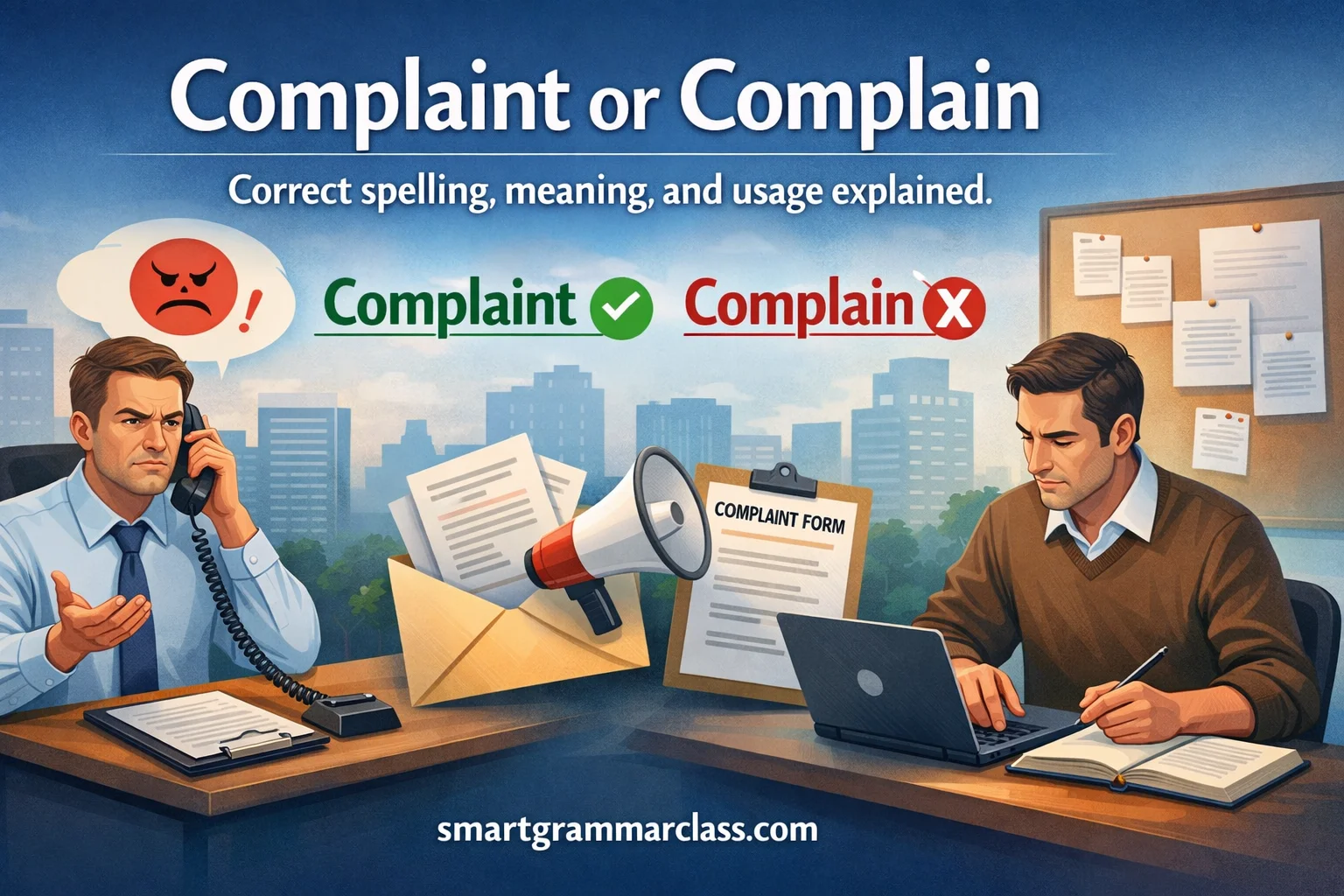
Many English learners face confusion between complaint and complain because these words sound similar but are used in different situations. In simple terms, complain is a verb showing an action, while complaint is a noun, a statement about a problem or issue. I still remember being paused mid-sentence, wondering if I should write “I want to complain” or “I have a complaint” in a formal email.
You are not alone in this distinction, and even experienced writers sometimes make the wrong choice, which can look unpolished. This guide gives a clear, helpful explanation with examples, so you can avoid mistakes, improve your skills, and use both forms correctly in writing, daily conversation, or even a blog post or academic paper.
Understanding the difference also helps in business communication, customer service messages, and social media like Instagram captions about college life, epic games, or late-night study sessions. A complaint often shows dissatisfaction, discomfort, or pain, for example when poor service at a restaurant is reported, while to complain is the act itself. Mixing them can feel embarrassing, especially in official letters, news reports, or school notices.
In both UK and US usage, the spelling stays the same, unlike words like focused or focussed. Keeping this grammar rule in mind improves clarity, accuracy, and professionalism, whether you are drafting, posting updates, broadcasting online, or managing projects and meetings. Over time, with practice and frequency, these common forms become easy to remember, helping your communication stay smooth, consistent, and full of credibility while giving your audience a clear glimpse into your thoughts without any hullabaloo.
Also read this : Perfect vs Prefect: Meaning, Spelling, Usage and Examples 2026
Complaint or Complain Quick Answer That Clears It Instantly
Here’s the truth in plain English:
- Complaint = a thing (noun)
- Complain = an action (verb)
That’s it. Simple, clean, and reliable.
Examples you’ll recognize immediately:
- “I filed a complaint.”
- “I need to complain about this issue.”
One names the problem. The other describes expressing it.
Why “Complaint or Complain” Confuses So Many People
At first glance, these words feel interchangeable. They share the same root. They sound nearly identical. That’s where the trouble begins.
Here’s what actually causes the confusion:
- Sound similarity leads people to rely on instinct instead of grammar
- Fast typing and autocorrect fail to catch context errors
- Lack of grammar awareness between nouns and verbs
- Overlapping usage in everyday speech
Consider this sentence:
“I want to make a complain.”
It sounds okay in casual conversation. But it’s wrong.
The correct version:
“I want to make a complaint.”
That one small shift changes everything.
The Real Difference Between Complaint and Complain
Let’s break it down in a way that sticks.
Complaint: The Noun You Can Hold Onto
Think of complaint as something tangible. You can file it, receive it, or respond to it.
Common contexts:
- Customer service
- Legal systems
- Workplace feedback
- Online reviews
Examples:
- “The company received multiple complaints.”
- “She submitted a formal complaint.”
- “Noise complaints increased last month.”
Now notice something subtle. You can count complaints. You can document them. That’s your clue.
Complain: The Action You Perform
Now switch gears.
Complain is what people do when they’re unhappy.
Examples:
- “Customers complain about slow delivery.”
- “He always complains about prices.”
- “She complained to the manager.”
You can’t “hold” a complain. You can only perform it.
That’s the key difference.
Side-by-Side Comparison Table That Makes It Obvious
| Feature | Complaint | Complain |
| Part of Speech | Noun | Verb |
| What It Represents | A problem or grievance | Expressing dissatisfaction |
| Example | “I filed a complaint.” | “I complain too much.” |
| Usage Context | Formal and informal writing | Everyday speech and action |
| Can You Count It? | Yes | No |
| Common Pairing | File a complaint | Complain about something |
Real-Life Usage of Complaint vs Complain (Where It Actually Matters)
Grammar rules mean nothing unless you can apply them. So let’s look at real-world usage across different situations.
Emails That Sound Professional and Clear
Writing an email? Precision matters.
Correct usage:
- “I’d like to submit a complaint regarding your service.”
- “I’m writing to complain about a billing issue.”
Notice how natural that feels. No awkward phrasing. No confusion.
Workplace Communication That Builds Credibility
In professional settings, small errors stand out.
Examples:
- “We’ve received several customer complaints this week.”
- “Clients continue to complain about response times.”
Using the wrong form here can make your communication look careless.
Social Media and Casual Writing
Even in relaxed spaces, clarity matters.
- “Another complaint about slow WiFi.”
- “People always complain, but rarely offer solutions.”
Short sentences. Clear meaning. No friction.
News Headlines That Demand Precision
Headlines rely on accuracy and brevity.
- “Passengers File Complaint Against Airline”
- “Residents Complain About Rising Costs”
Mix these up and the headline loses its punch.
Common Mistakes with Complaint or Complain (And How to Avoid Them)
Let’s get brutally honest. These mistakes happen all the time.
Using the Wrong Form
❌ “I want to make a complain.”
✔ “I want to make a complaint.”
Incorrect Verb Tense
❌ “He complaint yesterday.”
✔ “He complained yesterday.”
Mixing Up Structure
❌ “She gave a complain.”
✔ “She made a complaint.”
Forgetting Grammar Roles
❌ “The complaint loudly.”
✔ “They complained loudly.”
A Simple Trick You’ll Actually Remember
Here’s a shortcut that works every time:
- If you can replace the word with “issue”, use complaint
- If you can replace it with “express dissatisfaction”, use complain
Test it:
- “I filed an issue” → works → use complaint
- “I express dissatisfaction about the service” → works → use complain
No guessing needed.
British English vs American English: Any Difference?
Here’s some good news. No complications here.
Both American English and British English use:
- Complaint
- Complain
Spelling stays the same. Meaning stays the same. Usage stays the same.
That’s rare in English. Take the win.
Word Family and Variations You Should Know
Understanding related forms gives you an edge.
Core Forms
- Complaint → noun
- Complain → verb
Extended Forms
- Complained → past tense
- Complaining → ongoing action
- Complainant → person making a complaint
- Complainer → informal term
Usage Patterns Backed by Data
Search behavior reveals something interesting.
- “Complaint” dominates formal searches
- “Complain” appears more in casual queries
- Spikes often follow service failures or viral incidents
Case Study: Customer Service Breakdown
Let’s bring this to life.
A telecom company receives 5,000 support tickets in one week.
What happens next:
- Customers complain on social media
- The company logs each complaint
- Support teams respond to complaints
- Analysts review complaint patterns
See the pattern?
Complain = action
Complaint = record
Mixing them up would confuse the entire workflow.
Another Example: Workplace Scenario
Imagine a team meeting.
A manager says:
“We’ve received multiple complains this month.”
It sounds off immediately.
Correct version:
“We’ve received multiple complaints this month.”
Now it sounds professional. Clear. Credible.
Practical Usage Guide (Quick Reference)
Use “Complaint” When You Mean:
- A formal issue
- A written grievance
- A documented problem
Use “Complain” When You Mean:
- Speaking up
- Expressing frustration
- Taking action verbally or in writing
Visual Breakdown for Quick Learning
- Complaint → Object
- Complain → Action
Think of it like this:
- You file a complaint
- You choose to complain
That mental model sticks.
Why Getting This Right Actually Matters
It’s not just grammar. It’s perception.
Using the wrong word can:
- Undermine credibility
- Confuse readers
- Make writing feel careless
- Reduce clarity in professional settings
On the flip side, getting it right:
- Sharpens communication
- Builds trust
- Makes writing flow naturally
Advanced Insight: Formal vs Informal Tone
Here’s something most guides skip.
Complaint leans formal
- Used in legal, corporate, and official contexts
- Carries weight and structure
Complain leans conversational
- Used in speech and casual writing
- Feels more personal and immediate
Understanding tone helps you choose better.
FAQs
What is the difference between complaint and complain?
The word complain is a verb that shows an action, while complaint is a noun that refers to a statement about a problem or issue. Knowing this difference helps avoid confusion in writing and daily conversation.
Why do English learners get confused between these words?
Many English learners find these words tricky because they sound similar and are used in close situations. Without a clear explanation or proper examples, it is easy to make mistakes and choose the wrong form.
How can I use complaint correctly in a sentence?
You can use complaint when talking about a statement of dissatisfaction or discomfort, such as in a formal email, customer service messages, or official letters. It is common in business communication and news reports.
When should I use complain in everyday communication?
Use complain when describing the action of expressing discontent or a problem. It fits well in casual conversation, social media posts like Instagram captions, or even when sharing real-life situations from college life or study sessions.
What are simple tips to remember the correct usage?
A simple shortcut is to remember that complain is an action and complaint is a thing. Practicing in writing, emails, and blog posts improves clarity, accuracy, and professionalism over time.
Conclusion
In conclusion, understanding the complaint and complain difference is important for clear English writing and smooth communication in both formal and casual situations. When you remember that complain is a verb (an action) and complaint is a noun (a statement about a problem), it becomes easier to avoid confusion and common mistakes. With regular practice, using these words correctly will improve your clarity, accuracy, and overall professionalism in emails, conversation, and even social media.

mma Rose is a skilled grammar expert and language educator dedicated to helping learners improve their English with clarity and confidence. With extensive experience in teaching grammar, writing, and communication, she specializes in simplifying complex language rules into easy, practical explanations.
At Smart Grammar Class, Emma creates well-researched, accurate, and user-friendly content designed for students, professionals, and everyday learners. Her teaching approach focuses on real-life examples, clear structure, and actionable guidance, enabling readers to apply grammar rules effectively in both writing and speaking.
Emma is committed to maintaining high editorial standards, ensuring every article is trustworthy, up-to-date, and aligned with modern English usage. Her goal is to make grammar simple, accessible, and useful for everyone.