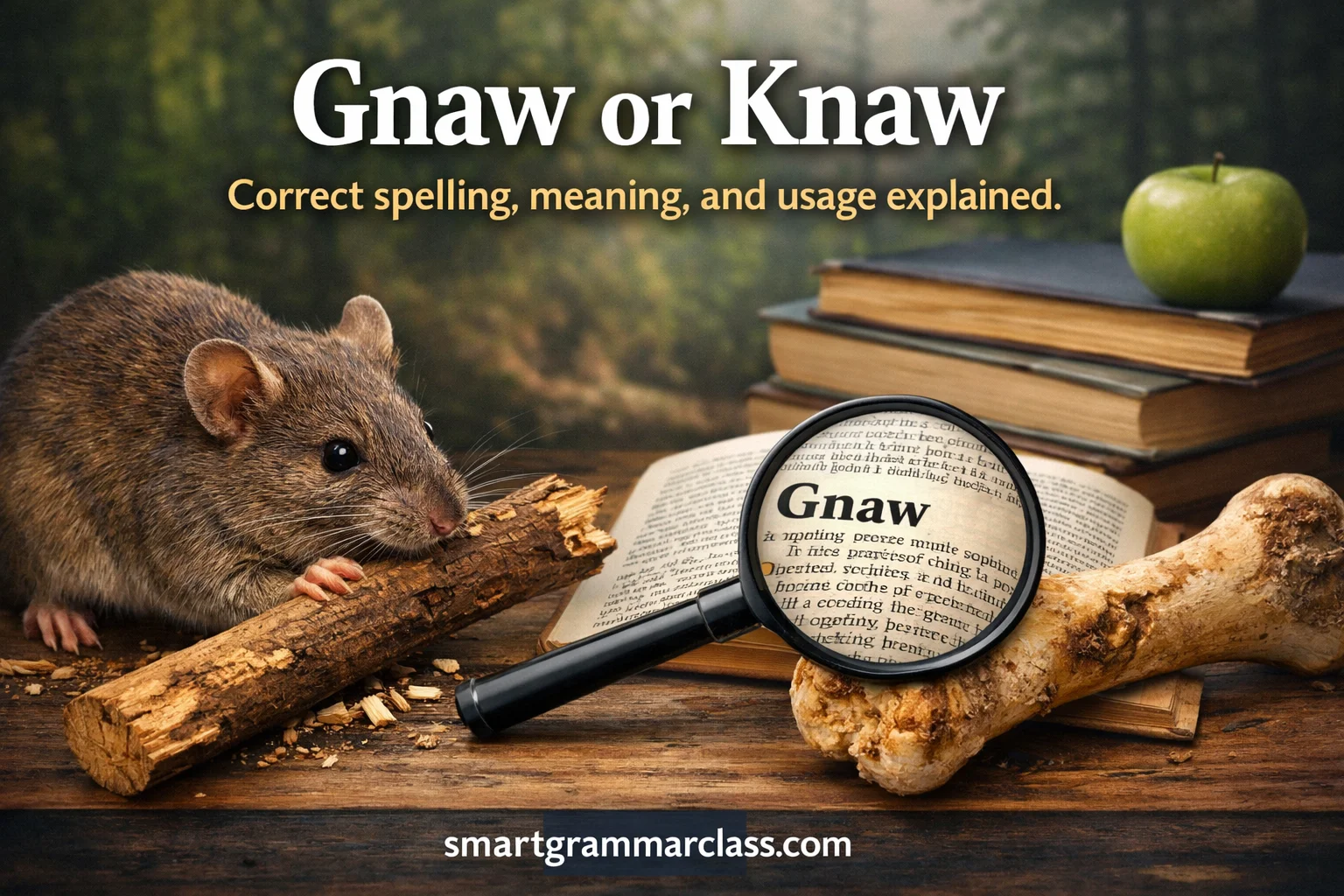
In 2026, many people still confused between gnaw and knaw because these words sound almost identical when spoken. I’ve seen even experienced writers pause mid-sentence and think twice before they write, which shows how tricky this spelling confusion can feel.
This guide will help you understand the difference without any guesswork and make your writing more professional. In standard English, only one is the correct spelling, while the other is an incorrect word often caused by pronunciation habits and phonetics.
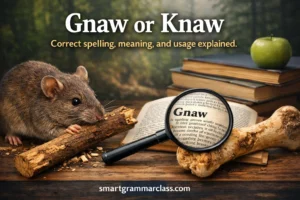
The correct word is gnaw, a verb that means to bite or chew persistently, like a dog that gnawed a bone or rodents like mice and rats chewing objects to sharpen their teeth or gain access to food. It is pronounced as “naw” because of the silent g, a common silent consonant in the English language with unusual spelling roots in its origins.
On the other hand, knaw is obsolete, nonstandard, and should be avoided in modern writing. This simple rule helps remove confusion, improve clarity in writing, and boost your communication skills, whether in American English or British English, making your language use more clear, confident, and exactly right in every sentence.
Also read this : Loose or Lose: Correct Spelling, Meaning and Usage in 2026
Quick Answer: Gnaw vs Knaw
Let’s cut straight to the point.
- Correct spelling: Gnaw
- Incorrect spelling: Knaw
- Meaning: To bite or chew something repeatedly over time
Here’s the key idea. Knaw is not a real English word. It doesn’t appear in any standard dictionary. It shows up only as a mistake.
Think of it like writing “definately” instead of “definitely.” It looks believable. It feels right. Still wrong.
If you remember one thing, remember this:
👉 Only “gnaw” is correct. Always.
Why “Gnaw” Is the Correct Spelling
At first glance, gnaw looks strange. That silent “g” doesn’t seem to belong. Why include a letter you don’t even pronounce?
The answer lies in history.
English didn’t develop cleanly. It borrowed words from Germanic languages and preserved many original spellings even after pronunciation changed. Over time, the “g” went silent. The spelling stayed behind like an old footprint.
Now compare that to knaw. It follows a pattern seen in words like:
- Know
- Knee
- Knife
That pattern tricks the brain. You assume the same logic applies. It doesn’t. English loves exceptions.
So while knaw feels logical, it has no historical backing. No dictionary support. No real usage in standard writing.
What Does “Gnaw” Actually Mean?
Let’s go deeper. A word becomes powerful only when you understand how to use it.
Core Definition
Gnaw (verb):
To bite or chew something repeatedly in a persistent way.
Picture a dog with a bone. It doesn’t take one bite and walk away. It keeps working at it. Slowly. Patiently. That’s gnawing.
Extended Meaning
Language often stretches beyond literal meaning.
Gnaw can also mean:
- To cause ongoing worry
- To create mental discomfort
- To persistently trouble someone
Examples That Make It Click
- The puppy gnawed on the chair leg all afternoon.
- Hunger began to gnaw at him during the long hike.
- A quiet fear continued to gnaw at her thoughts.
Notice the shift. The first sentence is physical. The second and third move into emotional territory.
That flexibility makes gnaw a vivid and expressive word.
The Origin of “Gnaw” (Why the Silent G Exists)
Let’s take a quick journey back in time.
The word gnaw comes from Old English “gnagan.” This term meant to bite or chew. Germanic languages influenced it heavily.
Over centuries, pronunciation simplified. People stopped pronouncing the “g.” However, spelling didn’t follow the same path.
English tends to preserve historical spelling even when pronunciation evolves. That’s why we still write:
- Gnat
- Gnome
- Gnash
Each word keeps the silent “g” as a nod to its roots.
Quick Timeline
| Period | Form | Change |
| Old English | gnagan | Full pronunciation |
| Middle English | gnawen | Transition phase |
| Modern English | gnaw | Silent “g” remains |
This historical baggage explains everything. The spelling may feel odd. Still, it carries centuries of linguistic evolution.
American vs British English: Any Difference?
Some words change across regions. Think of “color” vs “colour.” Or “center” vs “centre.”
Not this one.
| Region | Spelling | Notes |
| United States | Gnaw | Standard usage |
| United Kingdom | Gnaw | Identical spelling |
| Canada | Gnaw | Same as US and UK |
| Australia | Gnaw | No variation |
There’s no debate here. No alternate spelling. No regional twist.
Wherever you go, “gnaw” stays the same.
Gnaw vs Knaw: Clear Comparison Table
Sometimes a simple table makes things crystal clear.
| Feature | Gnaw | Knaw |
| Valid word | Yes | No |
| Meaning | Chew or bite repeatedly | None |
| Dictionary status | Listed everywhere | Not recognized |
| Usage | Formal and informal writing | Incorrect |
| Origin | Old English roots | No origin |
The verdict is obvious. One belongs in your vocabulary. The other doesn’t.
Common Mistakes With “Gnaw”
Even experienced writers slip up. Let’s break down why this happens.
Mishearing the Word
People spell words the way they hear them. “Gnaw” sounds like “naw.” That leads to guesswork.
Unfortunately, guesswork creates errors.
Confusing Similar Patterns
Words like know and knot influence spelling habits. Writers assume a silent “k” fits here too.
It doesn’t.
Typing Too Fast
Speed kills accuracy. When you rush, your brain fills in patterns automatically. That’s when knaw sneaks in.
Lack of Exposure
If you rarely see gnaw in writing, it feels unfamiliar. Unfamiliar words often get reshaped into something that looks more comfortable.
How to Remember the Correct Spelling
You don’t need to memorize rules. Use simple mental tricks.
Memory Trick
👉 “Gnaw has a g like growling animals.”
Imagine a dog growling while chewing a bone. That image locks in both the sound and spelling.
Visual Association
Picture the word:
G N A W
The “g” starts the action. The chewing continues. The word feels grounded.
Quick Checklist
- Starts with g
- Sounds like “naw”
- Always spelled the same way
Repeat it a few times. It sticks faster than you think.
“Gnaw” in Everyday Writing
This word fits into many contexts. Let’s explore how it shows up in real life.
Casual Conversation
- He kept gnawing on that idea like a dog with a bone.
- Stop gnawing your nails. It’s a bad habit.
Professional Emails
- A concern continues to gnaw at the project timeline.
- Uncertainty may gnaw at team confidence if not addressed.
News Writing
- Rising inflation began to gnaw at consumer spending.
- Prolonged drought continues to gnaw at agricultural output.
Social Media
- That plot twist is still gnawing at me.
- I can’t sleep. This decision is gnawing at my mind.
Same word. Different tone. Always effective.
Real-World Case Study: Why Spelling Matters
Imagine two job applicants.
Applicant A
- Writes clearly
- Uses correct spelling
- Pays attention to detail
Applicant B
- Makes small spelling mistakes
- Writes “knaw” instead of “gnaw”
- Appears less polished
Now think like a hiring manager.
Even small errors signal carelessness. They create doubt. That doubt can quietly influence decisions.
Key Insight
👉 Precision builds trust. Sloppy spelling erodes it.
That’s why mastering small details like gnaw vs knaw actually matters.
Words Commonly Confused With “Gnaw”
English loves tricky pairs. Here are a few related ones:
| Word | Meaning | Example |
| Gnaw | Chew repeatedly | The dog gnawed the bone |
| Gnash | Grind teeth | He gnashed his teeth in anger |
| Nibble | Take small bites | She nibbled on crackers |
| Chew | General biting action | He chewed his food slowly |
Each word has a slightly different flavor. Choose the one that fits your sentence.
When You Should Use “Gnaw”
Use gnaw when you want to show persistence.
Best Situations
- Repetitive physical action
- Lingering emotional tension
- Slow ongoing processes
Examples
- Doubt gnawed at his confidence.
- The animal gnawed through the rope.
- Regret began to gnaw at her decisions.
Short sentences hit harder. They carry weight without extra fluff.
When You Should Avoid It
Not every situation calls for gnaw.
Avoid using it when:
- The action happens once
- The tone needs simplicity
- Another word fits better
Example
❌ He gnawed a bite of pizza.
✔ He took a bite of pizza.
Use the right tool for the job. Don’t force it.
Advanced Usage Tips for Strong Writing
Want to elevate your writing? Try these strategies.
Use It for Emotional Impact
Words like gnaw create tension. They suggest something unresolved.
- A quiet fear gnawed at him.
That sentence feels alive.
Pair It With Strong Imagery
Combine the word with vivid context.
- The cold wind gnawed at their skin during the climb.
Now the reader feels the discomfort.
Keep It Natural
Don’t overuse it. One strong word beats five weak ones.
Quick Reference Cheat Sheet
- ✅ Correct: gnaw
- ❌ Incorrect: knaw
- Meaning: Repeated chewing or persistent worry
- Tip: Silent “g” always stays
Simple. Clear. Easy to remember.
FAQs
What is the correct spelling: gnaw or knaw?
The correct spelling is gnaw. The word knaw is incorrect and not used in standard English. Using gnaw helps maintain clarity in writing and avoids common spelling confusion.
Why do gnaw and knaw sound the same?
They sound similar because of phonetics and a silent consonant. In gnaw, the silent g is not pronounced, so it sounds like “naw,” which often leads to confusion in writing.
What does the word gnaw mean?
Gnaw is a verb that means to bite or chew persistently. It can describe animals like a dog chewing a bone, or even figurative uses like worries that gnaw at the mind.
Is knaw ever correct in English?
No, knaw is considered nonstandard and obsolete. It is not recognized in modern English language rules and should be avoided in both American English and British English.
How can I avoid mistakes with gnaw in writing?
To avoid mistakes, remember the simple rule that gnaw starts with a silent g. Regular practice, focusing on grammar, and learning usage rules can improve your writing skills and overall communication skills.
Conclusion
In 2026, understanding the difference between gnaw and knaw is a small but powerful step toward better writing and clear communication. The correct spelling is always gnaw, while knaw remains an incorrect word that should be avoided in standard English. By learning its meaning, pronunciation, and proper usage, you can remove confusion, reduce mistakes, and build stronger writing skills. With regular practice and attention to grammar and vocabulary, you’ll feel more confident and ensure your language stays accurate, clear, and professional every time you write.

mma Rose is a skilled grammar expert and language educator dedicated to helping learners improve their English with clarity and confidence. With extensive experience in teaching grammar, writing, and communication, she specializes in simplifying complex language rules into easy, practical explanations.
At Smart Grammar Class, Emma creates well-researched, accurate, and user-friendly content designed for students, professionals, and everyday learners. Her teaching approach focuses on real-life examples, clear structure, and actionable guidance, enabling readers to apply grammar rules effectively in both writing and speaking.
Emma is committed to maintaining high editorial standards, ensuring every article is trustworthy, up-to-date, and aligned with modern English usage. Her goal is to make grammar simple, accessible, and useful for everyone.