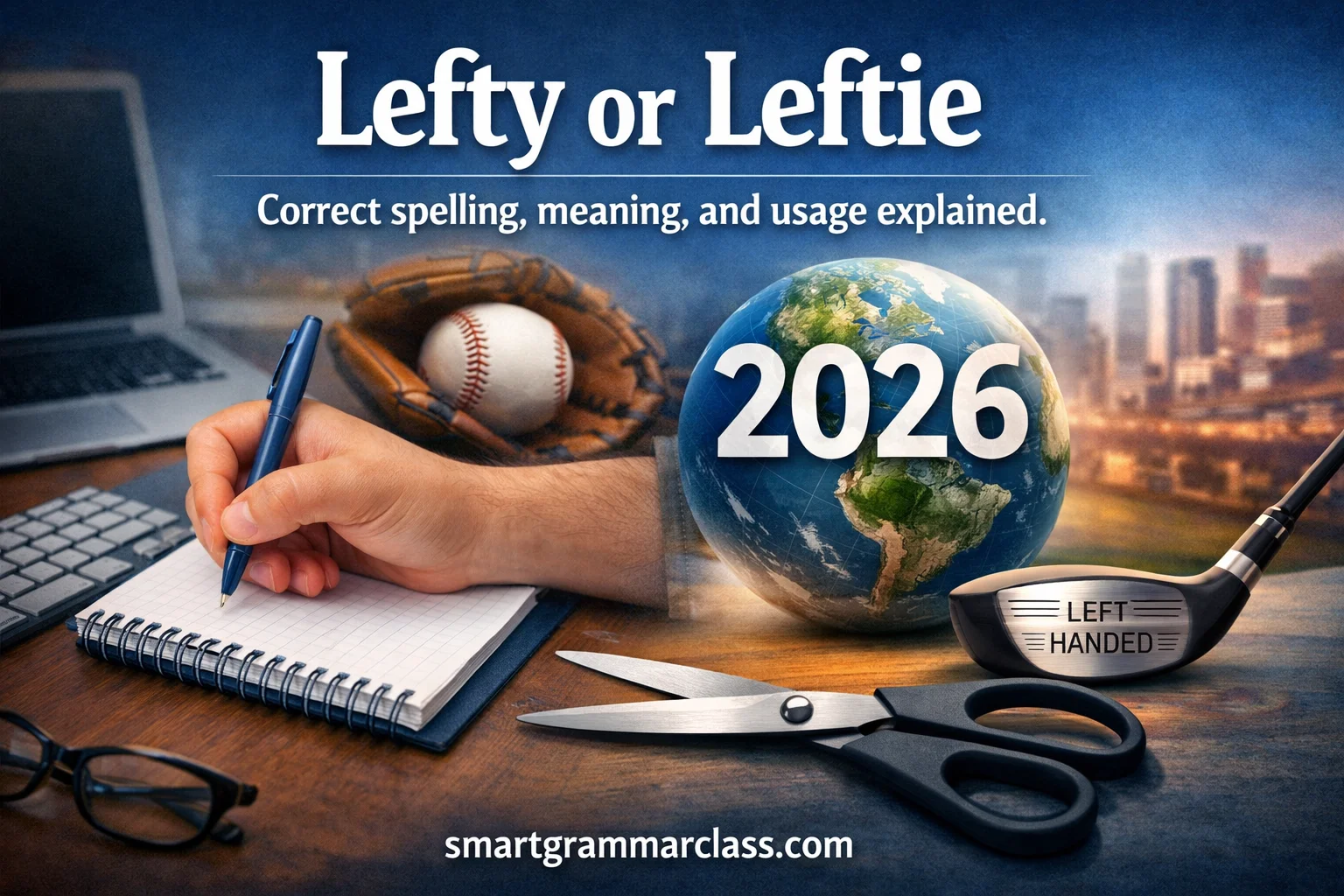
Many writers still pause and wonder about lefty or leftie when they see both versions in books, articles, and online posts. It’s easy to get confused, and many people search this question to find the right spelling for professional writing, academic work, or everyday communication.
This guide gives a clear explanation of the difference, showing how spellings vary based on audience, context, and writing tone. In most cases, both words carry the same meaning and refer to a left-handed person, making them interchangeable terms in casual conversation and even sports articles or political commentary about left-wing political views.
From my experience working with style guides and editing professional documents, the choice often depends on region and purpose. American English tends to favor lefty, while British English prefers leftie, as seen in Cambridge Dictionary and similar dictionaries.
These small nuances can influence reader perception, especially in formal writing, business communication, or broadcasting scripts, where accuracy and editorial standards matter. In informal settings like scheduling notes, drafting emails, or even talking about a pitcher facing lefties on the courts, both feel natural and acceptable terms. The key is to maintain consistency, avoid overthinking, and focus on clarity, so your article or message flows smoothly with precise language and fits your audience perfectly.
Also read this : Phoenix vs Pheonix: Correct Spelling, Meaning and Usage 2026
Lefty or Leftie The Quick Answer
If you want the fastest answer possible, here it is:
- “Lefty” is the preferred spelling in US English
- “Leftie” is more common in British English
- Both words carry the same meaning
That’s it. No complicated rules. No hidden grammar traps.
Still, if you stop there, you’ll miss the nuance that makes your writing sharper. So let’s dig deeper.
What Does Lefty or Leftie Mean?
At first glance, the term seems straightforward. It refers to someone who favors their left hand. But context changes everything.
Core meanings you’ll encounter
- Left-handed person
- Baseball pitcher who throws with the left hand
- Someone with left-leaning political views
That last one surprises people sometimes.
Everyday examples
- “She’s a lefty, so she writes at a different angle.”
- “The team signed a dominant lefty pitcher.”
- “He’s known as a bit of a lefty politically.”
Same word. Different shades of meaning.
That flexibility is what makes it so common in modern English.
The Origin of Lefty and Leftie
Words don’t appear out of nowhere. They evolve. They shift. They adapt to how people actually speak.
The root word “left” comes from Old English lyft. Back then, it carried negative connotations like weak or awkward. Over time, those associations faded.
Then came the informal suffixes.
How the variations formed
- “-y” ending → Popular in American slang
- “-ie” ending → Common in British diminutives
Think about similar examples:
- Dog → Doggie
- Sweet → Sweetie
- Smart → Smarty
Language follows patterns. Not strict rules.
So instead of one “correct” spelling emerging, both versions stuck. Each one found a home in different regions.
British English vs American English Spelling
This is where things get practical.
Different English-speaking regions favor different endings. Not because one is better. Just because habits formed over time.
Regional preference breakdown
| Region | Preferred Spelling | Notes |
| United States | Lefty | Dominates in media, sports, and everyday use |
| United Kingdom | Leftie | Matches British informal tone |
| Australia | Leftie | Follows UK conventions |
| Canada | Mixed | Both spellings appear frequently |
In the US, “lefty” feels natural and expected.
In the UK, “leftie” blends better with local speech patterns.
Why this matters
Imagine reading an American sports article that says “leftie pitcher.”
It’s not wrong. Still, it feels slightly off. Like something doesn’t quite fit.
That subtle mismatch affects readability more than you’d think.
Key Differences Between Lefty and Leftie
Let’s simplify the comparison.
What stays the same
- Meaning
- Usage contexts
- Informality level
What changes
- Spelling preference by region
- Tone perception
- Frequency of use
Side-by-side clarity
| Feature | Lefty | Leftie |
| Meaning | Same | Same |
| Tone | Direct, clean | Slightly playful |
| Region | US-focused | UK-focused |
| Popularity | Higher globally | Lower but steady |
Neither spelling is incorrect.
But one will always fit your audience better.
Which Spelling Should You Use in 2026?
This is where strategy comes in.
Simple decision rules
- Writing for a US audience → Use lefty
- Writing for UK readers → Use leftie
- Writing for global SEO → Mention both once then stick with one
Consistency matters more than anything else.
Switching between spellings mid-article creates friction. Readers notice. Even if they don’t consciously think about it.
A practical tip
Pick one version early. Stick to it throughout your content.
That small decision makes your writing feel polished and intentional.
Common Mistakes with Lefty or Leftie
Even simple words trip people up. Here’s what goes wrong most often.
Frequent errors
- Mixing both spellings randomly
- Assuming one spelling is universally correct
- Using the term in overly formal writing
- Misinterpreting the political meaning
Quick corrections
- Choose based on audience
- Stay consistent
- Match tone with context
Example mistake
❌ “The lefty pitcher was the best leftie on the team.”
✔ “The lefty pitcher was the best on the team.”
Cleaner. Stronger. Easier to read.
Lefty or Leftie in Everyday Usage
You’ll see these words everywhere once you start noticing them.
In sports
Baseball loves the term “lefty.”
Left-handed pitchers often have a strategic advantage. Their angle and delivery create problems for right-handed hitters.
Fun fact:
Around 10 12% of the population is left-handed, yet lefties make up a higher percentage of professional pitchers.
That’s not a coincidence.
In daily conversation
People use it casually all the time:
- “I’m a lefty, so desks feel weird.”
- “Being a leftie makes some tools harder to use.”
Short. Simple. Natural.
In politics
The word takes on a different tone here.
- “He’s considered a lefty in political circles.”
In this context, it refers to ideology. Not handedness.
Case Study: Why Lefty Dominates in US Sports
Let’s look at real usage patterns.
Example from baseball media
Sports headlines in the US overwhelmingly use “lefty.”
Why?
- It’s shorter
- It sounds sharper
- It fits headline space better
Hypothetical comparison
| Headline Version | Impact |
| “Team Signs Elite Lefty Pitcher” | Strong and direct |
| “Team Signs Elite Leftie Pitcher” | Slightly less natural in US |
That difference seems small. Yet it shapes reader perception.
Usage Trends and Search Data
Language leaves digital footprints. Search data tells a clear story.
Key observations
- “Lefty” has higher search volume globally
- “Leftie” shows spikes in UK-based searches
- Both terms remain stable over time
What this means for writers
- Use lefty for broader reach
- Include leftie if targeting international readers
That approach balances clarity and visibility.
Comparison Table: Lefty vs Leftie
Here’s everything in one place.
| Aspect | Lefty | Leftie |
| Definition | Left-handed person or concept | Same meaning |
| Region | United States | United Kingdom |
| Tone | Straightforward | Slightly softer |
| Popularity | Higher | Moderate |
| SEO Strength | Strong globally | Niche regional strength |
| Correctness | 100% correct | 100% correct |
Simple takeaway. Both work. Context decides.
Why Word Choice Like This Actually Matters
It might seem like a small detail. It isn’t.
Choosing the right variation:
- Improves readability
- Builds trust with your audience
- Aligns your writing with expectations
Think of it like wearing the right outfit to an event.
You could show up in anything. Still, the right choice makes everything click.
Practical Writing Tips You Can Use Immediately
Want to sound more natural when using terms like lefty or leftie?
Do this
- Match your audience’s region
- Keep sentences short and clear
- Use the term where it adds value
Avoid this
- Overexplaining simple words
- Switching spellings mid-content
- Forcing the term into every sentence
Example improvement
❌ “The left-handed individual, commonly referred to as a lefty or leftie…”
✔ “A lefty often adapts tools to fit their style.”
Cleaner. More human.
Interesting Facts About Left-Handed People
Let’s add some depth.
Quick facts
- About 1 in 10 people are left-handed
- Left-handedness is more common in men than women
- Many creative professionals are left-handed
Famous lefties
- Leonardo da Vinci
- Barack Obama
- Oprah Winfrey
Lefties have shaped history in surprising ways.
FAQs
Is lefty or leftie the correct spelling in 2026?
Both lefty and leftie are accepted spellings in 2026. The choice depends on region, audience, and writing tone, as both have the same meaning and are widely used in English usage.
What is the meaning of lefty and leftie?
The meaning of both terms refers to a left-handed person. In some contexts, especially in political commentary, they may also describe left-wing political views, but the core idea remains the same.
When should I use lefty vs leftie in writing?
Use lefty in American English and leftie in British English to match regional preferences. In formal writing or academic work, it’s better to follow style guides and maintain consistency throughout your article or professional documents.
Are lefty and leftie appropriate for professional writing?
They are mostly informal terms, so in business communication or broadcasting scripts, it’s safer to use “left-handed person” for better clarity and accuracy. However, they work well in casual conversation and everyday writing.
Why do people get confused between lefty and leftie?
Many people see both spellings floating in books, online posts, and sports articles, which creates confused usage. The single letter difference can influence reader perception, making it important to choose based on context, purpose, and audience fit.
Conclusion
In 2026, choosing between lefty and leftie comes down to understanding the correct spelling, meaning, and usage based on your audience, region, and writing tone. Both terms share the same meaning and are widely accepted, but American English often prefers lefty, while British English leans toward leftie. For professional writing, clarity and consistency matter more than the choice itself, while in casual conversation or everyday communication, either works naturally. By focusing on context, purpose, and accuracy, you can confidently use the right form without confusion.

Mia Rose is a dedicated grammar expert and language educator committed to helping learners master English with clarity and confidence. With extensive experience in teaching grammar, writing, and communication skills, she specializes in turning complex language rules into simple, easy-to-understand lessons.
At Smart Grammar Class, Mia creates accurate, well-researched, and practical content tailored for students, professionals, and everyday learners. Her teaching style focuses on real-world examples and clear explanations, enabling readers to confidently apply grammar rules in both writing and speaking.
Mia is committed to maintaining high editorial standards, ensuring every piece of content is reliable, up-to-date, and aligned with modern English usage. Her mission is to make grammar accessible, engaging, and useful for learners at all levels.