In 2026, many people still get confused between loose and lose, even though the difference is super simple once you see it clearly. I have often seen someone write loose when they meant lose, especially in social media posts, emails, and even business documents. These two words look and sound close, which makes them easy to mix up, but this tiny mistake can instantly chips away at your credibility. If you are searching for a quick guide, this one is made to explain everything in a clear, one-line way with examples that show how to use them correctly in daily life, schoolwork, and casual chats.
Here’s the truth: the confusion remains one of the most common grammar slip-ups in modern writing, and it confuses students, professionals, and even seasoned writers. To fix this, think of lose as a verb meaning to fail, misplace, or not win like when you lose your keys or a game, while loose is an adjective describing something not tight or not securely attached, like a loose tooth or clothing.
A trick I use is that loose has too much space with its double “o,” which helps me remember it means not tight, while lose is shorter and about loss or to get rid of something or be free from restraint. Even though they have identical-looking spellings and slightly different pronunciations, they carry entirely separate meanings, so using the correct one helps you avoid embarrassing mistakes and keeps your sentence polished.
Also read this : Breaker vs Braker: Correct Spelling Meaning and Usage Guide for 2026
Loose or Lose Quick Answer That Sticks
If you remember nothing else, remember this:
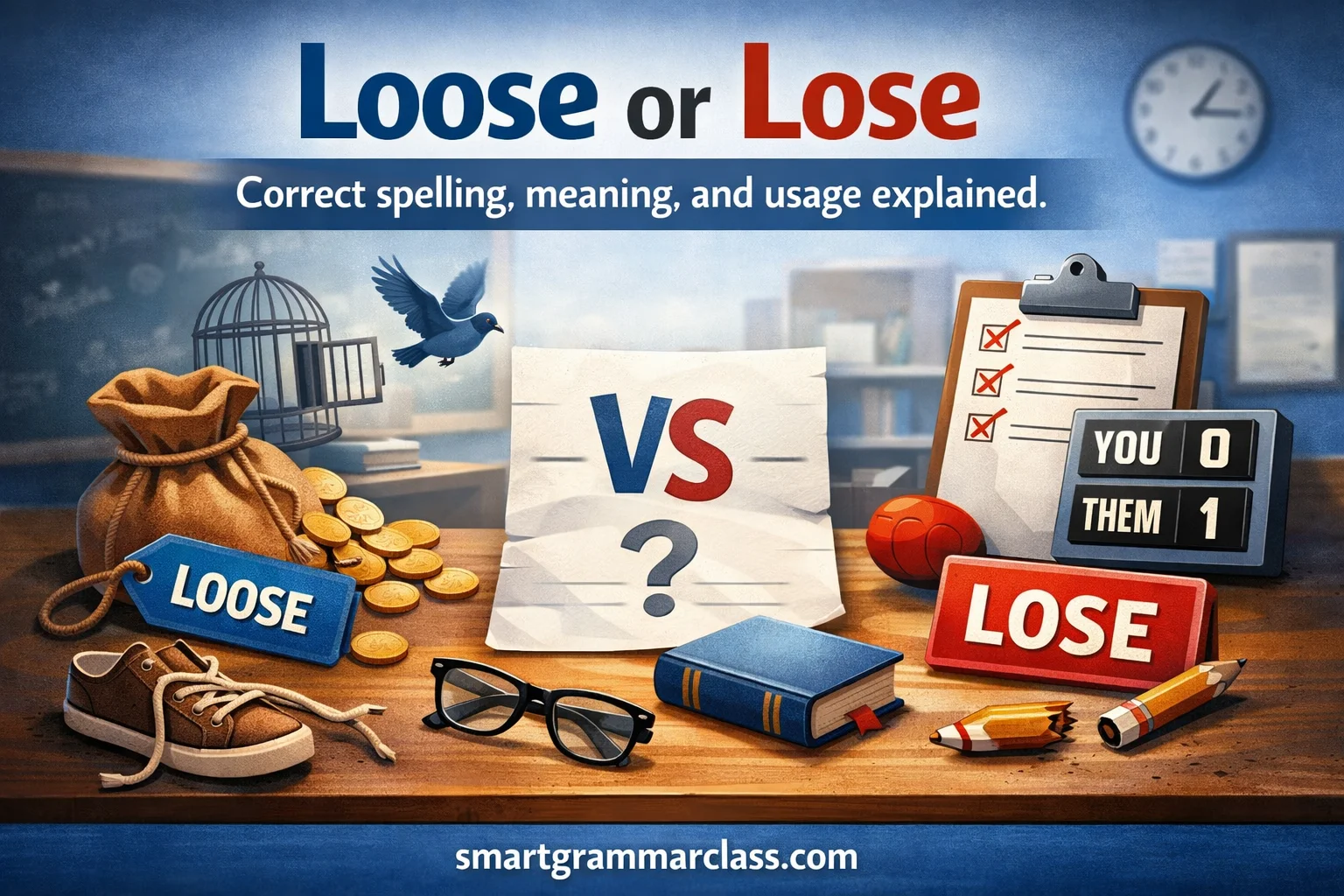
- Lose means to fail, miss, or no longer have something
- Loose means not tight, free, or relaxed
That’s it. Simple. Clean. No fluff.
Quick Memory Trick
- Lose = loss → both relate to failure
- Loose = extra “o” → extra space
Think of it like this. If something is loose, it has room to move. That extra “o” represents that space.
Why “Loose vs Lose” Confuses So Many People
At first glance, the difference looks obvious. Yet people mix them up constantly. Why?
Visual Similarity
Both words look nearly identical. One extra letter hides in plain sight. Your brain skims past it during fast reading or typing.
Pronunciation Trap
Here’s where things get tricky.
- Lose sounds like “looz”
- Loose sounds like “looss”
That subtle sound difference often disappears in casual speech.
Speed and Autopilot Writing
You type fast. Your brain fills in patterns. Mistakes slip through.
Example:
You type “I don’t want to loose this opportunity”
Your brain reads it as correct
You move on without noticing
It happens more than you think.
The Origins of Loose and Lose
These words didn’t evolve from the same root. They just happen to look similar today.
Lose: A Word Rooted in Loss
“Lose” comes from Old English losian. It meant to perish or be destroyed. Over time, the meaning shifted toward failure or misplacement.
Core idea: something is gone.
Loose: A Word About Freedom
“Loose” traces back to Old Norse lauss. It meant free, unattached, or untied.
Core idea: something is not restricted.
Why This Matters
Understanding origin builds intuition. You stop memorizing rules. You start feeling the meaning.
Loose vs Lose Comparison Table
Let’s break it down visually.
| Feature | Lose | Loose |
| Part of Speech | Verb | Adjective or Verb |
| Meaning | Fail or misplace | Not tight or free |
| Pronunciation | “looz” | “looss” |
| Example | I might lose my wallet | My shirt feels loose |
| Common Mistake | Loose weight ❌ | Lose clothing ❌ |
This table alone clears up most confusion.
Pronunciation Hack You’ll Never Forget
Say these out loud.
- Lose → ends with a buzzing “z” sound
- Loose → ends with a soft “s” sound
Simple Analogy
- Lose buzzes like a bee
- Loose hisses like a snake
That mental image sticks. Try it once. You won’t forget it again.
When to Use “Lose” Correctly
Whenever something disappears, fails, or slips away, you need “lose.”
Common Situations
- Losing a game
- Losing your keys
- Losing focus
- Losing money
Real Examples
- You might lose your chance if you wait too long
- They could lose the match tonight
- I don’t want to lose this opportunity
Key Insight
If the sentence involves failure or absence, “lose” is the right choice.
When to Use “Loose” the Right Way
Use “loose” when something isn’t tight, secure, or fixed.
Common Situations
- Loose clothing
- Loose screws
- Loose hair
- Letting something loose
Real Examples
- These jeans feel too loose
- The handle is loose and needs fixing
- The dog ran loose in the yard
Key Insight
If the sentence involves physical or metaphorical looseness, use “loose.”
Common Mistakes That Keep Showing Up
Even experienced writers slip here. Let’s clean them up.
Frequent Errors
- “I always loose my phone” ❌
- “Don’t loose hope” ❌
- “She might loose the game” ❌
Correct Versions
- I always lose my phone ✔
- Don’t lose hope ✔
- She might lose the game ✔
Another Set
- “These shoes are lose” ❌
- “Let it lose” ❌
Fixed
- These shoes are loose ✔
- Let it loose ✔ (only when meaning release)
Everyday Scenarios That Make It Click
Let’s move beyond rules. Real-life examples make this stick permanently.
Scenario One: The Gym
You say:
I want to lose weight
You don’t say:
I want to loose weight
Why? Because you’re talking about reduction, not looseness.
Scenario Two: Clothing Fit
You say:
This shirt is loose
You don’t say:
This shirt is lose
Because the shirt isn’t tight.
Scenario Three: A Lost Opportunity
You say:
Don’t lose this chance
Because chances disappear. They don’t become “untight.”
Scenario Four: A Dog Escaping
You say:
The dog is loose
Because the dog is free. Not missing.
Loose vs Lose in Digital Writing and SEO (2026 Insights)
This isn’t just grammar. It’s a traffic opportunity.
Search Trends
- “Loose vs lose” gets thousands of monthly searches
- “Lose vs loose meaning” continues to grow
- Misspellings generate high-volume traffic
Why Writers Should Care
Correct usage signals authority. Readers trust clean writing.
Mistakes do the opposite. They reduce credibility instantly.
SEO Advantage
When you use correct grammar:
- You rank better
- You retain readers longer
- You reduce bounce rates
That’s real impact.
Google Trends Data Insight
Curious about search behavior?
What the Data Shows
- Spikes during school seasons
- Consistent evergreen interest
- High confusion across age groups
Key Takeaway
This topic never goes out of style. It’s always relevant.
Advanced Memory Techniques That Actually Work
Forget memorizing definitions. Use these instead.
Replace-With Trick
Swap the word with a synonym.
- Replace with “fail” → use lose
- Replace with “not tight” → use loose
Example:
I might fail the game → I might lose the game
Visual Trick
Picture this:
- Loose → something hanging or relaxed
- Lose → something disappearing
That image builds instant clarity.
Spelling Pattern Trick
- Lose = short and sharp → quick action
- Loose = longer → more space
Case Study: Real Writing Mistake in Business Communication
A marketing email once read:
“Don’t loose this exclusive offer”
What Happened
- Readers noticed the error immediately
- Brand credibility dropped
- Engagement rates declined
Corrected Version
“Don’t lose this exclusive offer”
Lesson
Small mistakes create big impressions.
Another Case Study: Social Media Impact
A viral tweet used “loose” instead of “lose.”
Outcome
- Thousands of replies correcting it
- Original message lost focus
- Author credibility questioned
Insight
On social media, mistakes spread faster than corrections.
FAQs
What is the main difference between loose and lose?
The difference is simple: lose is a verb that means to fail, misplace, or not win, while loose is an adjective that describes something not tight or not securely attached. Knowing this helps avoid a very common grammar mistake.
Why do people get confused between loose and lose?
Many people get confused because the words look and sound close, and their spellings are very similar. This orthographic closeness makes it an easy mix-up, especially in fast writing like social media or emails.
How can I remember the correct spelling?
A helpful trick is to notice that loose has double “o,” which means extra space, so it describes something not tight. On the other hand, lose is shorter and relates to loss or to fail, making it easier to remember in daily use.
Can using the wrong word affect my credibility?
Yes, even a tiny mistake like this can affect your credibility, especially in business documents or professional emails. It may seem small, but it shows a lack of attention to correct usage and detail.
Are there simple examples to understand their usage?
Yes, here are clear examples: “I don’t want to lose my keys” and “This shirt is too loose.” These one-line examples show how each word is used correctly in real life situations.
Conclusion
In 2026, understanding the difference between loose and lose is essential for correct spelling, clear meaning, and proper usage in everyday writing. These two words may look and sound close, but their meanings are completely different, and mixing them can create confusion and reduce your credibility. By remembering that lose is a verb related to loss or to fail, and loose is an adjective describing something not tight, you can easily avoid this common mistake. With regular practice and attention, you will use both words correctly in emails, social media, and daily life without any doubt.

mma Rose is a skilled grammar expert and language educator dedicated to helping learners improve their English with clarity and confidence. With extensive experience in teaching grammar, writing, and communication, she specializes in simplifying complex language rules into easy, practical explanations.
At Smart Grammar Class, Emma creates well-researched, accurate, and user-friendly content designed for students, professionals, and everyday learners. Her teaching approach focuses on real-life examples, clear structure, and actionable guidance, enabling readers to apply grammar rules effectively in both writing and speaking.
Emma is committed to maintaining high editorial standards, ensuring every article is trustworthy, up-to-date, and aligned with modern English usage. Her goal is to make grammar simple, accessible, and useful for everyone.