If you’ve ever typed a sentence into Google and felt unsure about the correct spelling, you’re not alone—thousands of people search this confusing pair every month. The words naive and nieve may look and sound similar, especially in essays, comments, or social media, but only one belongs to standard English.
This confusion comes from English borrowing from French, mixed with differences in British spelling and American spelling, plus the internet being full of misspellings. This guide gives a quick answer, explains the origin, and shares usage tips so you can write confidently in any context. I’ve seen even experienced writers, students, and professionals make this mistake, and a tiny spelling slip can hurt your credibility more than you think.
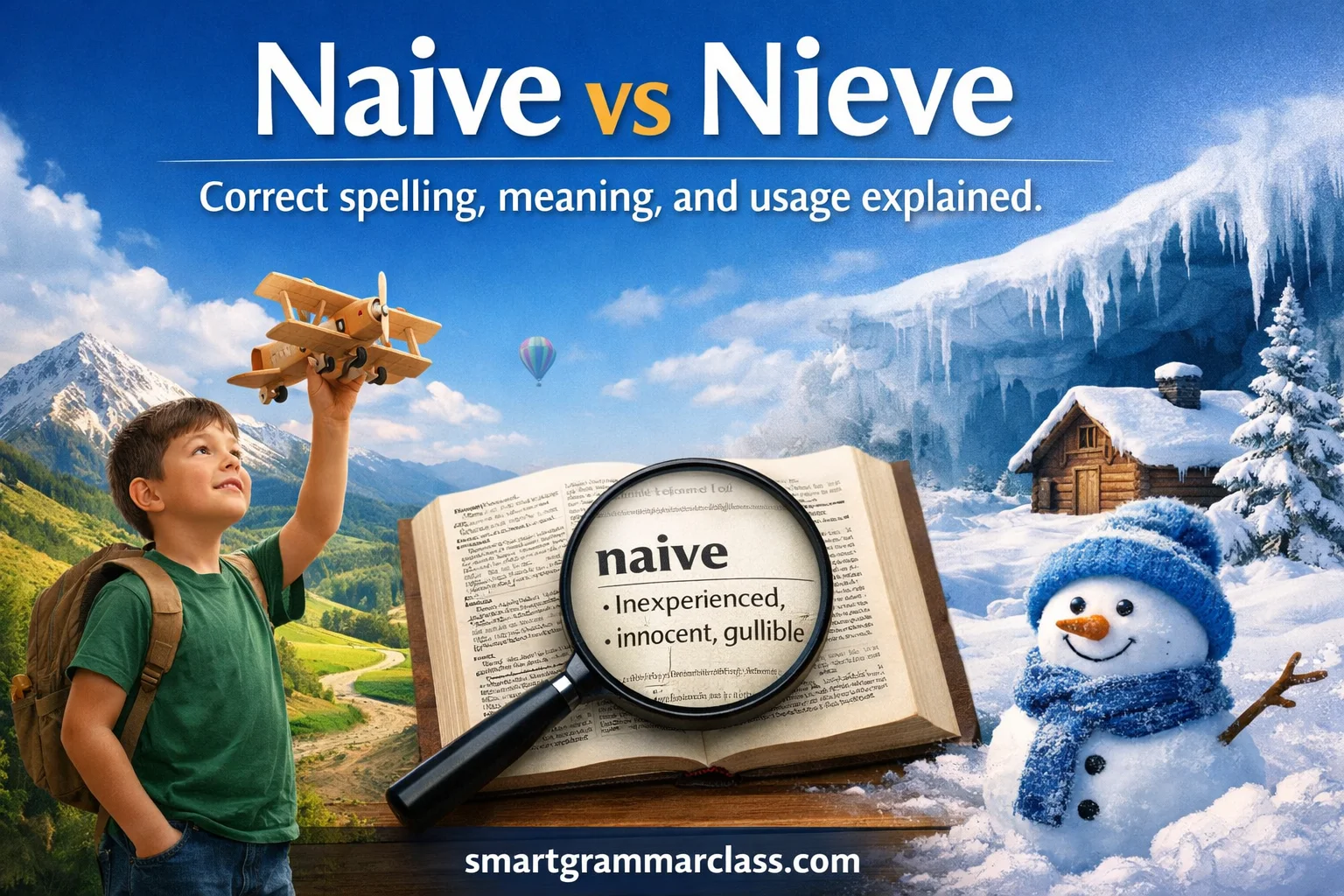
Here’s the clear answer: naive is the correct spelling, while nieve is a common misspelling often mistaken due to pronunciation or confusion with the Spanish word for snow. The word comes from the French word naïf (masculine) and naïve (feminine), a borrowed word where the diaeresis (the two dots) is now optional in modern English.
As an adjective, naive means lacking experience, wisdom, or judgment, and can also suggest being innocent or even gullible. This happens because when spoken quickly or typing fast, people rely on phonetic spelling, leading to mistakes. In formal writing, professional emails, or even captions, using the wrong spelling can seem careless. If you’ve ever paused, mid-sentence, in a moment of doubt, this break down should help you remember the difference, learn the pattern, and avoid errors every time—because small spelling choices truly shape meaning, tone, and credibility across work, study, and the web.
Also read this : Take Affect vs Take Effect: Correct Spelling and Meaning
Naive or Nieve: Quick Answer You Can Trust
Let’s get straight to it.
- Naive is the correct spelling
- Nieve is incorrect in English
There’s no gray area here. If you use “nieve” in emails, blog posts, or professional writing, readers will spot it immediately. That small error can make your content feel careless.
Here’s a quick comparison:
| Word | Correct | Meaning Exists | Usage Status |
| naive | Yes | Yes | Standard English |
| nieve | No | No | Misspelling |
Simple rule: If you mean innocent or inexperienced, use “naive.”
What Does “Naive” Mean in Real Context
The word naive describes someone who lacks experience or judgment. It can sound gentle. Sometimes it feels slightly critical depending on tone.
You’ll often see it in everyday situations.
Core meanings of naive
- Lacking practical experience
- Trusting too easily
- Showing innocence in judgment
- Missing complexity in thinking
Examples that feel natural
- “It’s naive to think success happens overnight.”
- “He sounded naive about how business really works.”
- “Her optimism felt naive but sincere.”
Notice how the tone shifts. In some cases, it’s almost kind. In others, it hints at poor judgment.
Why People Confuse Naive With Nieve
Here’s where things get interesting. The mistake isn’t random. It follows patterns.
Common reasons behind the confusion
- Spelling patterns clash
English has inconsistent rules. Words like “believe” push people toward “ie” endings. - Phonetic guesswork
People spell based on sound. “Naive” sounds like it could fit “nieve.” - Typing habits
Fast typing leads to automatic swaps. - Language crossover
In Spanish, “nieve” means snow. That influences bilingual writers.
Quick memory trick that works
If the word reminds you of “believe”, stop.
That’s your red flag.
Instead, remember this:
Naive has “ai” like “air” — think of fresh, airy thinking.
It sticks surprisingly well.
The Origin of Naive and Why It Matters
Understanding origin removes confusion instantly.
The word comes from the French “naïf.” It originally meant:
- Natural
- Genuine
- Unaffected
English borrowed it and simplified the spelling over time.
Key insight
The spelling “nieve” never existed in this evolution.
That alone settles the debate.
Naive vs Naïve: Why Two Versions Exist
You might notice two versions:
- naive
- naïve
Both are correct.
What’s the difference?
| Version | Usage Style | Common In |
| naive | Simplified | US and digital use |
| naïve | Formal / stylized | UK and editorial writing |
The two dots over the “i” are called a diaeresis. They show that vowels are pronounced separately.
However, modern typing habits often skip it.
Practical advice
- Use naive for simplicity
- Use naïve when style matters
Naive vs Nieve in American and British English
Spelling differences often depend on region. This case is slightly different.
American English prefers
- naive
British English uses
- naïve more often
- but also accepts naive
Comparison table
| Feature | American English | British English |
| Standard spelling | naive | naïve / naive |
| Special character | Rare | More common |
| Formal writing | naive | naïve |
| Online writing | naive | naive |
Takeaway
Regardless of region, “nieve” is always wrong.
Which Spelling Should You Use in 2026
Your choice depends on audience and platform.
If you write for US readers
Stick with:
- naive
It’s clean. It works everywhere.
If your audience is global
Use:
- naive
Why? It avoids encoding issues and looks natural across platforms.
If you write formal or editorial content
You may use:
- naïve
But only if consistency is maintained.
Best universal rule
When in doubt, use naive.
Common Mistakes With Naive vs Nieve
Mistakes happen. However, some show up more often than others.
Frequent errors
- Writing “nieve” instead of “naive”
- Mixing naive and naïve randomly
- Assuming nieve is a regional spelling
Quick correction checklist
Before publishing, ask:
- Does the word use “ai” instead of “ie”?
- Does it match the rest of your spelling style?
- Would spellcheck flag it?
If something feels off, it probably is.
Naive vs Nieve in Everyday Writing
You don’t just use this word in essays. It shows up everywhere.
In emails
- “It may be naive to expect instant feedback.”
In blogs
- “The strategy sounds naive given current trends.”
On social media
- “Thinking that would work feels naive honestly.”
In professional writing
- “Such assumptions appear naive under scrutiny.”
Case Study: How One Small Mistake Hurts Credibility
Imagine this scenario.
A freelancer submits a proposal:
“I know it sounds nieve but I believe this will work.”
The client notices the error instantly.
What happens next?
- Trust drops
- Attention shifts from idea to mistake
- Professional image weakens
Now compare:
“I know it sounds naive but I believe this will work.”
Same sentence. Different impact.
Lesson
Spelling errors don’t just look bad. They change how people judge you.
Usage Trends and Data Insights for 2026
Search behavior tells a clear story.
Observed trends
- “naive” dominates global usage
- “naïve” appears in formal writing
- “nieve” spikes only as a typo
What this means
- Correct spelling boosts trust
- Search engines favor accurate language
- Readers notice mistakes faster than ever
Side-by-Side Comparison of All Variations
Here’s everything in one place.
| Word | Correct | Usage Level | Where It Fits |
| naive | Yes | Universal | Blogs, emails, SEO |
| naïve | Yes | Formal / stylistic | Editorial, academic |
| nieve | No | Incorrect | Never use |
Advanced Insight: Tone and Context Matter
The word “naive” isn’t just about spelling. Tone shifts meaning.
Positive tone
- “Her ideas feel naive but refreshing.”
Neutral tone
- “The plan seems naive.”
Negative tone
- “That assumption is dangerously naive.”
Small wording changes affect perception.
Pro Tips to Never Misspell Naive Again
You don’t need to memorize rules. Just build habits.
Simple strategies
- Use spellcheck tools
- Read sentences out loud
- Look for “ai” not “ie”
- Save correct examples
Mental shortcut
Think of this phrase:
“Naive ideas need awareness.”
That “ai” sound repeats. It helps lock the spelling in memory.
FAQs
What is the correct spelling: naive or nieve?
The correct spelling is naive. The word nieve is a common misspelling and does not belong to standard English, even though it may look correct at first glance.
Why do people confuse naive with nieve?
Many people get confused because the words look and sound similar, especially when spoken quickly or when typing fast. The influence of the Spanish word for snow and phonetic spelling also adds to this confusion.
What does the word naive mean?
The word naive is an adjective that means lacking experience, wisdom, or judgment. It can also describe someone as innocent or slightly gullible, depending on the context.
Is naïve with two dots still correct in modern English?
Yes, naïve with a diaeresis (the two dots) comes from the original French word and is still correct. However, in modern English, writing it as naive without the dots is more common and widely accepted.
Does using the wrong spelling affect your writing?
Yes, using a wrong spelling like nieve can reduce your credibility, especially in formal writing, professional emails, or essays. Paying attention to spelling rules helps you write confidently and avoid simple but noticeable mistakes.
Conclusion
In 2026, understanding the difference between naive vs nieve is essential for clear and polished writing. The correct spelling is always naive, while nieve remains a common misspelling caused by pronunciation and phonetic spelling habits. Knowing the meaning and proper usage of naive helps you avoid simple errors that can impact your credibility in formal writing, professional emails, and even social media. By learning from this guide and applying these usage tips, you can write confidently, make better language choices, and eliminate spelling doubts in every context.

Mia Rose is a dedicated grammar expert and language educator committed to helping learners master English with clarity and confidence. With extensive experience in teaching grammar, writing, and communication skills, she specializes in turning complex language rules into simple, easy-to-understand lessons.
At Smart Grammar Class, Mia creates accurate, well-researched, and practical content tailored for students, professionals, and everyday learners. Her teaching style focuses on real-world examples and clear explanations, enabling readers to confidently apply grammar rules in both writing and speaking.
Mia is committed to maintaining high editorial standards, ensuring every piece of content is reliable, up-to-date, and aligned with modern English usage. Her mission is to make grammar accessible, engaging, and useful for learners at all levels.