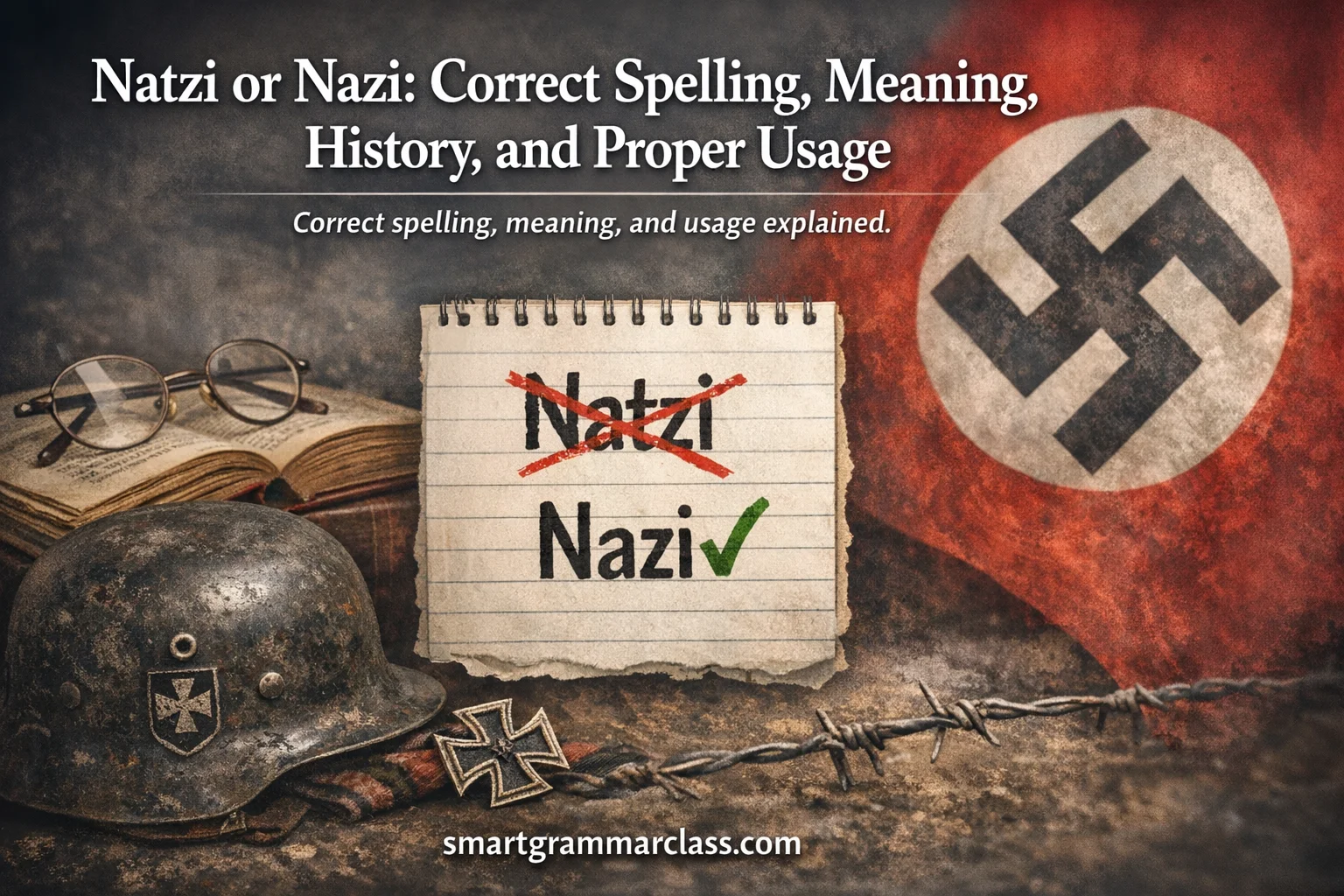
When I first saw the word Natzi in an online comment thread, I had to do a double take because it looked like a strange spelling variation of Nazi. The truth is simple: Nazi is the correct spelling, while Natzi is an incorrect form, often a typo caused by fast typing or keyboard slips. The word Nazi comes from the German term Nationalsozialist, which means National Socialist, and it is a contraction used in English.
In linguistics and grammar, such words often transform over time, but this one has a fixed historical form. The pronunciation also matters; it is pronounced with a /ts/ sound, not as “Nat-zi,” which adds to the confusion. I’ve seen this mistake appear in a headline or even a casual meme, where people use it colloquially without thinking about its historically loaded meaning.
From a historically informed point of view, using the right term is important because Nazi connects directly to Hitler, World War II, and the Holocaust, all of which are serious parts of history and not something to treat in a careless or ridiculous way. In modern writing, whether you are a writer or just posting examples online, proper usage shows respect for this sensitive historical concept. There is also a funny side where people say Grammar Nazis, but even that comes with debate about tone and context.
This article works as a guide to understand the difference, avoid common mistakes, and stay both grammatically correct and historically correct. As language keeps changing with newfangled trends, errors like Natzi may sneak in, but if you take a moment to learn and untangle them, accuracy always wins.
Also read this : Vendor vs. Vender: What’s the Real Difference?
Quick Answer: Is It “Natzi” or “Nazi”?
Let’s not overcomplicate it.
- ✅ Nazi — correct spelling
- ❌ Natzi — incorrect spelling
The confusion comes from pronunciation. When you say “Nazi” out loud, it can sound like there’s a “t” in the middle. That tiny illusion causes a lot of typing errors.
Example:
- Correct: Nazi Germany controlled much of Europe during WWII.
- Incorrect: Natzi Germany controlled much of Europe during WWII.
Simple rule. If you’re writing in English, always use “Nazi.”
What Does “Nazi” Actually Mean?
This isn’t just a spelling issue. The word carries serious historical weight.
Core Definition
A Nazi refers to a member of the National Socialist German Workers’ Party. This political party ruled Germany under Adolf Hitler from 1933 to 1945.
Key Facts You Should Know
- The Nazi regime was responsible for World War II
- It led to the Holocaust, where about 6 million Jews were murdered
- Millions of others—Roma, disabled individuals, political dissidents—were also persecuted
So when you use the word, you’re referencing one of the darkest chapters in modern history.
Modern Usage
Today, the word appears in two main ways:
- Historical use — referring to the actual regime
- Figurative use — slang like “grammar Nazi”
That second one? It’s common, but it comes with baggage. More on that later.
Where the Word “Nazi” Comes From
Language often tells a story. This one runs deep.
Origin Breakdown
The word “Nazi” comes from the German term:
Nationalsozialist
That’s a mouthful. So people shortened it. Germans often create nicknames or abbreviations this way.
Pronunciation Guide
- Written: Nazi
- Spoken: NAHT-see
- Phonetic: /ˈnɑːtsi/
Notice something? That “ts” sound is already built into the “z” in German pronunciation.
That’s why adding a “t” in English—like “Natzi”—doesn’t make sense. It’s already there, just not visible in the spelling.
Why Not “Natzi”?
Because English borrowed the word directly from German. It kept the original spelling intact.
Changing it would be like rewriting history. Or at least spelling it wrong.
Why People Misspell It as “Natzi”
This mistake isn’t random. It follows predictable patterns.
Common Reasons Behind the Error
- Phonetic confusion
People spell what they hear. The “ts” sound tricks them. - Influence of other words
English words like “pizza” or “pretzel” reinforce the “tz” pattern. - Typing errors
Fast typing leads to guesswork. - Autocorrect failures
Some devices don’t flag “Natzi” as incorrect right away.
Quick Comparison
| Feature | Nazi | Natzi |
| Accuracy | Correct | Incorrect |
| Origin | German | None |
| Dictionary | Recognized | Not recognized |
| Usage | Formal and informal | Avoid entirely |
If you’re aiming for credibility, even in a casual post, spelling matters.
Is There Ever a Case Where “Natzi” Is Correct?
Short answer? No.
Longer answer? Still no—but with a few edge cases.
Rare Exceptions
You might see “Natzi” in:
- Usernames or gamer tags
- Fictional character names
- Stylized branding
Even then, it’s intentional. Not correct.
What About Academic or Professional Writing?
There’s zero flexibility here.
- Use “Nazi” in essays, reports, or journalism
- Avoid creative spelling entirely
Think of it like spelling “physics” as “fiziks.” It might look playful. It won’t be taken seriously.
“Nazi” in Modern Usage: Context Matters More Than You Think
This is where things get nuanced.
Using the word correctly isn’t just about spelling. It’s about context.
Historical and Academic Use
This is the safest and most precise way to use the term.
Examples:
- Nazi policies reshaped Europe during the 1930s.
- The documentary explores Nazi propaganda methods.
Where You’ll See It
- History textbooks
- Research papers
- Museums like the United States Holocaust Memorial Museum
- Documentaries and academic journals
In these settings, the word is factual. No ambiguity. No slang.
Informal or Figurative Use
Now things get tricky.
You’ve probably heard phrases like:
- “grammar Nazi”
- “health Nazi”
- “clean freak Nazi”
They’re meant to describe someone strict or obsessive.
But Here’s the Catch
This usage can feel insensitive. It trivializes real historical suffering.
Some people don’t mind it. Others find it offensive.
Better Alternatives
If you want to stay safe, try:
- “detail-oriented”
- “strict”
- “perfectionist”
Same idea. Less controversy.
Common Mistakes to Avoid
Even smart writers slip up here. Let’s tighten things up.
Frequent Errors
- ❌ Writing “Natzi” instead of “Nazi”
- ❌ Using the term casually in serious contexts
- ❌ Making jokes without understanding the history
- ❌ Assuming slang usage is always acceptable
Quick Fix Checklist
Before you hit publish, ask yourself:
- Is the spelling correct?
- Does the context make sense?
- Could this come across as insensitive?
If you hesitate on any of those, revise.
Real-World Examples of Correct Usage
Let’s bring this down to earth.
In News Writing
- The article examines how Nazi ideology influenced wartime policies.
- Historians continue to study Nazi leadership strategies.
News outlets stick to accuracy. No slang. No shortcuts.
In Academic Writing
- Nazi propaganda relied heavily on visual symbolism.
- The rise of the Nazi party reshaped global politics.
Clarity matters here. So does precision.
In Everyday Conversation
- He’s very strict about grammar.
- She’s extremely detail-focused.
Notice something? You don’t actually need the slang version.
In Social Media
Social platforms blur the lines.
You’ll see both:
- Correct: Learning about Nazi history today.
- Incorrect: Reading about Natzi Germany.
One builds credibility. The other chips away at it.
British vs American English: Any Difference?
Some words shift across regions.
This one doesn’t.
Global Consistency
- 🇺🇸 American English: Nazi
- 🇬🇧 British English: Nazi
- 🌍 International usage: Nazi
No variations. No alternate spellings.
“Natzi” isn’t accepted anywhere in standard English.
Why People Search “Natzi”
This part gets interesting.
Search behavior often reflects human habits, not correctness.
Why “Natzi” Gets Traffic
- People type what they hear
- They rush and skip spell-check
- They assume both versions exist
What Data Suggests
Keyword tools often show:
- “Natzi” → lower volume, higher error rate
- “Nazi” → high volume, correct usage
So if you’re writing content, targeting both terms—while clarifying the correct one—can actually boost visibility.
Case Study: How a Simple Misspelling Affects Credibility
Imagine two blog posts.
Post A
- Uses “Nazi” correctly
- Explains the term clearly
- Provides historical context
Post B
- Uses “Natzi” repeatedly
- Lacks clarity
- Feels careless
Which one do you trust?
Exactly.
Even small errors signal larger problems. Readers notice. So do search engines.
Side-by-Side Comparison: Natzi vs Nazi
| Category | Nazi (Correct) | Natzi (Incorrect) |
| Spelling Status | Standard English | Misspelling |
| Linguistic Origin | German (Nationalsozialist) | None |
| Dictionary Presence | Yes (Oxford, Merriam-Webster) | No |
| Professional Use | Accepted | Not accepted |
| SEO Value | High | Low and error-driven |
| Credibility Impact | Builds trust | Reduces trust |
Deeper Insight: Why Spelling Accuracy Still Matters
It’s easy to brush this off. Just one letter, right?
Not quite.
Spelling Shapes Perception
When you write:
- Clearly → people trust you
- Sloppily → people question you
That applies everywhere:
- Blog posts
- Emails
- Social media
- Academic work
Think of It Like This
Spelling is like clothing.
You don’t need a tuxedo for every situation.
You do need to look put together.
FAQs
Is Natzi ever a correct spelling of Nazi?
No, Natzi is not the correct spelling. It is an incorrect spelling variation and usually happens due to a typo, fast typing, or simple mistake. The right word to use in all context is Nazi.
What is the meaning and history behind the word Nazi?
The word Nazi comes from the German term Nationalsozialist, meaning National Socialist. It is strongly linked to Hitler, World War II, and the Holocaust, making it a very important and sensitive historical concept.
Why do people get confused between Natzi and Nazi?
The confusion often comes from pronunciation, where people mishear the /ts/ sound, or from keyboard errors while typing online. Sometimes, it also appears in a meme or casual comment thread, spreading the misspelling further.
Is it okay to use Nazi in modern or casual writing?
In modern writing, using Nazi is acceptable only when it is historically informed and used with the right context. Using it in a careless or ridiculous way, especially in jokes or memes, can be disrespectful due to its serious history.
What does the term Grammar Nazis mean?
The phrase Grammar Nazis is used colloquially to describe people who strongly correct grammar and words. However, there is ongoing debate about this usage, as it connects a light idea to a heavy historical background, so it should be used carefully.
Conclusion
In the end, knowing the correct spelling of Nazi instead of Natzi is more than just good grammar—it reflects a clear understanding of its deep meaning and serious history. This word is tied to major events like World War II and the Holocaust, so its proper usage in any context is important and should never be careless. While small mistakes like a typo can happen in fast typing or online posts, being historically informed helps you avoid confusion and use language with respect and accuracy.

Emma Brooke is a dedicated grammar expert and language educator with a strong passion for helping learners master the English language with clarity and confidence. With years of hands-on experience in teaching grammar, writing, and communication skills, she specializes in breaking down complex language rules into simple, practical explanations.
At Smart Grammar Class, Emma focuses on creating accurate, easy-to-understand, and well-researched content that supports students, professionals, and everyday learners in improving their writing and speaking skills. Her approach combines real-world usage, clear examples, and structured guidance to ensure learners not only understand grammar rules but can apply them effectively.
Emma is committed to maintaining high editorial standards, ensuring every piece of content is reliable, up-to-date, and aligned with modern English usage. Her work reflects a deep understanding of language learning challenges and a mission to make grammar accessible to everyone.