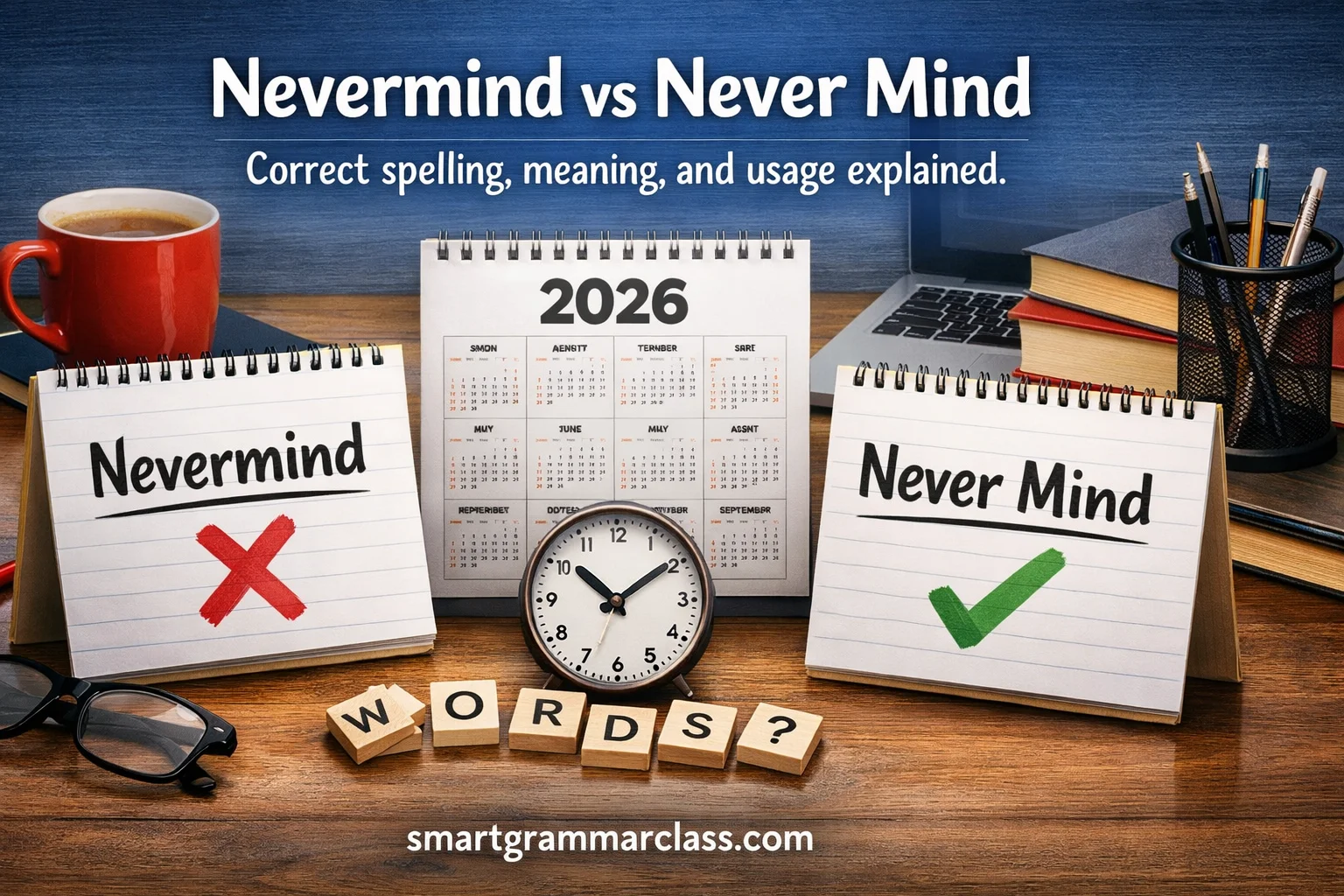
If you’ve ever typed nevermind or never mind and wondered which one is the correct spelling, you’re not alone. Many students, writers, and professionals get confused because this phrase feels so simple, yet a small change like a space between words creates a surprising amount of confusion.
In my own writing, I used to just pick what felt natural and move fast, but over time I learned that context plays a crucial role. This guide will explain the difference, so you don’t mix things up or keep thinking twice. The quick answer is that two words is the correct form in standard English, while one word is mostly nonstandard or colloquial usage.
When we break it down with grammar, logic, and real-world usage, never mind is used as a conjunction or said imperatively to suggest “don’t worry,” “forget it,” or to disregard something, like in examples such as “never mind him, I’ll do it” or “never mind about that.” On the other hand, nevermind appears as a rare noun, seen in phrases like “pay him no nevermind” or “it makes no nevermind,” often tied to colloquial dialect in some regions of the United States.
The language here is a bit quirky, where phrases may sound alike but have different meanings, so they are not always interchangeable. Today, with text, internet, and abbreviations like nvm or nm, people use it casually in almost all contexts, but for clear, correctly written articles, using never mind helps you remember the right choice and avoid second-guess moments.
Also read this : Babys or Babies: Correct Spelling and Meaning 2026
Nevermind or Never Mind The Fastest Clear Answer
Let’s get straight to it.
- “Never mind” (two words) is the correct and standard form
- “Nevermind” (one word) is informal and often considered nonstandard
If you’re writing anything important, stick with never mind.
Here’s a quick comparison that clears things up instantly:
| Version | Correctness | Usage Context | Safe to Use |
| Never mind | Fully correct | Formal + informal | Yes |
| Nevermind | Informal only | Texting, casual writing | Sometimes |
Bottom line:
If you want to sound polished, credible, and clear, go with never mind.
What “Never Mind” Actually Means in Real Life
Now let’s talk meaning. Because rules don’t matter if you don’t understand how people actually use the phrase.
At its core, “never mind” means “ignore it” or “it no longer matters.”
Simple. But context shapes everything.
Common meanings of “never mind”
- Dismissing something
- Telling someone not to worry
- Dropping a topic
- Correcting yourself mid-thought
Real-world examples
- “Never mind, I already fixed the issue.”
- “Oh, never mind. It’s not important.”
- “Never mind what I said earlier.”
Notice something subtle here.
The phrase can feel polite… or slightly frustrated. Tone depends on delivery.
Tone variations
| Situation | Tone | Example |
| Friendly conversation | Casual | “Never mind, I got it.” |
| Mild frustration | Slightly sharp | “Never mind, forget it.” |
| Professional | Neutral | “Never mind the previous message.” |
That flexibility makes it powerful. And easy to misuse if you’re not careful.
Where “Nevermind” Came From and Why It Exists
So why do people write “nevermind” at all?
Because language evolves through speech first.
People say “never mind” quickly. Over time, that speed compresses the phrase into one word in writing. It happens more often than you think.
Why “nevermind” shows up
- Fast typing habits
- Text messaging culture
- Informal writing styles
- Influence from other merged words
Think about words like:
- “already” (used to be “all ready”)
- “altogether” vs “all together”
English loves shortcuts. But not all shortcuts become standard.
The key distinction
- “Never mind” → grammatically structured phrase
- “Nevermind” → informal shortcut
Most major dictionaries still favor the two-word version. That tells you everything you need to know.
Formal vs Informal Writing What You Should Actually Use
Here’s where most people make mistakes.
They assume both forms work everywhere. They don’t.
Use “never mind” when:
- Writing emails at work
- Creating blog content
- Submitting academic work
- Writing reports or proposals
- Communicating with clients
Use “nevermind” when:
- Texting friends
- Writing casual dialogue
- Posting on social media
- Chatting informally
Real example
Professional email:
“Never mind the previous file. Please use the updated version attached.”
Casual text:
“nevermind lol I figured it out”
Both feel natural. But only one belongs in formal writing.
Quick rule that works every time
If the context matters, use two words.
Why People Confuse “Nevermind” and “Never Mind”
This confusion isn’t random. It follows clear patterns.
Main reasons behind the confusion
- Typing speed → people merge words unconsciously
- Autocorrect inconsistencies → both forms sometimes appear
- Language evolution expectations → people assume all phrases eventually combine
There’s another interesting factor.
English learners often prefer shorter forms because they seem simpler. That creates even more variation in usage.
A deeper insight
People rely on what “looks right” instead of what is right.
And “nevermind” looks modern.
That’s why it keeps spreading even though it’s not fully accepted.
Common Mistakes You Should Avoid Immediately
Let’s fix the mistakes that instantly hurt credibility.
Mistake one: using “nevermind” in professional writing
Wrong:
“Nevermind, I will send the report later.”
Better:
“Never mind, I will send the report later.”
Mistake two: mixing both forms
Inconsistent writing looks sloppy.
Wrong:
“Never mind the earlier message. Also, nevermind the attachment.”
Pick one. Stick with it. Preferably the correct one.
Mistake three: assuming both are equal
They aren’t.
One is standard. The other is casual.
Mistake four: using it too abruptly
Sometimes “never mind” can sound dismissive.
Instead of:
“Never mind.”
Try:
“Never mind, it’s all good now.”
That small addition softens the tone.
Real-World Examples That Show the Difference Clearly
Let’s bring this to life.
Scenario one: workplace communication
“Never mind the earlier instructions. Please follow the updated process.”
Clear. Professional. No confusion.
Scenario two: customer support
“Never mind that step. You can skip it safely.”
Helpful and direct.
Scenario three: casual conversation
“nevermind I already found it”
Totally fine in texting. Not ideal elsewhere.
Case Study: How One Small Word Affects Professional Perception
Consider two job applicants.
Applicant A writes:
“Nevermind the previous version of my resume.”
Applicant B writes:
“Never mind the previous version of my resume.”
Which one sounds more polished?
Applicant B. Every time.
That tiny space signals attention to detail. And attention to detail matters more than people admit.
Grammar Insight Why “Never Mind” Stays Two Words
Let’s simplify the grammar without making it boring.
In “never mind”:
- “Never” acts as an adverb
- “Mind” acts as a verb
Together, they form a phrase meaning:
“Do not pay attention” or “do not concern yourself”
That structure keeps them separate.
Similar examples
- “Do not worry”
- “Do not bother”
You wouldn’t combine those into one word. Same logic applies here.
Usage Trends What Data Actually Shows
Language trends don’t lie.
According to Google Ngram data:
- “Never mind” dominates in books and formal writing
- “Nevermind” appears more in casual digital communication
What this means
Formal English hasn’t fully adopted the one-word version.
And until it does, using “never mind” keeps you safe.
Quick Decision Guide Choose the Right One Instantly
No overthinking needed.
- Writing something important → never mind
- Writing casually → either works
- Unsure → choose never mind
One-line rule
When in doubt, don’t combine.
Subtle Nuances Most Articles Miss
Here’s where things get interesting.
“Never mind” doesn’t always mean the same thing emotionally.
Emotional variations
- Dismissive: “Never mind.”
- Reassuring: “Never mind, it’s okay.”
- Corrective: “Never mind, that was wrong.”
That flexibility makes it powerful in communication.
But it also means you need to be careful with tone.
Advanced Tip: When to Avoid “Never Mind” Entirely
Sometimes, the phrase isn’t the best choice.
Situations to avoid it
- Sensitive conversations
- Customer complaints
- Conflict resolution
Instead of:
“Never mind.”
Try:
“No worries, we’ve resolved it.”
It feels warmer. More human.
FAQs
What is the correct spelling: nevermind or never mind?
The correct spelling in standard English is never mind as two words. It is widely accepted in formal writing, articles, and professional use, while nevermind is considered nonstandard in most cases.
What does never mind actually mean?
The phrase never mind usually means “don’t worry,” “forget it,” or to disregard something. It is often used to tell someone not to pay attention to a concern or question.
Is nevermind ever correctly used?
Yes, but rarely. Nevermind can be used as a noun in colloquial usage, especially in phrases like “pay it no nevermind,” though this form is not common in formal writing.
Why are people confused between nevermind and never mind?
People get confused because both forms sound alike and feel natural when typed quickly. The small space between the words creates a big difference in grammar and meaning, which many overlook.
Can I use abbreviations like nvm or nm instead?
In casual text or on the internet, abbreviations like nvm or nm are widely used and understood. However, in formal writing or professional contexts, it’s better to use the full phrase never mind for better clarity and correctness.
Conclusion
In 2026, understanding the difference between nevermind and never mind is key for writing clearly and correctly. While never mind remains the correct form in standard English to express “don’t worry” or to disregard something, nevermind is mostly nonstandard and appears in colloquial usage or as a rare noun. From my experience, choosing the right phrase not only improves clarity but also builds confidence in everyday use, whether you’re a student, writer, or professional. By remembering this simple rule and noticing the context, you can avoid confusion and use both forms the right way without hesitation.

Mia Rose is a dedicated grammar expert and language educator committed to helping learners master English with clarity and confidence. With extensive experience in teaching grammar, writing, and communication skills, she specializes in turning complex language rules into simple, easy-to-understand lessons.
At Smart Grammar Class, Mia creates accurate, well-researched, and practical content tailored for students, professionals, and everyday learners. Her teaching style focuses on real-world examples and clear explanations, enabling readers to confidently apply grammar rules in both writing and speaking.
Mia is committed to maintaining high editorial standards, ensuring every piece of content is reliable, up-to-date, and aligned with modern English usage. Her mission is to make grammar accessible, engaging, and useful for learners at all levels.