Many people feel confusion when they type a search phrase on Google and start wondering why patient and patience sound the same but have different meanings in English. This common mix-up appears in emails, professional writing, and even social media posts, where a small mistake in a sentence can affect clear communication and hurt credibility.
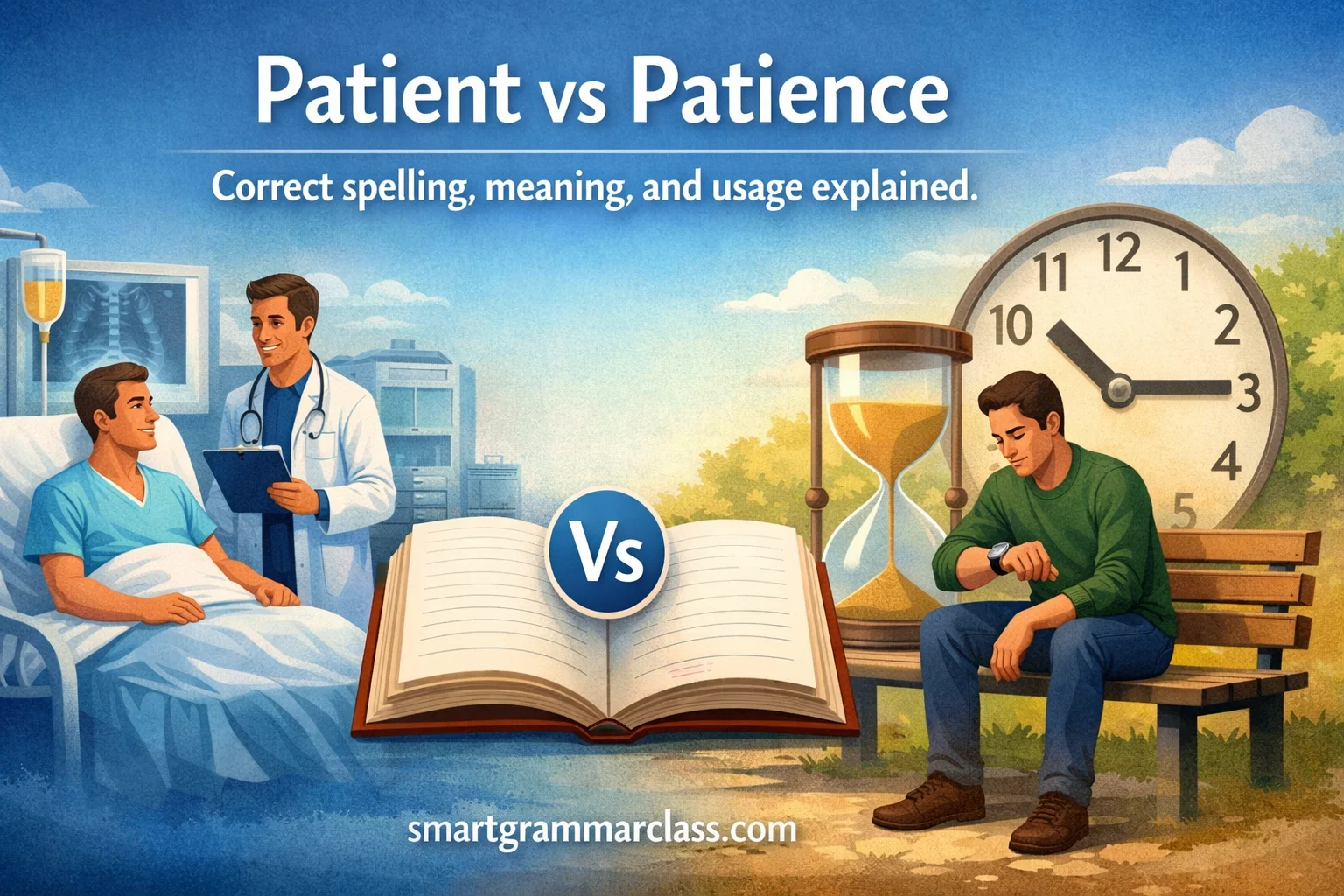
In simple terms, patient is a noun or adjective used for a person receiving medical care or someone who can remain calm, while patience is an uncountable noun showing the capacity to endure waiting without getting annoyed or anxious. From my own experience in editing, I’ve seen how this subtle difference instantly signals carelessness, even if the words look harmless at a glance.
To make it clear, think of real examples from everyday contexts like a doctor treating patients in a hospital or a parent handling children and teenagers during tough situations. The plural of patient refers to individuals needing medical attention, while patience reflects calmness, acceptance, and dealing with problems or delays. These homophones, though identical in pronunciation, follow different grammar rules, and learning simple tricks like linking c in patience with calm and t in patient with treatment can help you avoid second-guessing.
Their origins come from Latin and Old French words like patientia and pacience, showing how they evolved into modern spellings used worldwide. Whether you’re writing Instagram captions about college life, sharing Insta-worthy pictures, or posting about late-night study sessions and after-parties, using the correct spelling adds clarity and helps your followers get the right meaning without confusion.
Also read this : Leaves or Leafs: Correct Spelling, Meaning and Usage 2026
Patient or Patience Quick Answer That Clears the Confusion Fast
Here’s the short version you can remember in seconds:
- Patient = a person receiving care or someone who stays calm
- Patience = the ability to stay calm
That’s it. One describes a person or behavior. The other describes a quality or trait.
Quick Comparison Snapshot
| Word | Meaning | Example |
| Patient | A person or calm individual | She is a patient teacher |
| Patience | The ability to remain calm | He showed great patience |
A Memory Trick That Actually Works
Think of it like this:
- Patient = person
- Patience = power
If you can remember that, you’ll rarely mix them up again.
What Does “Patient” Mean? (With Real Context)
The word patient pulls double duty in English. It acts as both a noun and an adjective. That’s where things get interesting.
Patient as a Noun
Most people recognize this meaning first.
- A patient is someone receiving medical care
- Used in hospitals, clinics, and healthcare settings
Example:
- The doctor spoke calmly to the patient before surgery
But here’s something many overlook. The word doesn’t just belong in hospitals. It can show up in broader contexts where care or attention is involved.
Patient as an Adjective
Now it gets more subtle.
When used as an adjective, patient describes someone who stays calm under pressure.
- Someone who doesn’t rush
- Someone who tolerates delays
- Someone who handles frustration without snapping
Examples:
- She remained patient during the long meeting
- A patient teacher can change a student’s life
Tone and Nuance in Real Writing
Using “patient” correctly adds depth to your writing. It signals emotional control and maturity.
Compare these:
- He waited → basic
- He waited patiently → stronger
- He stayed patient despite delays → even stronger
The word shapes tone. It tells your reader how someone behaves, not just what they do.
What Does “Patience” Mean? (And Why It Matters More Than You Think)
Now let’s shift gears.
Patience is not a person. It’s not something you can point to. It’s something you practice.
Core Meaning
- The ability to remain calm
- The capacity to tolerate delays or frustration
- Emotional endurance in difficult situations
Example:
- Learning a new skill takes patience
Why This Word Shows Up Everywhere
You’ll notice “patience” appears in:
- Self-improvement books
- Leadership advice
- Parenting discussions
- Workplace communication
That’s not random.
Patience sits at the core of emotional intelligence. It influences decision-making, relationships, and long-term success.
Real-Life Context That Makes It Click
Imagine this:
You’re stuck in traffic. Cars barely move. Horns blare.
Two people react differently:
- One gets angry, honks, and stresses out
- The other stays calm and accepts the delay
That second person is showing patience.
It’s not about waiting. It’s about how you wait.
Patient vs Patience The Core Difference Explained Clearly
Let’s break it down in the simplest way possible.
- Patient = describes a person or behavior
- Patience = describes a quality or ability
Side-by-Side Comparison
| Feature | Patient | Patience |
| Type | Noun / Adjective | Noun |
| Meaning | Person or calm behavior | Ability to stay calm |
| Usage | Describing people or actions | Describing a trait |
| Example | She is very patient | She has a lot of patience |
Why People Confuse Them
It usually comes down to:
- Similar spelling
- Nearly identical pronunciation
- Shared root word
But functionally, they behave very differently.
Think of it this way:
- You are patient
- You have patience
That single distinction clears most confusion instantly.
How to Remember the Difference Instantly
Let’s make this stick.
Easy Word Association
- Patient = adjective or person
- Patience = endurance or calmness
Sound-Based Trick
Even though they sound similar, focus on the ending:
- -ent → often describes something (patient)
- -ence → often describes a state (patience)
Quick Mental Test
Before you choose the word, ask:
- Am I describing a person → use patient
- Am I describing a quality → use patience
Real-World Analogy
Think of a marathon:
- The runner is patient
- The race requires patience
Simple. Visual. Hard to forget.
Common Mistakes That Make You Look Unpolished
These errors show up everywhere. Emails. Essays. Even professional content.
Mistake One: Swapping the Words
❌ I don’t have the patient to deal with this
✔ I don’t have the patience to deal with this
Mistake Two: Overusing “Patient”
❌ This task needs patient
✔ This task requires patience
Mistake Three: Mixing Formal Tone
❌ Our team shows patience approach
✔ Our team takes a patient approach
Quick Fix Strategy
- Replace the word with “calm person” → if it fits, use patient
- Replace the word with “calm ability” → if it fits, use patience
Real-Life Examples You’ll Actually Use
Let’s bring this into everyday situations.
In Conversations
- Be patient, things will improve
- You need more patience when learning
In the Workplace
- A patient manager builds strong teams
- Success often depends on patience
In Academic Writing
- The study required patient observation
- The experiment demanded patience
On Social Media
- Growth takes patience
- Stay patient, your time will come
Patient vs Patience in Professional Writing
Word choice matters more than people think.
In business communication, using the wrong word can:
- Reduce clarity
- Affect tone
- Lower perceived professionalism
Email Example
Before:
- Thank you for your patient
After:
- Thank you for your patience
That one correction changes everything.
Customer Service Context
- We appreciate your patience during this delay
- Our team is working hard to assist every patient
Notice how both words appear naturally, but with different meanings.
Why It Impacts Credibility
Readers subconsciously judge writing quality.
Small mistakes signal:
- Lack of attention
- Weak communication skills
- Poor professionalism
Clean writing builds trust.
British vs American English Is There Any Difference?
Here’s the good news.
There is no difference between British and American English for these words.
- Patient is spelled the same
- Patience is spelled the same
No variations. No exceptions.
Common Myth
Some believe one version uses different spelling. That’s false.
Unlike words like “color” vs “colour”, these remain consistent globally.
Usage Trends and Popularity Over Time
Language evolves based on behavior.
- “Patience” spikes during self-improvement seasons
- “Patient” spikes in healthcare discussions
Interesting Pattern
- During global health events, “patient” usage rises sharply
- During productivity trends, “patience” gains traction
This reflects how language mirrors real-world priorities.
Synonyms That Can Replace Each Word (When You Want Variety)
Repeating the same word weakens writing. Let’s expand your vocabulary.
Alternatives for “Patient”
- Calm
- Tolerant
- Composed
- Understanding
Alternatives for “Patience”
- Endurance
- Persistence
- Restraint
- Calmness
When NOT to Replace
Be careful.
- In medical context, “patient” should not change
- In emotional context, “patience” carries specific meaning
Substituting blindly can distort your message.
Quick Practice Section (Test Yourself in Seconds)
Let’s sharpen your understanding.
Fill in the Blanks
- You need more ______ to succeed
- The doctor treated the ______ carefully
- She remained ______ during the delay
Answers
- patience
- patient
- patient
Mini Correction Exercise
Fix this sentence:
- I admire your patient
Correct version:
- I admire your patience
FAQs
What is the main difference between patient and patience in English?
The difference is simple: patient is a noun or adjective used for a person receiving medical care or someone who can stay calm, while patience is a quality that shows the capacity to endure waiting or frustrating situations without getting annoyed.
Why do people often feel confusion between patient and patience?
This confusion happens because both words are homophones, meaning they are pronounced the same in speech but have different meanings and spellings, which leads to a common mix-up in writing and social media posts.
How can I use patient and patience correctly in a sentence?
Use patient when talking about a doctor, hospital, or someone being treated medically, like “The patient is recovering,” and use patience when describing calmness or acceptance, like “She showed great patience during delays.”
Are there any simple tricks to remember the correct spelling?
Yes, a helpful trick is to link t in patient with treatment and c in patience with calm, which makes it easier to avoid mistakes and stop second-guessing while writing.
Why is using the correct spelling important in professional writing and communication?
Using the correct spelling improves clear communication, builds credibility, and prevents your message from looking careless, especially in emails, Google search content, or Instagram captions where even a small slip can change the tone.
Conclusion
In 2026, understanding the difference between patient and patience is essential for clear communication in both professional writing and everyday English. These words, though they sound the same, carry different meanings and using the correct spelling helps avoid confusion, improves credibility, and ensures your message is understood the right way. Whether you are writing emails, creating social media posts, or sharing real examples, mastering their usage shows attention to detail and strong grammar rules knowledge. By learning simple tricks and practicing with sentences, you can easily remember when to use patient for a person or patience for the quality of staying calm.

Emma Brooke is a dedicated grammar expert and language educator with a strong passion for helping learners master the English language with clarity and confidence. With years of hands-on experience in teaching grammar, writing, and communication skills, she specializes in breaking down complex language rules into simple, practical explanations.
At Smart Grammar Class, Emma focuses on creating accurate, easy-to-understand, and well-researched content that supports students, professionals, and everyday learners in improving their writing and speaking skills. Her approach combines real-world usage, clear examples, and structured guidance to ensure learners not only understand grammar rules but can apply them effectively.
Emma is committed to maintaining high editorial standards, ensuring every piece of content is reliable, up-to-date, and aligned with modern English usage. Her work reflects a deep understanding of language learning challenges and a mission to make grammar accessible to everyone.