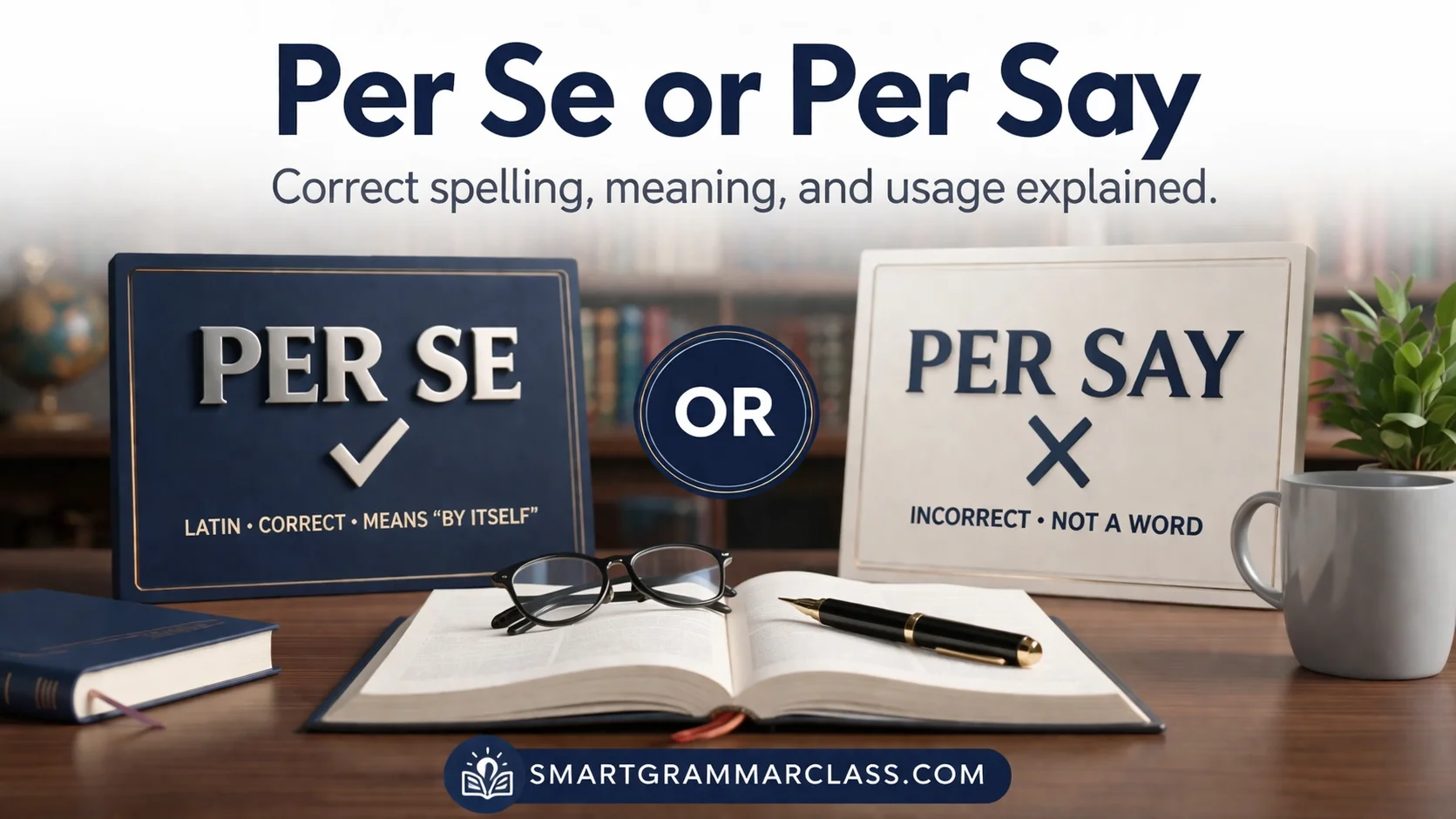
I remember the first time I typed “per say,” then paused, wondering if it looked right. That small worry is common among English learners, students, and even professionals who get confused because it sounds right but spells wrong. The correct spelling is per se, a Latin phrase that comes from a root meaning “by itself” or “in itself.”
Many people mix up the two because in casual speech they sound identical, but in formal writing like emails, essays, or business emails, using the right form helps your work looks polished and builds credibility. I’ve seen this in my own writing, where tiny details can shape how others judge your clarity and professionalism. The truth, upfront, is simple: per say is a misspelling with no real meaning, while per se is the correct phrase you should remember and use confidently.
To understand how it works, think of per se as a way to distinguish a specific element from a broader context, something considered independently or considered on its own, without outside factors. It is often used in negative statements or qualifying statements, especially in academic texts and professional communication. For example, saying “Pizza is not bad per se, but not great for someone lactose intolerant” helps express something intrinsically true without comparison to anything else.
These days, you’ll notice both versions used online, in blogs and social media, which makes the confusion worse, but learning the correct usage question once can improve grammar accuracy, writing clarity, and overall language confidence. As a writer, I always break down such tricky parts so the rule sticks, and by the end, you will never wonder again why one feels off and the other sounds right.
Also read this : Roll Call or Role Call: Correct Spelling, Meaning and Usage 2026
Per Se or Per Say The Fast, No-Nonsense Answer
If you’re in a hurry, here’s everything you need in seconds:
- ✅ Correct spelling: per se
- ❌ Incorrect spelling: per say
- 📌 Meaning: “by itself” or “in isolation”
- 💡 Purpose: Adds nuance or softens a statement
Example:
- “The plan isn’t bad per se, but it needs refinement.”
That one phrase shifts the tone. Without it, the sentence feels blunt. With it, the meaning becomes more precise.
What Does “Per Se” Actually Mean?
At its core, “per se” means “by itself.” Simple idea. Powerful effect.
When you use it, you’re telling the reader or listener to look at something in isolation, separate from everything else.
Break it down with a real-life analogy
Imagine you’re reviewing a restaurant:
- “The food isn’t bad.” → direct, possibly harsh
- “The food isn’t bad per se, but the service was slow.” → balanced and thoughtful
You’re not attacking the food itself. You’re pointing out that the issue lies somewhere else.
Why this matters
“Per se” acts like a precision tool in language. It helps you:
- Avoid sounding overly critical
- Add nuance to your argument
- Clarify what you really mean
Without it, your message can feel incomplete or misleading.
Why “Per Say” Keeps Showing Up Everywhere
If “per se” is correct, why does “per say” appear so often?
Short answer: people write what they hear.
The real reasons behind the confusion
- Phonetic spelling: “Per se” sounds like “per say”
- Latin unfamiliarity: Most people don’t recognize Latin phrases
- Autocorrect gaps: Not all tools catch the mistake
- Social media influence: Incorrect usage spreads quickly
A quick reality check
Search engines show thousands of queries for “per say meaning.” That tells you something important confusion is widespread.
But here’s the catch:
👉 Using “per say” instantly signals a lack of attention to detail.
In professional writing, that small mistake can quietly hurt your credibility.
The Origin of “Per Se” (And Why It Still Exists)
“Per se” didn’t come out of nowhere. It has roots going back centuries.
Where it comes from
- Language: Latin
- Original meaning: “through itself” or “by itself”
- Adopted into English through legal and academic writing
Why it stuck around
Unlike many outdated phrases, per se survived because it fills a very specific role:
- It adds clarity without adding extra words
- It expresses nuance that simpler words often miss
Modern relevance
Even in 2026, you’ll find “per se” in:
- Business communication
- Legal documents
- Academic writing
- Everyday conversation
It’s one of those rare phrases that bridges formal and casual language.
When to Use “Per Se” (With Real-World Examples)
This is where things get practical. Knowing the meaning is one thing. Using it naturally is another.
Use “per se” when you want to clarify intent
It works best when:
- You’re softening criticism
- You’re separating one idea from another
- You’re adding nuance to a statement
Everyday examples that actually sound natural
- “Working late isn’t the problem per se, it’s the lack of balance.”
- “The design isn’t bad per se, it just feels outdated.”
- “The idea isn’t flawed per se, execution needs work.”
Notice the pattern?
👉 It often appears after a negative phrase to refine meaning.
Quick formula you can follow
Not [problem] per se, but [real issue]
That structure works almost every time.
When NOT to Use “Per Se”
Here’s where most people go wrong. They start using it everywhere.
That’s a mistake.
Avoid using “per se” when:
- It doesn’t add clarity
- It makes the sentence sound forced
- A simpler word does the job better
Bad vs good examples
Incorrect:
- “I per se enjoy movies.”
Better:
- “I enjoy movies.”
Rule of thumb
If removing “per se” doesn’t change the meaning, you don’t need it.
Keep your writing clean. Don’t decorate it unnecessarily.
Per Se vs Similar Phrases (Clear Comparisons That Matter)
“Per se” isn’t the only phrase people use to add nuance. But it’s often confused with others.
Here’s how it stacks up:
| Phrase | Meaning | Best Use Case |
| Per se | By itself | Clarifying nuance |
| As such | In that role | Formal or logical explanation |
| Essentially | Basically | Simplifying ideas |
| Intrinsically | Naturally | Deeper or academic tone |
Key takeaway
- Use “per se” when isolating a concept
- Use alternatives when simplifying or explaining
Choosing the right phrase makes your writing feel intentional.
British vs American English Is There Any Difference?
This question pops up more than you’d expect.
The answer is simple
- 🇺🇸 American English: per se
- 🇬🇧 British English: per se
No difference. No variation. No exceptions.
What about “per say”?
- ❌ Not British
- ❌ Not American
- ❌ Not correct anywhere
That clears it up.
Common Mistakes and How to Avoid Them
Even confident writers slip up here. Let’s fix that.
The most common errors
- Writing “per say” instead of “per se”
- Placing it awkwardly in a sentence
- Using it without adding meaning
Practical fixes
- Memorize the correct spelling
- Use it sparingly
- Read your sentence out loud
Quick correction table
| Mistake | Fix |
| Per say | Per se |
| Overusing the phrase | Use only when needed |
| Random placement | Place after key idea |
Per Se in Professional Writing vs Casual Speech
“Per se” adapts well across different contexts. That’s part of its appeal.
In professional writing
You’ll see it in:
- Legal documents
- Academic research
- Business communication
Example:
- “The strategy isn’t ineffective per se, but requires adjustment.”
In casual conversation
It shows up in:
- Everyday speech
- Social media posts
- Informal discussions
Example:
- “It’s not weird per se, just unexpected.”
Pro tip
In casual settings, use it lightly. Too much can sound unnatural.
Real Usage Data and Trends (2026 Insight)
Language evolves. Usage patterns tell an interesting story.
What current trends show
- “Per se” remains dominant in formal writing
- “Per say” continues to rise in search queries
- Grammar tools increasingly flag incorrect usage
Why this matters
Correct usage does more than avoid mistakes. It:
- Builds trust
- Signals attention to detail
- Enhances readability
Insight worth remembering
People may search for “per say,” but they respect “per se.”
Quick Memory Trick So You Never Get It Wrong Again
Let’s make this easy to remember.
Simple trick
- “Per se” = Latin → ends with “e”
- “Per say” = sounds right → but wrong
Another way to lock it in
Think of “se” as “self.”
So “per se” = “by itself.”
That mental shortcut sticks surprisingly well.
FAQs
What is the correct spelling: per se or per say?
The correct spelling is per se. The form per say is an incorrect spelling and has no real meaning, even though it may look or sound acceptable in casual use.
What does per se actually mean?
The meaning of per se is “by itself” or “in itself.” It is used when something is considered independently, without outside factors or comparison.
Why do people get confused between per se and per say?
Many people get confused because both versions sound the same in casual speech. This makes it easy to mix up the spelling, especially for English learners, students, and even professionals.
Where should you use per se in writing?
You can use confidently per se in formal writing like emails, essays, and business emails, as well as in academic texts and professional communication, where clarity and credibility matter.
Can using per say affect your writing quality?
Yes, using per say can make your writing looks polished at first but actually feels off to careful readers. It can reduce your writing clarity and grammar accuracy, which may impact how others judge your work.
Conclusion
In 2026, understanding the difference between per se and per say is a small but powerful step toward better writing clarity and stronger language confidence. The correct spelling per se carries real meaning and real usage, while per say remains an incorrect spelling that can quietly harm your credibility. Once you truly understand how this Latin phrase works and start to use confidently in emails, essays, and daily writing, you eliminate hesitation and ensure your content always looks polished and professional.

Mia Rose is a dedicated grammar expert and language educator committed to helping learners master English with clarity and confidence. With extensive experience in teaching grammar, writing, and communication skills, she specializes in turning complex language rules into simple, easy-to-understand lessons.
At Smart Grammar Class, Mia creates accurate, well-researched, and practical content tailored for students, professionals, and everyday learners. Her teaching style focuses on real-world examples and clear explanations, enabling readers to confidently apply grammar rules in both writing and speaking.
Mia is committed to maintaining high editorial standards, ensuring every piece of content is reliable, up-to-date, and aligned with modern English usage. Her mission is to make grammar accessible, engaging, and useful for learners at all levels.