When I first typed these two words in an essay, I had to ask myself if I was using the right one, because many people search for terms that look and sound similar, which creates confusion. This is a very common issue in school, work, and even online writing, where a small mistake can change the whole sentence and affect the quality of your work.
In this guide, I will explain in simple way the basic rules, so in the end, you will know exactly which word to use and how to avoid errors when choosing between them. At a glance, the difference may seem tiny, but it actually trips thousands of writers every day, because a misplaced letter can shift the meaning entirely and make your writing feel careless, even though the truth is that the meanings do not really overlap.
The word perfect is an adjective and sometimes a verb that describes something flawless, ideal, or something you want to improve, while prefect is a noun that refers to a high-ranking official or a student with authority who may monitor others. These two are easily confused, and even spell-check or an application like word processing software or other programs may not catch the slip-up, because both are real words.
When looking in a dictionary, they may resemble each other, so you might possibly make a wrong guess about what you wanted or meant to say. I have seen tools judge a page correctly yet still gives a pass to the wrong word anyway, and sometimes autocorrect even suggests the wrong one since both start with similar letters. These tools may save time, but they are often off base and can produces humorous results. This grammar article will help you understand through examples and exercises, so you can be sure you have understood the correct usage in real situations.
Also read this : Awhile or A While: Correct Spelling, Meaning and Usage 2026
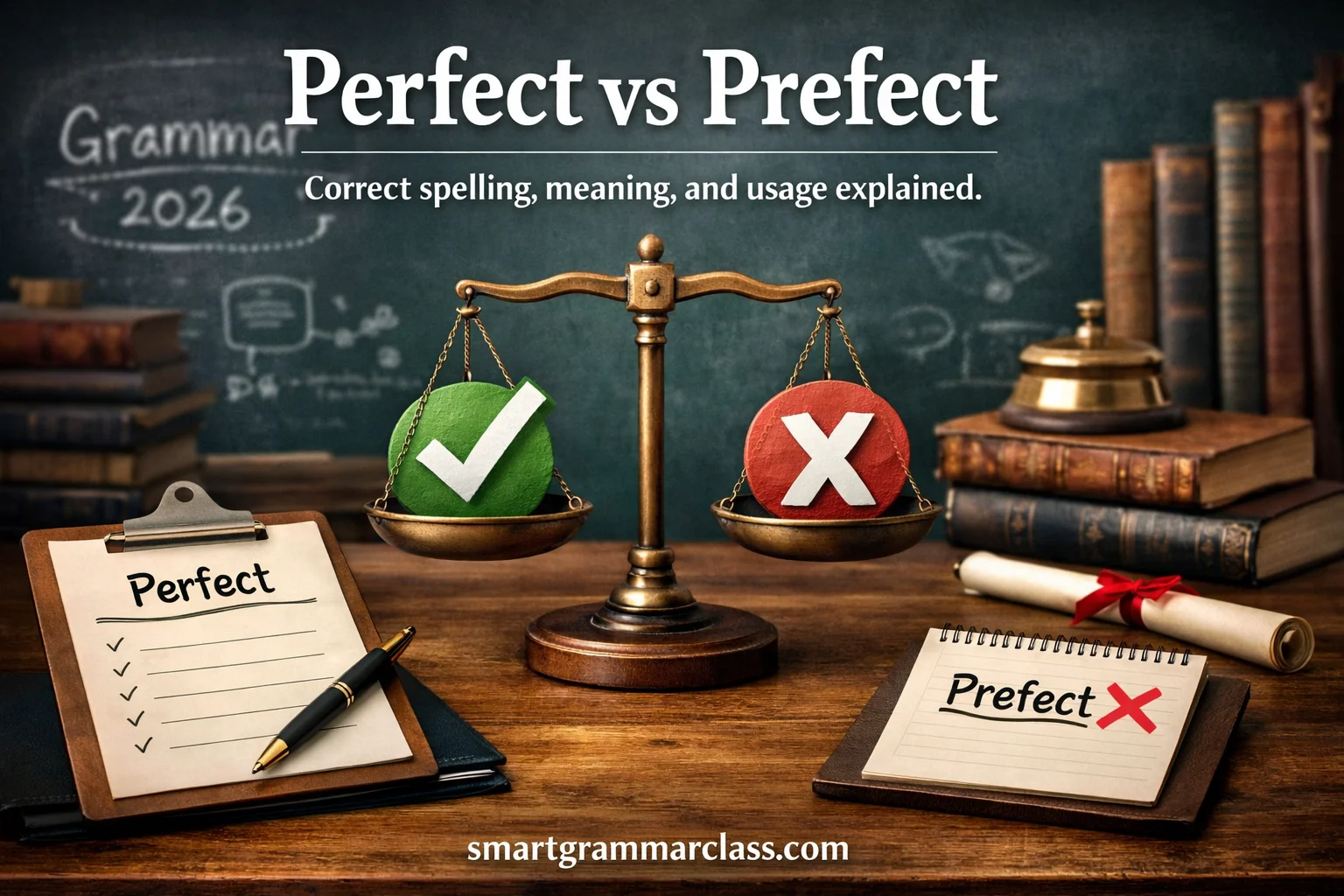
Quick Answer: Perfect vs Prefect Which One Should You Use?
If you’re in a hurry, here’s the clean distinction:
- Perfect → something flawless, ideal, or complete
- Prefect → a student leader or official authority figure
Example:
- “This design is perfect.”
- “She was appointed as a prefect.”
Quick mental shortcut:
If you’re describing quality, use perfect
If you’re naming a role, use prefect
Simple. But let’s go deeper so you never second-guess again.
What Does “Perfect” Mean?
The word perfect carries weight. It’s one of those terms people use daily, often without thinking twice. Yet it holds multiple layers of meaning depending on context.
Core Meaning
At its heart, perfect means:
- Flawless
- Complete
- Exactly as intended
It signals that nothing needs improvement.
Different Uses of “Perfect”
The versatility of this word makes it powerful:
- Adjective:
“That’s a perfect solution.” - Verb:
“He worked hard to perfect his craft.” - Noun (less common):
“Striving for the perfect.”
Tone and Connotation
Here’s where nuance matters.
“Perfect” can sound:
- Genuine → “Perfect timing!”
- Exaggerated → “This is absolutely perfect!!!”
- Sarcastic → “Oh, perfect. Just what I needed.”
Context shapes meaning more than the word itself.
Real-World Examples of “Perfect”
Let’s bring it to life.
Casual conversation:
- “That pizza was perfect.”
Professional setting:
- “Your proposal is perfect for our needs.”
Social media:
- “Perfect sunset tonight 🌅”
Customer service:
- “Perfect, I’ve processed your request.”
Notice something? The word fits almost anywhere.
What Does “Prefect” Mean?
Now let’s shift gears.
Prefect is far less common. Many people go years without using it. That’s exactly why confusion happens.
Core Meaning
A prefect is:
- A student leader in a school
- Or an official appointed authority in certain systems
Where You’ll See “Prefect”
This word lives in specific environments:
- British and Commonwealth schools
- Historical or governmental contexts
- Formal institutional settings
In American English, it’s rarely used.
Real-World Examples of “Prefect”
School setting:
- “He was selected as head prefect.”
Formal context:
- “The prefect oversaw disciplinary procedures.”
Historical reference:
- “Roman prefects governed regions.”
Why “Prefect” Feels Unfamiliar
Here’s the key reason:
Most US-based writers never encounter it in daily life.
So when typing quickly, the brain defaults to the familiar word perfect.
That’s where mistakes creep in.
Perfect vs Prefect: Side-by-Side Comparison
Let’s strip this down visually.
| Feature | Perfect | Prefect |
| Meaning | Flawless, ideal, complete | Student leader or official role |
| Usage | Extremely common | Rare |
| Context | Everyday language | Schools, governance |
| Part of Speech | Adjective, verb, noun | Noun |
| Geography | Global | UK, Commonwealth |
One glance. Total clarity.
Why People Confuse Perfect vs Prefect
This confusion isn’t random. It follows predictable patterns.
Visual Similarity
- Both words look nearly identical
- Only one letter separates them
That’s enough to trick your brain mid-sentence.
Typing Speed
When you type fast:
- Your fingers default to familiar patterns
- “Perfect” wins almost every time
Autocorrect Interference
Ironically, tools meant to help can hurt.
- Autocorrect often replaces “prefect” with “perfect”
- Spellcheck may not flag either
Lack of Exposure
If you’ve never seen “prefect” used properly:
- You won’t recognize it as valid
- You’ll assume it’s a typo
The Key Difference Explained Simply
Let’s simplify it even further.
- Perfect = describes things
- Prefect = describes a person
That’s it.
Think of it like this:
You admire something that’s perfect
You appoint someone as a prefect
Once that clicks, mistakes disappear.
Origin and Etymology: Where These Words Come From
Words carry history. These two are no exception.
Perfect
Derived from Latin:
- perfectus → meaning completed
Over time, it evolved to mean:
- Flawless
- Ideal
- Without defect
Prefect
Also Latin in origin:
- praefectus → meaning placed in charge
That meaning stayed remarkably consistent.
It still refers to authority.
Why This Matters
Understanding origins helps anchor memory.
- Perfect → completion
- Prefect → leadership
Different roots. Different roles.
British vs American Usage Differences
Language shifts across regions. This is a prime example.
In the United Kingdom
“Prefect” is common in schools:
- Students take on leadership roles
- They help enforce rules
- They act as role models
In the United States
The term is rarely used.
Instead, schools use titles like:
- Class president
- Student council member
- Hall monitor
What This Means for You
If you’re writing for a US audience:
- “Prefect” may confuse readers
If you’re writing for a UK audience:
- It may feel completely normal
Context matters. Always.
Common Mistakes and How to Avoid Them
Even strong writers slip up here.
Let’s fix that.
Common Errors
- “She is the perfect of the school” ❌
- “This is a prefect solution” ❌
Correct Versions
- “She is the prefect of the school” ✅
- “This is a perfect solution” ✅
Quick Fix Checklist
Before you hit publish, ask:
- Am I describing quality? → Perfect
- Am I naming a role? → Prefect
One question saves your credibility.
Everyday Usage Examples That Actually Make Sense
Let’s ground this in real life.
Emails
- “This timeline works perfectly for us.”
- “The plan is perfect as outlined.”
Avoid:
- “This is prefect for us”
School Context
- “She earned the role of prefect after years of effort.”
Social Media
- “Perfect day. No complaints.”
Professional Writing
- “The system operates at near-perfect efficiency.”
Precision matters here. Small errors stand out.
Grammar Insight: “Perfect” in Verb Tenses
Here’s where things get interesting.
“Perfect” isn’t just a descriptive word. It also appears in grammar structures.
Present Perfect
\text{have/has} + \text{past participle}
Example:
- “I have finished the report.”
Past Perfect
\text{had} + \text{past participle}
Example:
- “She had left before I arrived.”
Future Perfect
\text{will have} + \text{past participle}
Example:
- “They will have completed the task by tomorrow.”
Why This Matters
Understanding these forms improves:
- Writing clarity
- Timeline accuracy
- Professional tone
It also reinforces how versatile “perfect” really is.
Perfect vs Prefect in Search Trends (2026 Insights)
Search behavior reveals real confusion.
Key Observations
- “Perfect” dominates global usage
- “Prefect” spikes during school terms
- Most searches come from spelling uncertainty
What People Are Actually Asking
- “Is it perfect or prefect?”
- “What does prefect mean?”
- “Why does autocorrect change prefect?”
Insight
People don’t just want definitions. They want certainty.
That’s exactly what this guide delivers.
Memory Tricks That Actually Work
Let’s make this stick permanently.
Trick One
Perfect = “perfection”
Same root. Same meaning.
Trick Two
Prefect = “principal-like role”
Both relate to authority.
Trick Three
Visual cue:
- Perfect → longer, smoother word
- Prefect → shorter, sharper
Different feel. Different function.
When Word Choice Impacts Your Credibility
This isn’t just about spelling.
It’s about perception.
Why It Matters
- Small mistakes signal carelessness
- Readers lose trust quickly
- Professional tone weakens instantly
Real Scenario
Imagine sending this email:
“This is a prefect solution for your business.”
It looks wrong. It feels off.
Now compare:
“This is a perfect solution for your business.”
Clean. Confident. Credible.
Quick Recap Table
| If You Mean… | Use This Word |
| Something flawless | Perfect |
| A student leader | Prefect |
FAQs
What is the main difference between perfect and prefect?
The word perfect is used to describe something flawless or ideal, while prefect refers to a person, usually a student or official, who has authority or responsibility. One describes quality, and the other names a role.
Why do people often confuse perfect and prefect?
People confuse them because both words look and sound very similar. A small spelling change can easily be missed, especially when writing quickly or relying on autocorrect tools.
Can spell-check tools detect the mistake between perfect and prefect?
Not always. Since both words are correct in spelling, most spell-check tools will not flag them as errors, even if they are used in the wrong context.
How can I remember the correct usage of perfect and prefect?
A simple trick is to link perfect with “perfection” or something ideal, and prefect with “person” or “position.” This helps you quickly decide which word fits your sentence.
Where are these words commonly used in real life?
Perfect is commonly used in daily conversations, writing, and descriptions, while prefect is mostly used in school systems or official roles where someone is given authority.
Conclusion
In summary, understanding the perfect vs prefect difference is important for clear and correct writing. Although their spelling and sound are similar, their meaning and usage are very different, and even a small mistake can affect your message. By learning simple rules, checking real examples, and practicing regularly, you can avoid confusion and use the right word with confidence in any situation.

mma Rose is a skilled grammar expert and language educator dedicated to helping learners improve their English with clarity and confidence. With extensive experience in teaching grammar, writing, and communication, she specializes in simplifying complex language rules into easy, practical explanations.
At Smart Grammar Class, Emma creates well-researched, accurate, and user-friendly content designed for students, professionals, and everyday learners. Her teaching approach focuses on real-life examples, clear structure, and actionable guidance, enabling readers to apply grammar rules effectively in both writing and speaking.
Emma is committed to maintaining high editorial standards, ensuring every article is trustworthy, up-to-date, and aligned with modern English usage. Her goal is to make grammar simple, accessible, and useful for everyone.