In 2026, many people still mix up roll call and role call, even though the correct spelling is easy once you understand the meaning and real usage. As a writer, I’ve often been paused, mid-sentence while trying to write quickly, because these are deceptively simple phrases that can cause spelling mistakes in emails, meetings, or even published content.
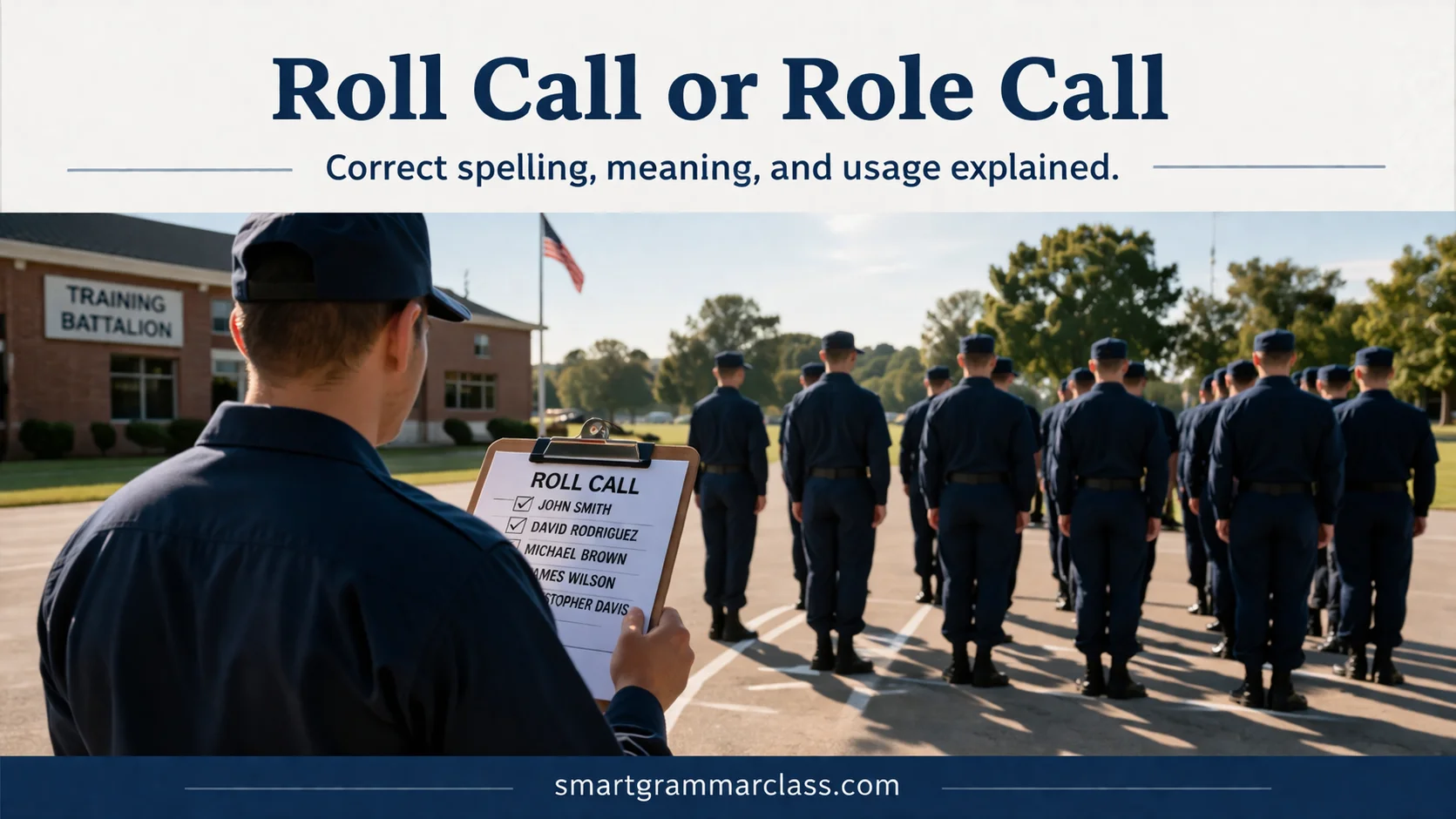
Both words sound the same, and they are pronounced identically, making them classic homophones, but their meanings are completely different. A roll call is the act of reading a list of names aloud to check attendance, commonly in school, the military, or organizational procedures, while role refers to a position, function, or responsibility. This common mistake may seem small, but it often undermines your credibility in professional writing or even a simple blog.
From my experience in classroom management and professional settings, getting this term correct helps maintain clarity and avoids awkward or confusing meetings. A teacher taking attendance every morning is doing a roll call, not a role call, which is always incorrect in that context. The truth is that many students, participants, and even native English speakers get tripped up because the phrases look superficially interchangeable.
But once you learn the distinction, you’ll remember forever and confidently use the right English terms in any situation. Think of roll as a noun linked to a list or attendance sheet, where names are called out, verified, and marked as present, helping ensure student accountability. This simple guide explains the process, gives practical examples, and helps you avoid an embarrassing mistake the next time you search, choose, or use this keyword in your writing.
Also read this : Complaint or Complain: Correct Spelling Meaning in 2026
Roll Call vs Role Call The Fast Answer You Actually Need
Let’s cut straight to it.
- Correct term: ✅ Roll call
- Incorrect (in most cases): ❌ Role call
Why?
Because roll call refers to reading names from a list. Meanwhile, role refers to a character or function someone plays.
Quick example:
- “The teacher took a roll call before class started.” ✔
- “The teacher took a role call before class started.” ✘
Simple rule you can remember:
You roll through names, but you play a role.
Once that clicks, you won’t second-guess it again.
What “Roll Call” Really Means (With Real-World Context)
At its core, roll call is about checking who’s present.
Plain-English Definition
A roll call is the act of reading a list of names aloud to confirm attendance.
Short. Clear. Practical.
Where You’ll Actually Hear It
You don’t just hear this phrase in classrooms. It shows up everywhere.
- Schools
Teachers call student names to mark attendance. - Military settings
Officers verify personnel presence. - Business meetings
Teams confirm attendance at the start. - Government and legislative sessions
Officials record votes and presence.
Why “Roll” and Not “List”?
Here’s where it gets interesting.
The word roll comes from historical documents. Names used to be written on long scrollsliterally rolled-up sheets of parchment. When officials read names, they were reading from a roll.
So “roll call” literally meant:
Calling names from a rolled document.
Even though we don’t use scrolls anymore, the term stuck. Language has a long memory.
Why “Role Call” Confuses So Many People
Now let’s talk about the mistake.
At first glance, “role call” seems logical. After all, “role” is a common word.
Why People Get It Wrong
- “Role” is more familiar in modern language
- It sounds identical to “roll” when spoken
- Autocorrect often replaces “roll” with “role”
The Real Meaning of “Role”
The word role refers to:
- A character in a movie or play
- A function in a job or system
- A responsibility someone holds
Examples:
- “She played the lead role in the film.”
- “His role in the company is crucial.”
See the difference? It has nothing to do with attendance or lists.
Where Confusion Happens Most
- Workplace emails
- Social media captions
- Blog posts and articles
- Student assignments
One small mistake. Big difference in clarity.
Roll Call vs Role Call Side-by-Side Comparison
Sometimes, a table makes things click instantly.
| Term | Meaning | Correct Usage | Example |
| Roll Call | Reading names from a list | ✅ Yes | The manager started with a roll call |
| Role Call | Refers to roles or functions | ❌ No (in this context) | Incorrect usage |
Key takeaway:
If you’re talking about attendance, it’s always roll call.
The Origin of “Roll Call” (Short but Fascinating)
Language doesn’t appear out of nowhere. There’s always a story.
Historical Roots
- The term dates back to early military and government systems
- Names were recorded on parchment rolls
- Officials would physically unroll the document and read names
Evolution Over Time
- Scrolls became paper lists
- Paper lists became digital systems
- But the phrase never changed
That’s why we still say “roll call” today, even in Zoom meetings.
It’s a linguistic fossilstill alive and useful.
British vs American English Is There Any Difference?
Here’s a question people often overthink.
Short Answer
There is no difference.
Both American English and British English use:
- ✔ Roll call (correct)
- ✘ Role call (incorrect in this context)
Why the Confusion Exists
People assume:
- “Maybe it’s a regional spelling thing”
- “Maybe British English uses ‘role call’”
It doesn’t.
This isn’t like color vs colour. The correct term stays the same everywhere.
When You Should Use “Roll Call” (Practical Scenarios)
This is where clarity matters most. You want to sound natural and correct every time.
In Schools
Teachers use roll call daily.
- “Let’s begin with a roll call.”
- “Roll call will take five minutes.”
In Business Meetings
Used for attendance tracking.
- “We’ll start with a quick roll call.”
- “Roll call confirmed all team members are present.”
In Government and Formal Settings
Often used in voting procedures.
- “A roll call vote was conducted.”
In Casual Conversations
Yes, even informally.
- “Quick roll callwho’s coming tonight?”
In Virtual Meetings
Especially common now.
- “Let’s do a roll call before we begin the call.”
Common Mistakes You’ll See Everywhere
Even experienced writers slip up.
Frequent Errors
- Writing “role call” in professional emails
- Using the wrong term in blog posts
- Mixing it up in academic writing
Real Example of a Mistake
“We’ll begin the meeting with a role call.”
That’s incorrect.
Quick Fix Strategy
- Ask yourself: Are names being read aloud?
- If yes → use roll call
- If no → rethink your sentence
Pro Tip
Turn on grammar toolsbut don’t rely on them blindly. Many tools still miss this mistake.
Real Examples in Everyday Writing
Seeing real usage helps lock it in.
Emails
- “We’ll begin with a roll call at 10 AM.”
- “Please be present for roll call.”
News Writing
- “The مجلس conducted a roll call vote.”
- “Attendance was verified through roll call.”
Social Media
- “Roll callwho’s still awake?”
- “Friday night roll call!”
Formal Documents
- “Attendance shall be recorded via roll call.”
- “Roll call is mandatory for all members.”
“Roll Call” in Modern Trends and Usage Data
Search behavior tells an interesting story.
What People Are Searching
- “roll call or role call”
- “is role call correct”
- “roll call meaning”
Why Confusion Is Growing
- Voice typing increases homophone errors
- AI tools sometimes suggest incorrect phrasing
- Fast writing leads to overlooked mistakes
Data Insight
According to Google Trends:
- Searches for “roll call vs role call” have steadily increased
- Spikes occur during academic seasons
- Workplace-related queries are rising
What This Means for You
If you use the correct term consistently, you immediately stand out as more precise and professional.
Quick Memory Trick So You Never Get It Wrong Again
Let’s make this stick for good.
The Simple Rule
- Roll = list of names
- Role = a character or function
Easy Phrase to Remember
You roll through names, but you play a role.
Say it once. You’re done.
Bonus: Similar Word Mix-Ups You Should Avoid
If this one tripped you up, these might too.
Common Confusing Pairs
- Affect vs Effect
- Then vs Than
- Compliment vs Complement
- Loose vs Lose
- Principal vs Principle
Why They Matter
Small mistakes can:
- Change meaning
- Confuse readers
- Hurt credibility
Quick Tip
When in doubt, pause and test the sentence. Context always reveals the right choice.
FAQs
What is the difference between roll call and role call?
Roll call means calling out a list of names aloud to check attendance, while role call is a misspelling and always incorrect in this context. The confusion happens because both words sound the same, but their meanings are different.
Why do people often mix up these two terms?
Many people, including native English speakers, get confused because the phrases are pronounced identically and are homophones. These deceptively simple phrases can easily cause spelling mistakes, especially in fast writing like emails or meetings.
Where is roll call commonly used in real life?
Roll call is widely used in school, the military, and other organizational procedures where attendance needs to be checked. It involves reading a list, calling out names, and marking individuals as present for proper record and accountability.
Is role call ever the correct spelling?
No, role call is always incorrect when referring to attendance. The word role means a position or function, so using it in this phrase is a grammar mistake that can affect your credibility in professional writing.
How can I remember the correct spelling easily?
A simple trick is to link roll with a list or attendance sheet that is being read aloud. Once you understand this distinction, you will remember forever and avoid making an embarrassing mistake in any situation.
Conclusion
In 2026, understanding the difference between roll call and role call is essential for clear and professional writing. While both words sound the same, only roll call is the correct spelling when referring to attendance and the act of reading a list of names aloud. Using the wrong term is a common mistake that can undermine credibility, especially in emails, meetings, and published content. By learning the meaning, real usage, and simple distinction between these confusing terms, you can confidently avoid spelling mistakes and use the right phrase in any situation.

mma Rose is a skilled grammar expert and language educator dedicated to helping learners improve their English with clarity and confidence. With extensive experience in teaching grammar, writing, and communication, she specializes in simplifying complex language rules into easy, practical explanations.
At Smart Grammar Class, Emma creates well-researched, accurate, and user-friendly content designed for students, professionals, and everyday learners. Her teaching approach focuses on real-life examples, clear structure, and actionable guidance, enabling readers to apply grammar rules effectively in both writing and speaking.
Emma is committed to maintaining high editorial standards, ensuring every article is trustworthy, up-to-date, and aligned with modern English usage. Her goal is to make grammar simple, accessible, and useful for everyone.