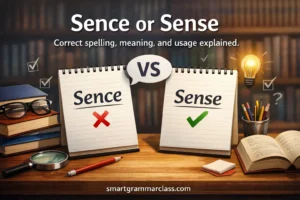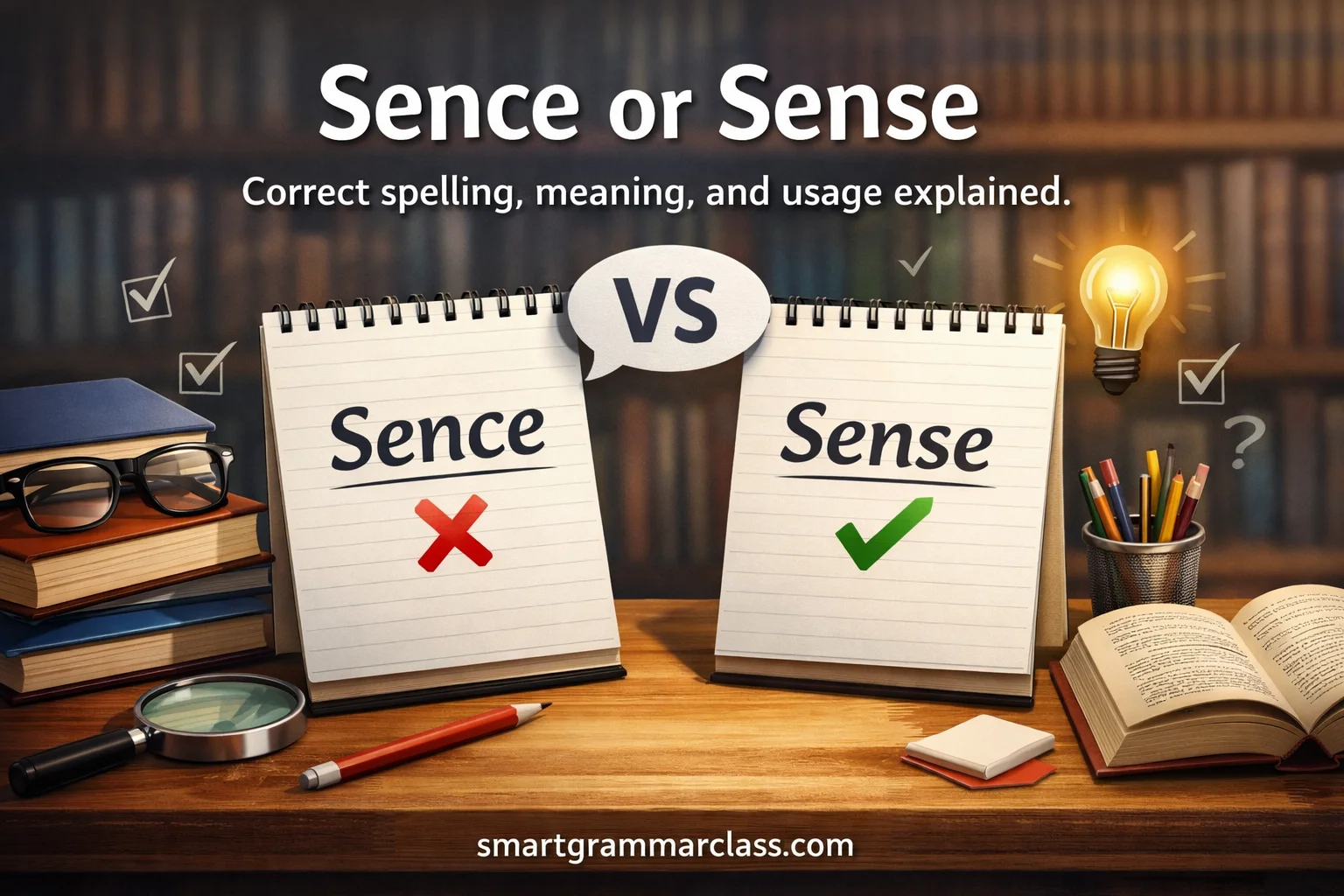
In the English language, the correct spelling is sense, while sence is a wrong spelling caused by phonetic similarity and simple typographical error. I’ve seen many writers, students, and even professionals make this common mistake when something “sounds right but looks off.”
The word sense is a recognized word that refers to feeling, perception, and understanding, and it appears in daily writing, from college Instagram captions to emails. A quick explanation is that sense connects to biological perception, like the five sensory faculties: smell, touch, taste, hearing, and sight, which help humans and animals perceive stimuli from outside and inside the body.
To avoid mistakes, always remember that sense fits in sentences like “this makes sense” or shows common sense and good judgment. The definition includes awareness, a particular meaning, or even a vague impression, depending on contextual meaning and semantic meaning.
In my experience as someone who loves English learning, focusing on spelling rules, grammar, and proofreading helps your writing skills truly shine. A simple comparison with words like dense, tense, or fence shows why people get mistakenly confused, but consistent editing and smart word choice improve clarity, expression, and overall communication.
Also read this : Whether You Like It or Not: Correct Spelling Meaning in 2026
⚡ Sence or Sense Quick Answer
Let’s keep this simple and direct.
- ✅ Sense = correct spelling
- ❌ Sence = incorrect spelling
- 📌 Works the same in US English and British English
Example:
- ✔️ That makes perfect sense
- ❌ That makes perfect sence
If you remember one thing from this guide, let it be this:
If you write “sence” you’re making a spelling mistake. No exceptions.
📌 What Does “Sense” Actually Mean
Now let’s go deeper. The word “sense” isn’t just about spelling. It carries multiple meanings depending on how you use it.
At its core, sense relates to perception, understanding, and meaning.
Core meanings of “sense”
- Physical perception → your ability to see, hear, smell, taste, and touch
- Logical thinking → your ability to reason and judge
- Interpretation → your ability to understand something
Quick reference table
| Context | Meaning | Example |
| Physical | Awareness through senses | She lost her sense of taste |
| Logical | Reason or judgment | That decision makes sense |
| Interpretive | Understanding meaning | I can’t make sense of this text |
Real-life examples
- You trust your sense of direction when navigating
- You rely on common sense in daily decisions
- You try to make sense of confusing situations
Each use feels slightly different. Still, they all connect to one idea. Understanding the world around you.
🧠 Why People Confuse “Sence” and “Sense”
This confusion doesn’t happen randomly. There are clear reasons behind it.
Phonetic similarity
Both words sound identical. When you say them out loud, there’s no difference.
That’s where the brain gets tricked. You write what you hear.
Influence of similar words
English is full of words ending in “-ence”:
- science
- sentence
- difference
So your brain assumes “sence” should follow the same pattern.
It feels logical. But it’s wrong.
Typing habits and autocorrect
Fast typing leads to small mistakes. Sometimes autocorrect doesn’t catch “sence” because it treats it like a proper noun or ignores it.
Mental shortcut
Your brain often prioritizes speed over accuracy. It guesses the spelling instead of recalling it.
That’s why even good writers slip.
🔍 Is “Sence” Ever Correct
Short answer. No.
Long answer. Still no.
Here’s the reality
- “Sence” is not recognized in any standard English dictionary
- It has no grammatical function
- It appears only as a typo or misspelling
What happens if you use it
Using “sence” can:
- Lower your credibility
- Make writing look careless
- Affect academic or professional work
Strong takeaway
“Sence” is always incorrect in modern English writing.
There are no exceptions. No regional variations. No hidden meanings.
✍️ Correct Usage of “Sense” in Sentences
Understanding meaning is good. Using it correctly is better.
Let’s look at practical examples you’ll actually use.
Everyday sentences
- This explanation makes complete sense
- She has a strong sense of responsibility
- I can’t make sense of these numbers
- He has a great sense of humor
- Trust your sense of judgment
Usage patterns
You’ll often see “sense” used in phrases like:
- make sense
- common sense
- sense of direction
- sense of purpose
Pro tip
If your sentence relates to thinking, feeling, or understanding, then “sense” is the right choice.
🚫 Common Mistakes with “Sence or Sense”
Even experienced writers make these mistakes.
Let’s expose the most common ones so you can avoid them.
Mistake one: writing “sence” instead of “sense”
This is the biggest issue. It happens in emails, essays, and even published content.
Mistake two: confusing “sense” with “since”
These words look similar. They sound different. Yet people still mix them.
- ❌ Since it makes no since
- ✔️ Since it makes no sense
Mistake three: overusing “makes sense”
This phrase is useful. However, using it too often weakens your writing.
Instead, vary your language:
- That seems logical
- That adds up
- That’s reasonable
Quick correction list
- ❌ sence → ✅ sense
- ❌ since (wrong context) → ✅ sense
🔄 Sense vs Since vs Cents
Here’s where things get interesting.
These three words confuse a lot of people. They look similar. They mean completely different things.
Comparison table
| Word | Meaning | Example |
| Sense | Understanding or feeling | That makes sense |
| Since | Time or reason | Since last year |
| Cents | Money | I have fifty cents |
Easy way to remember
- Sense = thinking or feeling
- Since = time or cause
- Cents = money
Example in one sentence
Since yesterday, I spent fifty cents, and it makes sense.
📚 Origin of the Word “Sense”
Words carry history. Knowing that history makes them easier to remember.
Where “sense” comes from
- Derived from Latin word “sensus”
- Meaning perception, feeling, or awareness
- Entered English through Old French
Evolution
Over time, the meaning expanded. Still, the core idea stayed the same.
It always relates to perception and understanding.
Why this matters
When you know the origin, spelling feels less random.
“Sensus” evolved into “sense” not “sence.”
🌍 US vs UK English Spelling
Some words change between regions. This one doesn’t.
Key fact
- “Sense” is spelled the same in US English and UK English
No variation exists
Unlike words like:
- color vs colour
- center vs centre
“Sense” stays consistent everywhere.
What this means for you
You don’t need to adjust spelling based on location.
One word works globally.
📊 Sence or Sense Google Trends and Usage Data
Let’s look at real-world usage.
Key insight
- “Sense” dominates search results worldwide
- “Sence” appears mainly in typo searches
What this tells us
People often search for “sence or sense” because they’re unsure.
That’s exactly why this topic matters.
🧩 Memory Trick to Never Misspell “Sense” Again
You don’t need to memorize rules forever. A simple trick works better.
Easy memory hack
“Sense helps you make sense.”
Both words use the same spelling.
Another trick
Think of the word sensor. It comes from the same root.
You wouldn’t write “sencor.” So don’t write “sence.”
🧪 Case Study: Real Writing Mistakes and Fixes
Let’s make this practical.
Case one: student essay
Original:
This argument makes no sence.
Fixed:
This argument makes no sense.
Impact:
The corrected version sounds polished and credible.
Case two: business email
Original:
Your proposal makes good sence to us.
Fixed:
Your proposal makes good sense to us.
Impact:
Professional tone improves instantly.
Case three: blog content
Original:
It doesn’t make sence why this happened.
Fixed:
It doesn’t make sense why this happened.
Impact:
Clarity and trust increase.
🧠 Advanced Usage of “Sense”
Let’s go beyond basics.
Abstract expressions
- sense of belonging
- sense of urgency
- sense of achievement
Idiomatic expressions
- come to your senses
- knock some sense into someone
- lose your sense of direction
Why this matters
Using these phrases correctly makes your writing feel natural and human.
🧾 Quick Reference Cheat Sheet
Keep this handy.
Correct vs incorrect
| Incorrect | Correct |
| Sence | Sense |
When to use “sense”
- Talking about understanding
- Talking about perception
- Talking about logic
🪄 Writing Tips to Avoid This Mistake Forever
A few small habits can save you from big errors.
Practical tips
- Slow down when typing important content
- Use spell check tools
- Read your writing out loud
- Look for context clues
Smart habit
When in doubt, replace the word with understanding. If it fits, use “sense.”
FAQs
What is the correct spelling: sence or sense?
The correct spelling is sense. The word sence is a misspelling and not a recognized word in the English language, often caused by phonetic similarity or a typographical error.
Why do writers and students make this common mistake?
This confusion happens because both words sound similar in pronunciation, and during fast writing or when something is typed quickly, the wrong spelling may slip in without proper proofreading.
What is the meaning and usage of the word sense?
The word sense is a noun that refers to feeling, perception, or understanding, and sometimes works as a verb meaning to feel something. It is widely used in sentences, idioms, and phrases to express awareness or good judgment.
Can you give example sentences using sense correctly?
Yes, here are simple example sentences: “This idea makes sense,” and “She has strong common sense.” These examples show proper usage rules and help improve sentence structure and clarity.
How can I avoid mistakes and spell correctly in daily writing?
To avoid mistakes, focus on spelling rules, regular editing, and careful proofreading. Improving your language skills, vocabulary, and paying attention to contextually relevant words will help your writing shine and reduce common errors.
Conclusion
In conclusion, understanding the difference between sence and sense is essential for clear and effective writing in the English language. Always remember that sense is the correct spelling, while sence is a common mistake caused by phonetic similarity or typographical error. By focusing on meaning, usage, and proper spelling rules, you can easily avoid mistakes and improve your communication. With regular proofreading, better vocabulary, and attention to contextual meaning, your writing skills will grow stronger and your sentences will always make perfect sense.

Mia Rose is a dedicated grammar expert and language educator committed to helping learners master English with clarity and confidence. With extensive experience in teaching grammar, writing, and communication skills, she specializes in turning complex language rules into simple, easy-to-understand lessons.
At Smart Grammar Class, Mia creates accurate, well-researched, and practical content tailored for students, professionals, and everyday learners. Her teaching style focuses on real-world examples and clear explanations, enabling readers to confidently apply grammar rules in both writing and speaking.
Mia is committed to maintaining high editorial standards, ensuring every piece of content is reliable, up-to-date, and aligned with modern English usage. Her mission is to make grammar accessible, engaging, and useful for learners at all levels.