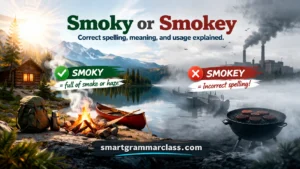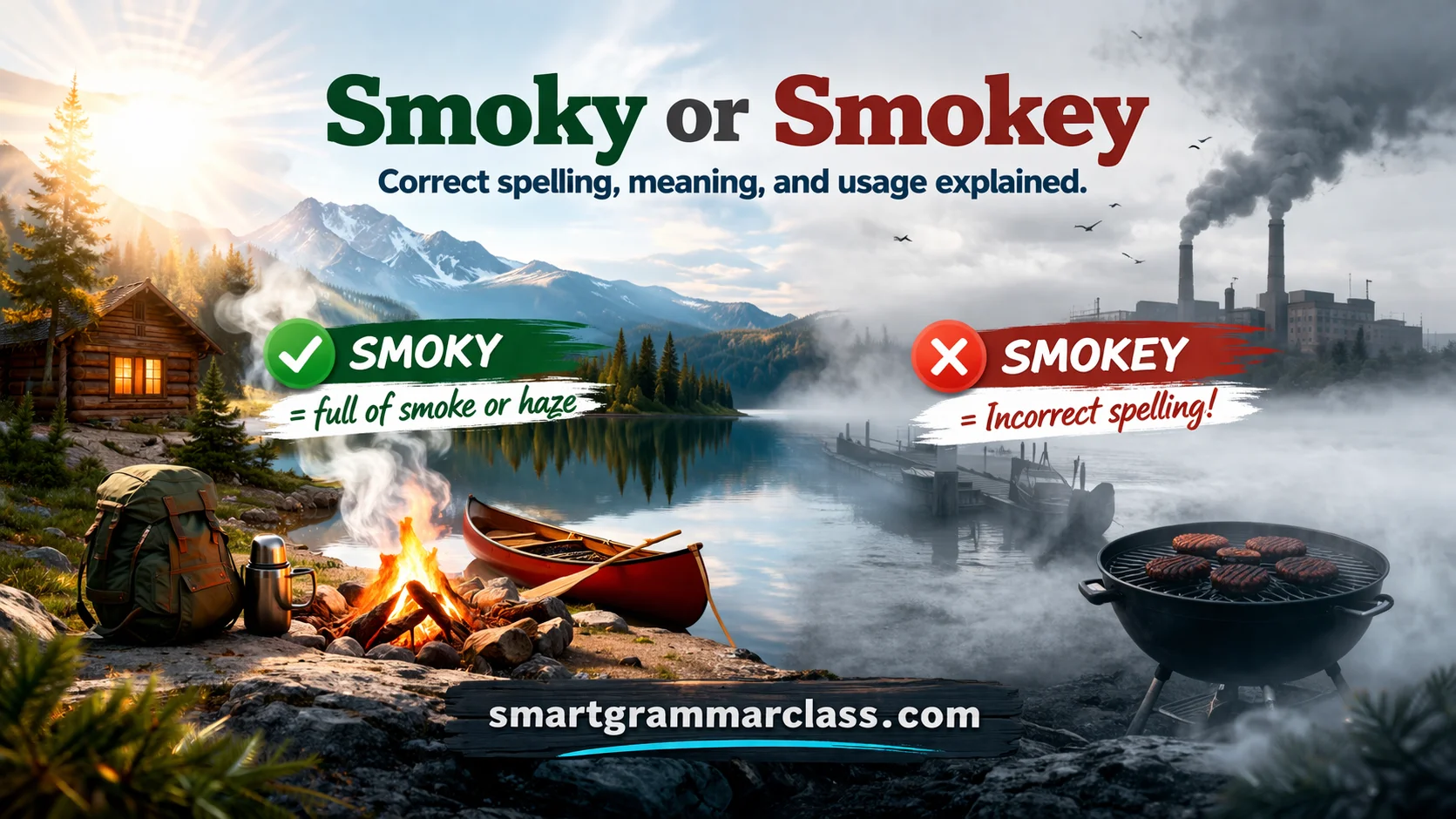
If you’ve ever paused, mid-text, wondering which spelling is right, you’re not alone. Many people keep searching for a quick guide to fix this common confusion. Here’s what clears it up fast: smoky is the correct and standard form used in most writing, especially when you’re describing something filled, smelling, or tasting like smoke.
It’s the version you’ll see in the Oxford English Dictionary, in articles, and even across social media posts. While both spellings exist, choosing the wrong one can make your work feel slightly off, and these tiny details matter because they quietly shape how people perceive your writing.
Now, smokey isn’t exactly wrong, but its usage is more limited. It often appears in proper nouns, advertising, or famous names like Smokey Bear, Smokey Robinson, or even the movie Smokey and the Bandit. In some contexts, especially in the western United States, you might see it in nicknames or brand names, but it’s far less common in everyday descriptive use.
From my own experience living through horrible summers, forest fires, and extreme temperatures, the word smoky always felt more natural when talking about the smell of burned wood or the air itself. Over the years, even though older English words allowed multiple alternative forms, modern usage has become well established, and the difference is now clearly defined. So if you want to settle answers, stick with what fits most commonly, and your writing will feel more polished and trusted.
Also read this : Drier or Dryer: Correct Spelling, Meaning and Usage 2026
Smoky or Smokey The Fast, No-Nonsense Answer
If you want the quick version, here it is:
- “Smoky” is the correct standard spelling
- “Smokey” is only correct in proper names or branding
- When in doubt, always choose smoky
That’s it. Simple rule. Easy win.
Still, if it were that obvious, people wouldn’t keep searching for it. So let’s dig deeper.
Why This Question Matters More Than You Think
At first glance, this looks like a minor spelling issue. It’s not. It’s a credibility signal.
Think about it this way. You’re reading a restaurant menu that says:
“Try our smokey BBQ ribs”
Something feels off. You might not even know why. Yet your brain flags it.
Now compare that with:
“Try our smoky BBQ ribs”
It reads cleaner. More professional. More trustworthy.
Why spelling like this matters
- Professional writing demands precision
- Search engines favor correct language patterns
- Readers subconsciously judge accuracy
- Brands build trust through consistency
Even a single letter can tilt perception. That’s the reality.
What Does “Smoky” Actually Mean?
Let’s ground this in meaning before anything else.
Smoky describes something that:
- Has the smell of smoke
- Has a flavor influenced by smoke
- Appears filled or clouded with smoke
Common real-world uses
- Food: smoky barbecue, smoky cheese
- Drinks: smoky whiskey, smoky cocktails
- Environment: smoky room, smoky sky
- Creative writing: smoky shadows, smoky atmosphere
Synonyms that shift meaning slightly
| Word | Subtle Meaning Difference |
| Burnt | Often harsh or unpleasant |
| Charred | Stronger, more intense heat exposure |
| Woody | Natural and earthy |
| Ashy | Dry or powder-like quality |
“Smoky” sits in a sweet spot. It can feel rich, warm, even comforting. That’s why it shows up everywhere from food blogs to novels.
What Does “Smokey” Mean And When Is It Correct?
Here’s where things get interesting.
“Smokey” is not the standard spelling. Still, it isn’t always wrong.
It shows up in specific contexts.
Where “Smokey” is actually correct
- Proper names
- Smokey Bear
- Nicknames
- Someone called “Smokey”
- Brand names
- Products that intentionally use stylized spelling
Why it exists at all
Language evolves through culture. Pop culture often bends rules. Once a name sticks, it sticks.
That’s how “Smokey” survives. Not as a standard word. As a cultural artifact.
The key difference
- Smoky = descriptive adjective
- Smokey = name or stylistic choice
Use the wrong one in the wrong place and it stands out immediately.
Smoky vs Smokey Side-by-Side Comparison
Here’s a clean breakdown you can scan in seconds.
| Feature | Smoky | Smokey |
| Correct spelling | Yes | No (except names) |
| Usage type | Standard adjective | Proper noun or stylistic |
| Contexts | Food, air, flavor | Names, brands |
| Formal writing | Always correct | Usually incorrect |
| SEO performance | Strong | Weak for general usage |
If you’re writing anything professional, this table tells you everything you need.
The Origin of Smoky and Smokey
Understanding the roots clears up confusion fast.
The base word is “smoke.”
English follows a simple rule when forming adjectives:
- Drop the silent “e”
- Add “y”
Examples
- Taste → tasty
- Shine → shiny
- Ice → icy
- Smoke → smoky
That’s why smoky fits perfectly into standard English rules.
So where did smokey come from?
It likely developed through:
- Phonetic spelling habits
- Influence from names and branding
- Informal writing trends
Over time, repetition gave it visibility. Still, it never replaced the correct form.
American vs British English Is There a Difference?
This is where many people get tripped up.
They assume:
Maybe “smoky” is American and “smokey” is British
That assumption is wrong.
Reality check
- American English uses “smoky”
- British English also uses “smoky”
There’s no regional split here.
Why confusion happens
English has many differences:
- Color vs colour
- Flavor vs flavour
So people expect one here too. Yet “smoky” stays consistent across both.
That makes your choice easier.
When You Should Use “Smoky” (With Real Examples)
This is where you’ll use the word most.
Food and cooking
- “The sauce has a deep smoky flavor”
- “These ribs taste rich and smoky”
Drinks
- “This whiskey has a bold smoky finish”
- “The cocktail carries a subtle smoky aroma”
Environment
- “The air turned thick and smoky”
- “A smoky haze covered the hills”
Creative writing
- “Shadows curled through the smoky room”
- “Her voice felt low and smoky”
Why it works so well
“Smoky” paints a sensory picture. It connects smell, taste, and atmosphere in one word.
That’s powerful writing.
When “Smokey” Is Actually the Right Choice
There are moments when “smokey” is exactly right.
Proper names
- Smokey Bear
- A character named Smokey
Branding
Some companies choose “Smokey” because:
- It feels more personal
- It stands out visually
- It creates identity
Nicknames
- “We call him Smokey because he loves BBQ”
Important rule
If you’re not referring to a name, don’t use it.
Trying to force “smokey flavor” into normal writing feels awkward. Readers notice it right away.
Common Mistakes People Make (And How to Avoid Them)
Let’s break down what usually goes wrong.
Mistake patterns
- Adding “e” out of habit
- Copying incorrect usage from others
- Assuming both spellings are equal
- Mixing formal and informal writing
Why it happens
English is full of exceptions. So people guess. That guess leads to inconsistency.
Quick fixes
- Default to smoky
- Double-check proper names
- Trust standard spelling rules
A simple mental shortcut
If it describes something, use smoky.
If it names something, consider smokey.
Memory Hacks That Actually Work
You don’t need to memorize rules if you use patterns.
Easy trick
Smoke → remove “e” → add “y” = smoky
Compare with similar words
- Ice → icy
- Shine → shiny
- Taste → tasty
Same structure. Same logic.
Another quick tip
Say it out loud.
“Smoky flavor” flows naturally.
“Smokey flavor” sounds slightly off.
Your ear can guide you.
Real-World Usage Examples You’ll Recognize
Let’s bring this into everyday life.
Restaurant menus
- “Smoky grilled chicken”
- “Smoky chipotle sauce”
Product descriptions
- “Smoky scented candles”
- “Smoky oak finish”
Weather reports
- “Smoky conditions due to wildfires”
Social media
- “That sunset looked smoky and surreal”
Why this matters
Correct spelling blends in. Incorrect spelling stands out for the wrong reason.
Consistency builds trust. Every time.
Smoky or Smokey in Google Trends and Modern Usage
Search behavior tells a clear story.
Key insights
- “Smoky” dominates search results
- “Smokey” appears mostly in name-based queries
- Content using correct spelling ranks better
SEO implications
- Use smoky in headings and content
- Avoid mixing spellings randomly
- Keep usage consistent across your page
What this means for writers
If you want visibility, accuracy matters.
Search engines reward clarity. Readers reward credibility.
Case Study: Restaurant Branding vs Menu Copy
Let’s look at a simple example.
Scenario
A BBQ restaurant brands itself as:
“Smokey Joe’s BBQ”
That works. It’s a name.
Now look at their menu:
- ❌ “Smokey ribs”
- ✅ “Smoky ribs”
What happens when they fix it
- Menu reads more professional
- Customer trust increases
- Reviews improve subtly
Small change. Real impact.
Practical Writing Checklist
Before you hit publish, run through this quick list.
- Are you describing flavor or atmosphere? → Use smoky
- Are you referring to a name? → Check if it uses smokey
- Did you stay consistent throughout the text?
- Does it sound natural when read out loud?
This takes less than a minute. It saves you from common mistakes.
Quick Recap Never Get It Wrong Again
Let’s lock it in.
- Smoky is the correct spelling in almost every case
- Smokey is limited to names and branding
- If unsure, choose smoky and move on
That’s all you need.
FAQs
Is smoky or smokey the correct spelling in everyday writing?
The correct spelling for most situations is smoky, especially when you are describing something filled, smelling, or tasting like smoke. It is the standard form used in modern writing, articles, and social media posts.
Why does the spelling smokey still exist?
The spelling smokey still exists because it appears in proper nouns, brand names, and famous names like Smokey Bear. It is also sometimes used in nicknames, which is why people often feel confused when both versions are seen.
Does using the wrong spelling affect writing quality?
Yes, using the wrong spelling can make your work feel less polished. These tiny details matter because they quietly shape how people perceive your writing, and repeated mistakes can reduce trust.
What do dictionaries say about smoky and smokey?
According to the Oxford English Dictionary, smoky is the accepted and well established form for general usage. While smokey may appear as an alternative, it is far less common in standard contexts.
When should I use smokey instead of smoky?
You should use smokey only when referring to specific names, brands, or titles like a mascot, movie, or person’s first name. In all other contexts, smoky is the better and more commonly used choice.
Conclusion
In 2026, the confusion between smoky and smokey is easy to clear once you understand their meaning, usage, and correct spelling. The word smoky remains the standard choice for everyday writing, especially when describing anything related to smoke, while smokey is mostly limited to proper nouns, names, and branding. Choosing the right form may seem like a small detail, but it helps keep your content polished, improves trust, and ensures your message is clearly defined for readers.

Emma Brooke is a dedicated grammar expert and language educator with a strong passion for helping learners master the English language with clarity and confidence. With years of hands-on experience in teaching grammar, writing, and communication skills, she specializes in breaking down complex language rules into simple, practical explanations.
At Smart Grammar Class, Emma focuses on creating accurate, easy-to-understand, and well-researched content that supports students, professionals, and everyday learners in improving their writing and speaking skills. Her approach combines real-world usage, clear examples, and structured guidance to ensure learners not only understand grammar rules but can apply them effectively.
Emma is committed to maintaining high editorial standards, ensuring every piece of content is reliable, up-to-date, and aligned with modern English usage. Her work reflects a deep understanding of language learning challenges and a mission to make grammar accessible to everyone.