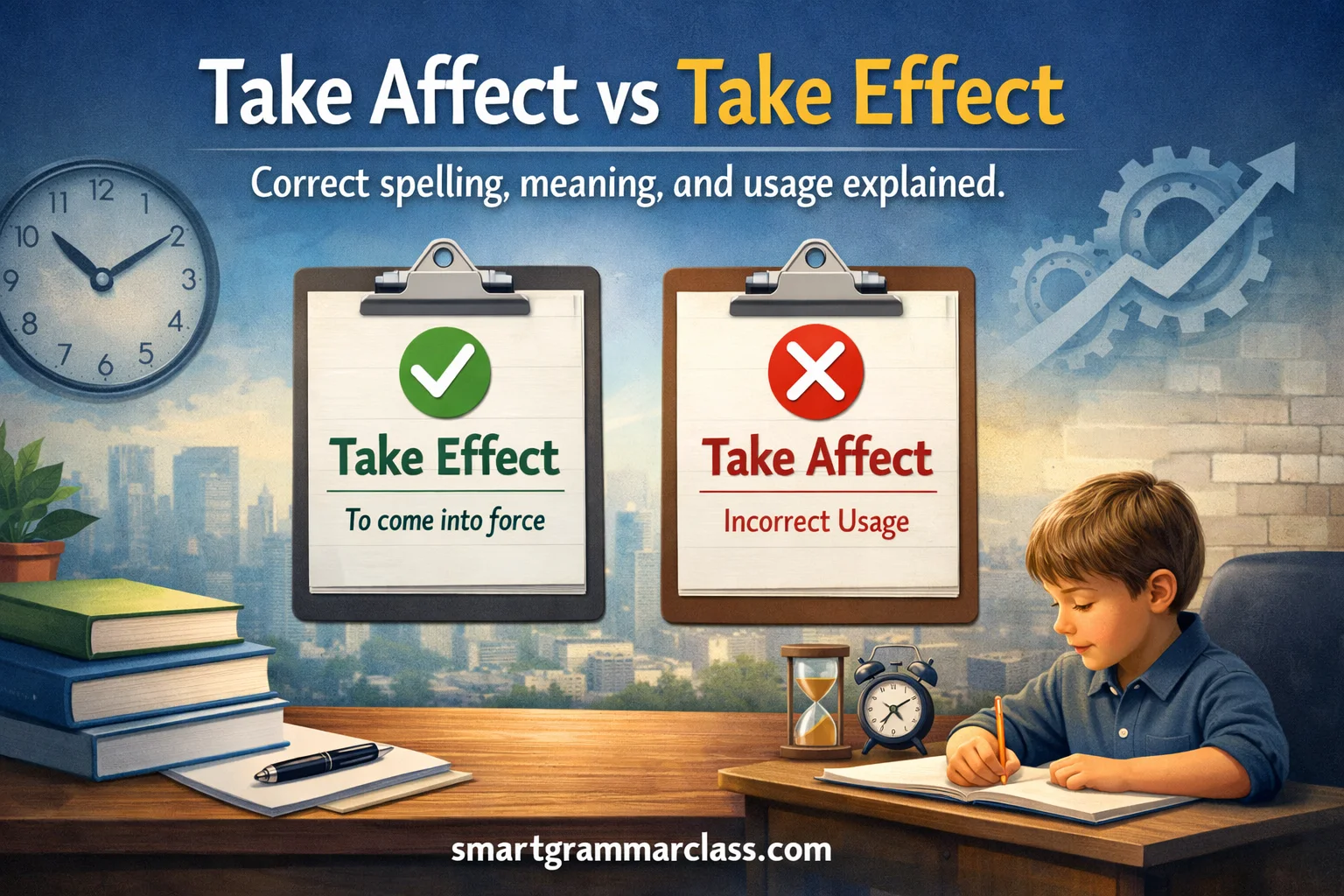
When I first started editing emails, reports, and even content for a company website, I noticed how often people mix up take affect and take effect—it’s one of those commonly confused phrases in the English language that even native English speakers struggle with. The correct spelling matters because each phrase has a totally different meaning and usage. Take effect is the correct phrase when something becomes operational, active, or starts to produce results, like a policy starting next month or a new law beginning tomorrow.
On the other hand, take affect is usually an incorrect phrase, often just a typo or a mistake, though in rare cases in casual writing, “affect” can be used as a verb meaning to influence. Knowing this difference improves clarity, avoids awkward rewrites, and builds confident, professional writing.
From my experience working with students, writers, and professionals, the simplest way to stop this mix-up is to remember that “effect” is usually a noun (a result), while “affect” is a verb (to influence). This small trick helps when you’re stuck, second guessing, or trying to avoid common errors during editing and proofreading.
Whether you’re writing emails, posts, or academic content, understanding these tricky phrases helps you convey different meanings with clarity in writing. This quick guide is designed to make language learning easier, especially for foreign language learners, by using simple examples, easy tips, and real-life usage rules. Over time, mastering such confusing words improves your grammar, strengthens your vocabulary, and makes your communication more precise, whether for everyday usage or academic writing.
Also read this : Unfazed vs. Unphased: The Complete Guide to Avoid Mistakes
Quick Answer — Take Affect or Take Effect?
Let’s cut straight to it.
- ✅ Correct: Take effect
- ❌ Incorrect: Take affect (in almost every situation)
Fast takeaway:
- Use “take effect” when something becomes active or starts working
- Avoid “take affect” unless you’re using affect as a rare psychological noun
If you remember one thing, make it this:
When something starts working, it always takes effect, never “takes affect.”
What Does “Take Effect” Mean?
At its core, “take effect” means something begins to operate or becomes active.
Simple. Clean. No confusion.
Break it down:
- Take → to begin
- Effect → a result or outcome
Put them together and you get:
Something begins to produce a result.
Real-world examples that actually make sense:
- The new tax law will take effect on January 1
- Your insurance coverage takes effect immediately after approval
- The medication usually takes effect within 20 minutes
- The software update will take effect after you restart your device
Notice the pattern? Every time, something transitions from inactive to active.
Why “Take Affect” Sounds Right (But Isn’t)
Here’s where things get tricky.
The confusion between affect vs effect has tripped people up for decades. The words sound almost identical in everyday speech. That’s the trap.
The real difference:
- Affect (verb): to influence something
- Effect (noun): the result of that influence
Think of it like this:
- Rain affects your plans
- The effect is that you stay home
Now ask yourself:
Does “take affect” logically make sense?
Not really.
You can’t “take influence.” But you can “take effect” because results can begin.
Can “Take Affect” Ever Be Correct? (Technically Yes, Practically No)
Let’s be precise.
There is a version of “affect” that functions as a noun. It appears in psychology.
Example:
- The patient showed a flat affect
In this context, “affect” refers to emotional expression.
So could “take affect” ever work?
In theory, maybe. In reality, no one uses it that way.
Why it fails in normal writing:
- It doesn’t fit natural sentence structure
- It sounds awkward to native speakers
- It creates confusion instead of clarity
Bottom line:
If you write “take affect,” readers will assume it’s a mistake. Because it almost always is.
Real-World Usage — Where “Take Effect” Shows Up Most
This phrase isn’t just grammar trivia. It shows up in places where precision matters.
Common contexts:
- Legal documents
- Government policies
- Employment contracts
- Medical instructions
- Technology updates
Why it matters in these fields:
A single word can change meaning. Or worse, damage credibility.
Case Study: Policy Confusion
A regional company once sent this email:
“The new benefits plan will take affect next quarter.”
Employees responded with questions. Some thought it was a typo. Others weren’t sure if the policy was finalized.
A small mistake created uncertainty.
After correction:
“The new benefits plan will take effect next quarter.”
Clarity restored. Confidence returned.
Common Mistakes People Keep Making
Even experienced writers slip up here.
Most frequent errors:
- Using affect when they mean effect
- Assuming both spellings are interchangeable
- Relying on spellcheck instead of understanding meaning
Quick corrections:
- ❌ The changes will take affect soon
- ✅ The changes will take effect soon
- ❌ The rule takes affect tomorrow
- ✅ The rule takes effect tomorrow
Why these mistakes persist:
- Pronunciation similarity
- Lack of grammar fundamentals
- Habitual misuse
British vs American English — Any Difference?
Some grammar rules vary between regions. This one doesn’t.
Clear answer:
- 🇺🇸 American English → take effect
- 🇬🇧 British English → take effect
No variation. No exceptions.
What this means for you:
You don’t need to adjust based on audience location.
“Take effect” is universally correct.
Data Insight — What People Actually Search
Search behavior tells an interesting story.
Thousands of users type “take affect vs take effect” into search engines every month.
That alone shows how widespread the confusion is.
Key observations:
- “Take affect” appears frequently in search queries
- Most users are actively trying to correct themselves
- Grammar-related searches have grown steadily since 2020
Why this matters for writers:
If people are searching for it, they’re noticing it.
That means mistakes stand out more than ever.
Easy Trick to Never Mix Them Up Again
You don’t need complex grammar rules. Just use a simple mental shortcut.
The “Result Test”:
Ask yourself:
Is this about something starting to produce a result?
If yes → use effect
Memory hack:
- Effect = End result
- Both start with “E”
Example:
- The new system takes effect → it starts producing results
Quick. Reliable. Foolproof.
Advanced Breakdown — Affect vs Effect in Detail
If you want deeper clarity, this section nails it.
Core differences:
| Word | Part of Speech | Meaning | Example |
| Affect | Verb | To influence | The weather affects traffic |
| Effect | Noun | A result or outcome | The effect was immediate |
Less common uses:
| Word | Rare Usage | Example |
| Affect | Noun (psychology) | Flat affect in patients |
| Effect | Verb | To bring about change |
Example of “effect” as a verb:
- The manager will effect changes in policy
Even here, notice something.
You still wouldn’t say “take affect.”
Practical Examples You Can Use Immediately
Let’s make this stick with real sentences.
Business writing:
- The agreement will take effect upon signature
- Pricing changes take effect next billing cycle
Healthcare:
- This medication should take effect within one hour
Technology:
- The update will take effect after installation
Daily conversation:
- The new rules take effect tomorrow
Short. Natural. Correct every time.
Why This Small Detail Matters More Than You Think
It’s easy to brush this off as minor. It’s not.
Here’s what’s really at stake:
- Credibility: Mistakes make writing look careless
- Clarity: Wrong wording creates confusion
- Professionalism: Details signal expertise
Think of it like this:
Using “take affect” in a formal document is like wearing mismatched shoes to a meeting.
People notice.
Quick Reference Table — Take Affect vs Take Effect
| Phrase | Correct? | Meaning | Usage Frequency |
| Take effect | ✅ Yes | Becomes active or operational | Very common |
| Take affect | ❌ No | Incorrect in standard usage | Extremely rare |
A Simple Checklist Before You Write
Before you hit publish or send that email, run through this quick check.
- Are you describing something starting or activating?
- Does the sentence refer to a result?
- Would “result” fit in place of the word?
If yes, you already know the answer.
Use effect.
FAQs
What is the difference between take affect and take effect?
Take effect is the correct phrase and means something becomes active or starts to produce results, like a policy or new law. Take affect is usually an incorrect phrase and often just a mistake or typo.
Why do people confuse take affect and take effect?
These are commonly confused phrases because of their similar spelling and pronunciation. Even native English speakers and foreign language learners mix them up, especially in everyday usage and quick writing.
Is take affect ever correct in the English language?
In very rare cases, “affect” can be used as a verb meaning to influence, but “take affect” is still generally considered incorrect. For clear and professional writing, always use take effect.
How can I remember the correct usage easily?
A simple tip is to link “effect” with a result (a noun) and “affect” with influence (a verb). This trick helps avoid second guessing and improves clarity in writing.
Where should I use take effect in writing?
You should use take effect in emails, reports, academic writing, and official documents like a contract or company website content. It ensures clear writing, better communication, and fewer common errors during editing and proofreading.
Conclusion
In the end, understanding the difference between take affect and take effect is essential for correct spelling, clear meaning, and proper usage in the English language. While take affect is mostly an incorrect phrase, take effect is the right phrase used in professional writing, academic writing, and everyday usage when something becomes active or starts to produce results. By following this simple guide, using easy tips, and practicing regularly, you can avoid common errors, improve your grammar and vocabulary, and write with more clarity, confidence, and accuracy in all forms of communication.

Mia Rose is a dedicated grammar expert and language educator committed to helping learners master English with clarity and confidence. With extensive experience in teaching grammar, writing, and communication skills, she specializes in turning complex language rules into simple, easy-to-understand lessons.
At Smart Grammar Class, Mia creates accurate, well-researched, and practical content tailored for students, professionals, and everyday learners. Her teaching style focuses on real-world examples and clear explanations, enabling readers to confidently apply grammar rules in both writing and speaking.
Mia is committed to maintaining high editorial standards, ensuring every piece of content is reliable, up-to-date, and aligned with modern English usage. Her mission is to make grammar accessible, engaging, and useful for learners at all levels.