Have you ever wondered which one looks right when you’re alone and writing—time flies or time flys? It’s one of those common spelling mistakes in english that people don’t always care about until they start writing more correctly for school, work, or social media. I remember typing a quick message once and feeling that small confusion—it took just a few seconds, but I had already typed it without thinking.
In a text or email, that tiny pause where you paused and thought “wait” can create a tiny moment of doubt, but it actually matters. The correct version simply sounds more natural and polished, while the wrong one quietly signals a mistake. The good news is, once you understand it properly, you won’t hesitate again before sending a message or writing a report.
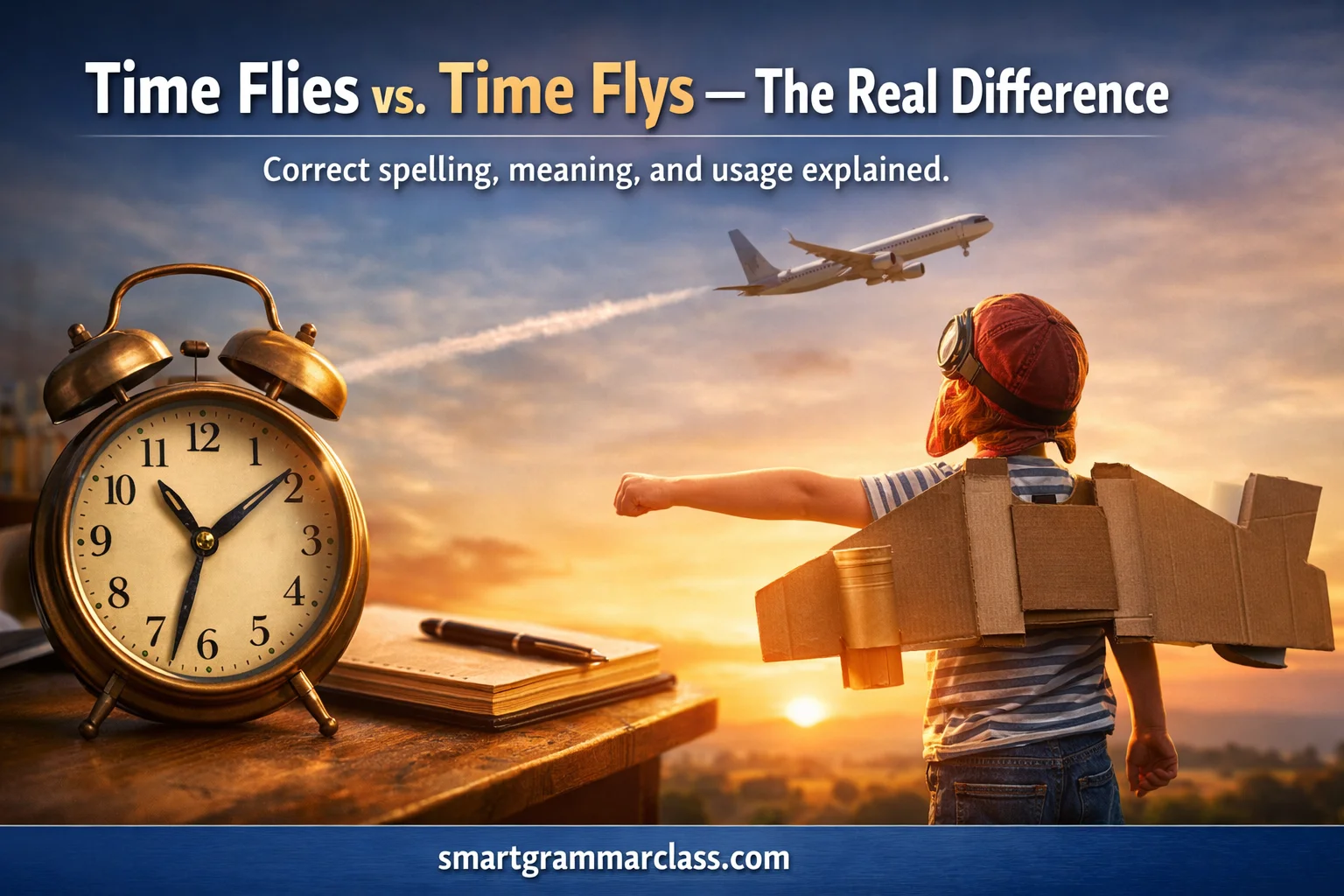
The correct phrase is “time flies,” an idiom whose meaning is that time passes quickly. Here, “flies” is a third-person singular verb, a word often used when you’re having fun or deeply engaged. The language we use presents small pitfalls, and this is one of those everyday usage issues where expressions can be tricky.
There is no exception here—it is commonly correct, even though people sometimes write it incorrectly due to habit. The proper form connects to a familiar sensation: time seems to pass faster when you’re engaged in activities you love or caught up in life’s busier moments. This saying captures a universal feeling succinctly. The confusion may arise because it comes down to spelling rules—if you usually want to make a noun plural, you simply add “s” at the end, but here it’s a verb, not what it’s supposed to look like at first glance.
The short answer is no, “flys” isn’t correct unless you’re talking about something very specific like a rare form, not the common winged insect or this phrase. “Flies” is the spelled modern standard, and this error is exactly what this article aims to explain with simple examples you can actually use.
Also read this : Good Morning vs Goodmorning: What’s Correct and Why It Matters
Why “Time Flies” vs. “Time Flys” Confuses So Many People
English has a habit of playing tricks. Words that sound right don’t always look right. Spelling rules shift just enough to trip you up.
Now add speed typing, autocorrect, and casual writing into the mix. It’s no surprise people second-guess themselves.
Here’s where the confusion usually starts:
- The word “fly” feels simple
- Adding an “s” seems logical → flys
- But English doesn’t always follow intuition
Instead, it follows patterns. And once you see the pattern, everything clicks.
The Short Answer (No Fluff)
Let’s settle it immediately:
- ✅ “Time flies” is correct
- ❌ “Time flys” is incorrect
That’s it.
But stopping there won’t help you avoid future mistakes. So let’s dig into why this is true.
What Does “Time Flies” Mean?
“Time flies” isn’t just a sentence. It’s an idiom—a phrase that carries meaning beyond its literal words.
Simple Meaning
It means:
Time passes quickly, often faster than expected.
You’re not saying time literally has wings. You’re describing a feeling.
Real-Life Examples
- “I can’t believe it’s already December. Time flies.”
- “Time flies when you’re enjoying yourself.”
- “We just met last year—time really flies.”
Each sentence shares the same idea. Time moves faster than you realize.
A Quick Analogy
Think of holding sand in your hand.
At first, it feels like you have plenty. Then suddenly, it’s gone. That’s how “time flies” feels in real life.
Why “Time Flys” Is Wrong (But Still Common)
Now let’s address the mistake directly.
“Time flys” looks like it should work. But it doesn’t.
Here’s the problem
The word “flys” is not the correct form of the verb “fly” in this case.
Instead, English requires:
- Fly → flies
So the correct sentence becomes:
- “Time flies”
Why Do People Still Write “Time Flys”?
A few reasons:
- They assume adding “s” works for all verbs
- They don’t remember the -y to -ies rule
- They rely on how the word sounds instead of how it’s spelled
It’s a classic example of instinct clashing with grammar.
The Grammar Rule You Actually Need
This is where things finally make sense.
The Core Rule
When a verb ends in consonant + “y”, you:
- Drop the “y”
- Add “ies”
Examples That Make It Click
| Base Verb | Correct Form | Incorrect Form |
| Fly | Flies | Flys ❌ |
| Try | Tries | Trys ❌ |
| Cry | Cries | Crys ❌ |
But There’s a Twist
If the verb ends in a vowel + “y”, you simply add “s”.
| Base Verb | Correct Form |
| Play | Plays |
| Stay | Stays |
| Enjoy | Enjoys |
Why This Matters
Understanding this one rule eliminates dozens of common spelling errors. Not just “time flies.”
You stop guessing. You start knowing.
Quick Comparison: Time Flies vs. Time Flys
Sometimes, a simple visual comparison works best.
| Phrase | Correct? | Explanation |
| Time flies | ✅ Yes | Correct verb form of “fly” |
| Time flys | ❌ No | Misspelling of “flies” |
If you remember nothing else, remember this table.
Common Situations Where This Mistake Happens
Even strong writers slip here. Not because they don’t know better—but because they’re moving fast.
Where you’ll see it most
- Social media captions
- Text messages
- Emails written in a rush
- Comments and online posts
Why it slips through
- Spellcheck sometimes misses context
- Autocorrect doesn’t always fix it
- People trust instinct over rules
A Quick Reality Check
Small grammar mistakes can change perception.
In casual texting? No big deal.
In professional writing? It matters.
Easy Memory Tricks That Actually Work
Let’s make this stick so you don’t forget.
Trick One: Match the Sound Pattern
If it sounds like:
- “tries”
- “cries”
Then it’s:
- “flies”
Trick Two: Visual Association
Imagine time as a bird.
Birds don’t “flys.” They fly → flies.
That image helps your brain lock the correct form instantly.
Trick Three: Replace the Word
Swap “time” with “he”:
- “He flies” ✅
- “He flys” ❌
If it works for “he,” it works for “time.”
Real Examples in Everyday Writing
Let’s put this into real context.
Correct Usage
- “Time flies when you’re busy.”
- “It feels like we just started—time flies.”
- “Time flies during the holidays.”
Incorrect Usage
- “Time flys when you’re distracted.” ❌
- “Wow, time flys so fast.” ❌
Side-by-Side Comparison
| Incorrect Sentence | Correct Sentence |
| Time flys when you’re working | Time flies when you’re working |
| Time flys so quickly | Time flies so quickly |
Seeing both versions makes the difference obvious.
Case Study: How One Small Error Changes Perception
Imagine two job applicants.
Applicant A writes:
“Time flies when you’re managing multiple projects.”
Applicant B writes:
“Time flys when you’re managing multiple projects.”
Same idea. Same sentence structure.
But here’s what happens subconsciously:
- Applicant A feels polished and detail-oriented
- Applicant B feels careless or rushed
That’s the power of one letter.
Related Mistakes You Might Also Be Making
“Time flies vs. time flys” isn’t the only trap.
Here are a few similar ones:
Common Errors
| Incorrect | Correct |
| Trys | Tries |
| Crys | Cries |
| Flys | Flies |
| Frys | Fries |
Why These Matter
They all follow the same rule.
Once you master one, you fix all of them.
Deep Dive: Why English Uses “-ies” Instead of “-ys”
This isn’t random. It’s about pronunciation and readability.
Without the Rule
Words like “flys” would feel awkward to read.
With the Rule
“Flies” flows naturally. It matches how we speak.
English evolved to make reading smoother—even if it feels inconsistent at times.
When “Flys” Might Appear (Rare Cases)
To be precise, “flys” can exist—but not in the way most people use it.
Rare Usage Example
- As a proper noun (a name or brand)
- In very old or non-standard writing
Important Takeaway
In modern, correct English:
You should never use “time flys.”
FAQs
Is “time flys” ever correct in English?
No, “time flys” is not correct in standard english. The correct form is “time flies,” because “flies” is the proper third-person singular verb form of “fly.” Using “flys” is a common spelling mistake and may signal a mistake in formal writing like a report, email, or school work.
Why do people confuse “flies” and “flys”?
This confusion usually happens because people think they need to make a noun plural and just add an “s” at the end. But here, the word is a verb, not a noun. The issue can arise quickly when you’ve typed something without thinking, especially in social media or a fast text message.
What does the phrase “time flies” actually mean?
“Time flies” is an idiom whose meaning is that time passes quickly, especially when you’re having fun or are deeply engaged in activities you love. It captures a universal feeling that most people have experienced during life’s busy or happy moments.
How can I remember the correct version easily?
A quick guide is to remember that “time” is singular, so it needs a third-person singular verb—“flies.” If you ever pause and wondered which one looks right, take a tiny moment to check. With practice, the correct version will sound more natural and polished to you.
Does using the wrong spelling really matter?
Yes, it matters, especially in formal writing for work or school. Even though it may seem like a small error, it can create doubt about your attention to detail. The good news is that once you understand the difference and use it properly, you won’t hesitate when writing any message or content again.
Conclusion
In the end, the difference between time flies and time flys comes down to simple english spelling and understanding how a third-person singular verb works. While it’s a common mistake many people make when writing quickly, especially in a text or social media, using the correct phrase helps your content feel more natural and polished. Once you truly understand the meaning of the idiom—that time passes quickly when you’re enjoying life’s moments—you’ll use it properly without a second thought.

mma Rose is a skilled grammar expert and language educator dedicated to helping learners improve their English with clarity and confidence. With extensive experience in teaching grammar, writing, and communication, she specializes in simplifying complex language rules into easy, practical explanations.
At Smart Grammar Class, Emma creates well-researched, accurate, and user-friendly content designed for students, professionals, and everyday learners. Her teaching approach focuses on real-life examples, clear structure, and actionable guidance, enabling readers to apply grammar rules effectively in both writing and speaking.
Emma is committed to maintaining high editorial standards, ensuring every article is trustworthy, up-to-date, and aligned with modern English usage. Her goal is to make grammar simple, accessible, and useful for everyone.