Many writers, students, and professionals get confused because unfazed and unphased sound different but still cause a common mix-up in emails, social media, and even formal writing. I’ve personally paused, mid-sentence, wondering about the right spelling choice, and that moment of doubt can make your text feel unclear or even unprofessional.
The truth is simple: unfazed is the correct and recognized word in standard English, while unphased is just a misspelling often arranged from confusion with phases or scientific contexts. In simple terms, using the wrong word in your blog or message can break your flow and make you second-guess your writing, even when your idea is strong.
To clarify the difference, unfazed is used to describe someone who is undisturbed, unconcerned, and calm in an unexpected situation, facing adversity, criticism, or challenges without being worried, upset, or affected by stress or surprise. It shows a state of calmness, where a person can remain composed even in chaos and continued their work without being altered or changed emotionally.
This correct usage is key in everyday language, helping you communicate your reaction clearly and confidently. With clear examples and a bit of learning, this small common mistake becomes easy to fix, giving you more practical control over your words and making your writing feel natural, strong, and precise without ever feeling unsure again.
Also read this : Spicy or Spicey – The Correct Spelling
Unfazed vs Unphased – Quick Answer You Can Trust
Let’s get straight to it.
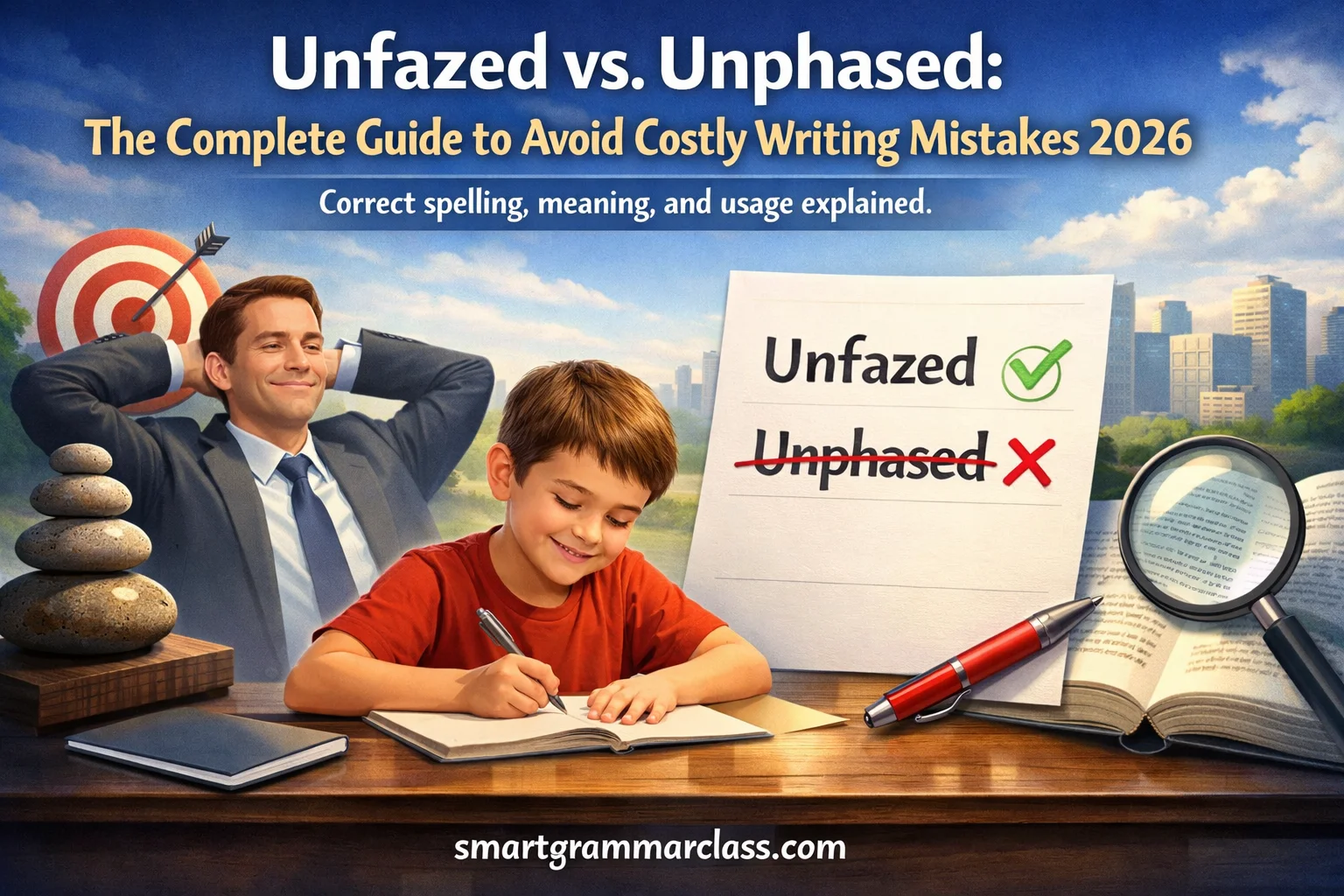
- ✅ Unfazed = correct in everyday writing
- ❌ Unphased = usually incorrect
Definition:
Unfazed means not disturbed, not worried, or not affected. (Cambridge Dictionary)
Quick Example
- ✅ She remained unfazed during the interview.
- ❌ She remained unphased during the interview.
If you’re talking about emotions, reactions, or staying calm under pressure, unfazed is always your word.
Why People Confuse Unfazed and Unphased
Here’s where things get interesting.
These two words sound exactly the same. Linguists call this a homophone problem—words that sound identical but mean different things. (Writing Explained)
But that’s only part of the story.
The Real Reasons Behind the Confusion
- “Phase” is far more common than “faze”
- Most people rarely see “faze” used alone
- Spell-check often misses the error
- Your brain defaults to familiar spelling
Think about it like this:
Your ears hear “unfazed.”
Your brain writes “unphased.”
That mismatch causes the mistake.
A Simple Analogy
It’s like confusing:
- Brake vs Break
- Their vs There
They sound the same. They aren’t interchangeable.
What Does Unfazed Mean (With Real-Life Context)
Let’s dig deeper.
Unfazed comes from the verb faze, which means to disturb or unsettle someone. (Merriam-Webster)
So when someone is unfazed, they stay calm. Nothing rattles them.
Core Meaning
- Calm under pressure
- Not emotionally affected
- Mentally composed
Real-Life Examples You’ll Recognize
- A CEO handling a crisis without panic
- A student staying calm during exams
- An athlete ignoring a loud crowd
Example sentences:
- He stayed unfazed despite the criticism.
- She looked completely unfazed after the mistake.
Notice the pattern?
It’s always about emotional control.
What Does Unphased Mean (Rare but Technically Real)
Now here’s the twist.
Unphased isn’t completely fake—it’s just rare and misunderstood.
It relates to the word phase, which refers to a stage in a process. (Merriam-Webster)
Actual Meaning of “Unphased”
- Not divided into stages
- Done all at once instead of gradually
Where You Might See It
- Engineering documents
- Scientific writing
- Project planning discussions
Example (Technical Use Only)
- The rollout was unphased, meaning it happened all at once.
That’s it.
In everyday writing? You almost never need this word.
Unfazed vs Unphased – Side-by-Side Comparison
Here’s where clarity clicks.
| Feature | Unfazed | Unphased |
| Correct for daily writing | ✅ Yes | ❌ No |
| Meaning | Not disturbed or worried | Not done in stages |
| Usage frequency | Very common | Extremely rare |
| Context | Emotions, reactions | Technical processes |
Bottom Line
If you’re writing for humans—not engineers—use unfazed.
Faze vs Phase: The Root of the Problem
To truly master this, you need to understand the root words.
Faze
- Meaning: to disturb or unsettle (Encyclopedia Britannica)
- Used emotionally
- Usually appears in phrases like:
- “It didn’t faze me”
- “Nothing fazes her”
Phase
- Meaning: a stage or step in a process (Merriam-Webster)
- Used in structured progression
- Common phrases:
- “Phase one”
- “Phase out”
- “Phase in”
Memory Trick You’ll Never Forget
Here’s a simple rule that works every time:
Faze = Feelings
Phase = Process
If emotions are involved, choose unfazed.
If stages or steps are involved, choose phase.
Common Mistakes That Make Your Writing Look Unpolished
Even experienced writers slip up here.
Let’s fix that.
Mistake #1: Using “Unphased” in Daily Writing
- ❌ I was unphased by the situation
- ✅ I was unfazed by the situation
Mistake #2: Confusing “Unfazed” with “Unimpressed”
They’re not identical.
- Unfazed = not emotionally affected
- Unimpressed = not impressed or not interested
Example:
- He was unfazed by the criticism
- He was unimpressed by the movie
Subtle difference. Big impact.
Mistake #3: Assuming Both Words Are Interchangeable
They’re not.
This isn’t like “color vs colour.”
There’s no regional variation here.
Real-World Examples That Actually Make Sense
Let’s make this practical.
Workplace Examples
- She stayed unfazed during the high-pressure meeting
- He remained unfazed despite tight deadlines
Social Situations
- She was unfazed by online criticism
- He stayed unfazed after the awkward moment
Sports Context
- The team looked unfazed under pressure
- The rookie stayed unfazed in his debut
You’ll notice something:
The word always connects to resilience.
Synonyms That Add Variety to Your Writing
Repeating “unfazed” too often can feel flat.
Mix it up.
Better Alternatives
- Unbothered
- Composed
- Unflappable
- Undaunted
- Calm under pressure
Example Upgrade
Instead of:
She remained unfazed.
Try:
She stayed calm and unflappable.
It reads smoother. Sounds more human.
Is This a British vs American English Issue?
Short answer: No.
Both US and UK English use:
- ✅ Unfazed
There’s no regional spelling difference here.
Important Insight
“Unphased” isn’t a British variant.
It’s simply a common mistake.
Usage Trends and Why This Keyword Matters
Here’s something most guides miss.
The confusion between unfazed and unphased is a high-search-intent keyword.
Why?
- People hear the word more than they see it
- They search to confirm spelling
- Many repeat the mistake online
What That Means for Writers
- Using unfazed correctly boosts credibility
- Using unphased damages trust instantly
It’s a small detail. It signals big things.
Quick Memory Hacks That Actually Stick
Let’s lock this in.
Hack #1: Feelings vs Process
- Emotional → Unfazed
- Step-by-step → Phase
Hack #2: Replace the Word
Try swapping in “calm.”
If the sentence still works, use unfazed.
Hack #3: Visual Trick
Picture chaos around you.
You stand still. Calm. Unshaken.
You are unfazed.
Case Study: How One Word Changes Perception
Let’s look at a real-world scenario.
Scenario: Job Application Email
Version 1 (Incorrect):
I remained unphased under pressure.
Version 2 (Correct):
I remained unfazed under pressure.
What Changes?
- Version 1 → signals poor attention to detail
- Version 2 → sounds polished and confident
That one letter—ph vs f—changes how people judge you.
FAQS
What is the difference between unfazed and unphased?
The difference is simple: unfazed is the correct and recognized word in standard English, while unphased is a misspelling. Even though they have similar sounds, they have distinct meanings, and only one is accepted in proper writing.
Why do people get confused between these words?
People get confused because the words sound different but close enough to create a mix-up, especially in emails, social media, and formal writing. The connection to phases in scientific contexts also adds to the spelling confusion.
When should I use unfazed in a sentence?
You should use unfazed to describe someone who is calm, unconcerned, or unaffected in an unexpected situation, like facing criticism, stress, or challenges without feeling worried or upset.
Is using the wrong word really a big problem?
Yes, using the wrong word can make your text look unprofessional and unclear, especially in a blog or professional message. It may cause readers to second-guess your skills and reduce the impact of your clear examples or ideas.
How can I avoid this common mistake in the future?
The best way is through learning and practice. Remember that unfazed means staying composed and showing calmness during adversity or surprise, and always double-check your spelling choice if you feel unsure while writing.
Conclusion
In the end, understanding unfazed vs unphased helps you avoid a very common but costly writing mistake that can make your work look unprofessional and unclear. The key difference is easy to remember: unfazed is the correct and recognized word in standard English, used to describe someone who stays calm, unconcerned, and unaffected even in stress, criticism, or unexpected situations, while unphased is simply a misspelling. Once you clarify this and practice using the correct usage in your blog, emails, or formal writing, you’ll write more confidently, avoid confusion, and communicate your ideas with clarity and precision.

Mia Rose is a dedicated grammar expert and language educator committed to helping learners master English with clarity and confidence. With extensive experience in teaching grammar, writing, and communication skills, she specializes in turning complex language rules into simple, easy-to-understand lessons.
At Smart Grammar Class, Mia creates accurate, well-researched, and practical content tailored for students, professionals, and everyday learners. Her teaching style focuses on real-world examples and clear explanations, enabling readers to confidently apply grammar rules in both writing and speaking.
Mia is committed to maintaining high editorial standards, ensuring every piece of content is reliable, up-to-date, and aligned with modern English usage. Her mission is to make grammar accessible, engaging, and useful for learners at all levels.