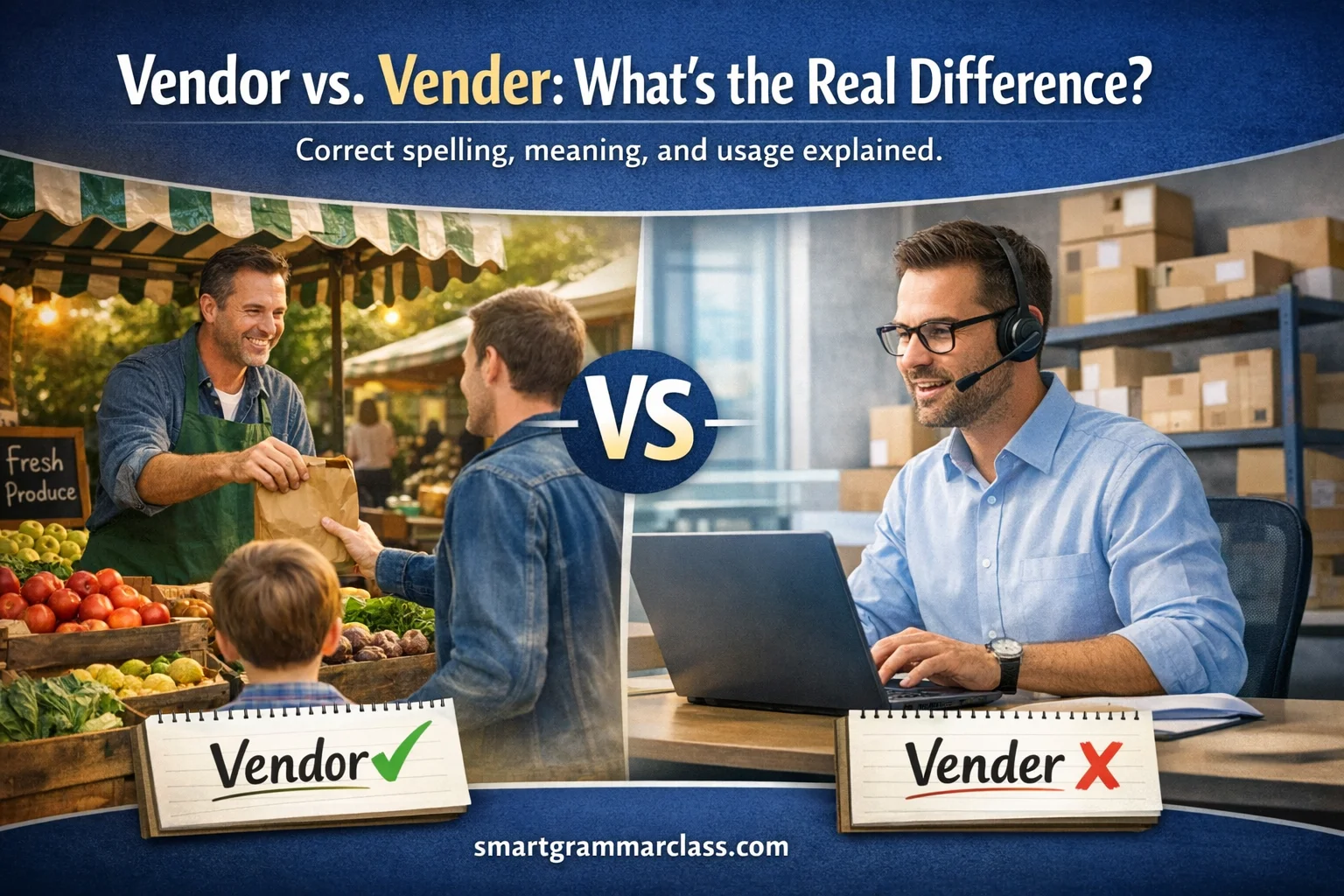
In simple terms, the difference between vendor and vender is mostly about spelling and usage, but it often confuses writers, students, and even professionals. I’ve seen this many times while reviewing business emails and online content, where one small letter changes the tone of professional writing. The standard and widely accepted form is vendor, which refers to a person or company that sells goods or services.
This is the preferred choice in formal English, especially in legal contexts, documents, and essays. On the other hand, vender is an accepted alternative, but it is less common and often seen as a misspelling in modern language, unless used in proper names, foreign languages, or styles like the New Yorker house style that some writers try to emulate.
From my experience while reading and sending professional documents, I’ve noticed that this small difference can make people paused, wondering if something is wrong, even when the words are technically interchangeable in some situations. The truth is that vendor is the correct and widely accepted term in most business and general readers contexts, while vender has a more rare, almost historical meaning with slight differences in usage.
Many learners and even native speakers make mistakes by using vender in a sentence where vendor fits better, especially when typed quickly and the words look identical at a glance, creating confusion. This guide explains the ratio of usage and helps you understand when each type is acceptable, so you can write more accurate, clear, and polished content about anything related to selling without feeling incorrect, and handle such choices confidently as a beginner or expert.
Also read this : Natzi or Nazi: Correct Spelling, Meaning and Proper Usage
Quick Answer: Vendor vs. Vender
Here’s the truth without any fluff:
- “Vendor” is the correct, modern, and widely accepted spelling
- “Vender” exists but is rare and considered outdated in most contexts
- In professional writing, always use vendor
Simple. But the “why” behind it matters more than the rule itself.
Why People Confuse Vendor and Vender
This confusion didn’t come out of nowhere. English has a habit of bending rules, then quietly breaking them.
Here’s what causes the mix-up:
- Pattern recognition: Words like sender, lender, and tender follow a similar structure. So naturally, people assume vender fits the pattern.
- Historical overlap: Both spellings appeared in older English texts.
- Autocorrect issues: Some tools don’t flag “vender” as incorrect.
- Global variations: Certain regions held onto older spellings longer.
Now add fast typing and tight deadlines. Mistakes happen.
However, modern English has clearly settled on one winner.
What Does “Vendor” Mean Today?
Let’s break it down in plain terms.
A vendor is anyone who sells goods or services. That’s the core definition. But in real life, it goes deeper depending on the context.
Common meanings of “vendor”:
- A person selling items at a market
- A company supplying products to another business
- A service provider in a contract agreement
- A seller on an online platform
Where you’ll see “vendor” used daily:
- Business contracts
- Procurement departments
- E-commerce platforms
- Real estate transactions
- Tech and SaaS agreements
Example sentences:
- “We selected a new vendor for office supplies.”
- “The vendor failed to meet delivery deadlines.”
- “Top-rated vendors get more visibility online.”
Notice how natural it sounds. That’s because it’s the standard.
Why “Vendor” Dominates Modern English
Language evolves based on usage, not rules alone.
Over time, “vendor” became dominant for three key reasons:
Consistency Across Industries
Businesses rely on clear communication. “Vendor” became the default in contracts, policies, and legal documents.
Dictionary Standardization
Major dictionaries list vendor as the primary spelling. “Vender” often appears as a secondary or archaic form.
Global Adoption
From the US to Europe to Asia, companies use vendor. That consistency matters in global business.
What About “Vender”? Does It Mean Anything?
Yes. But not in the way most people expect.
“Vender” is technically valid
It comes from the same root word as “vendor.” Historically, both were used to describe someone who sells something.
So why don’t we use it anymore?
Because language favors clarity over tradition.
Where “vender” still appears:
- Older literature
- Historical documents
- Rare dictionary entries
- Occasional regional usage
Why it’s risky to use today:
- It looks like a typo
- It can confuse readers
- It weakens professional credibility
In short, it’s not wrong. It’s just not right for modern use.
Vendor vs. Vender: Side-by-Side Comparison
Here’s a clear breakdown so you never second-guess again.
| Feature | Vendor | Vender |
| Modern Usage | Widely accepted | Rare and outdated |
| Professional Use | Standard across industries | Not recommended |
| Dictionary Status | Primary spelling | Secondary or archaic |
| Business Context | Common | Almost never used |
| Reader Perception | Clear and correct | Confusing or incorrect-looking |
One glance at this table tells you everything you need to know.
Which One Should You Use? (Simple Rule)
Let’s make this easy.
👉 Always use “vendor.”
That rule covers 99.9% of situations.
When might “vender” be acceptable?
Only in very specific cases:
- Quoting historical texts
- Writing academic content about language evolution
- Referencing original spellings in literature
Outside of that, skip it.
Why Using the Wrong Spelling Can Hurt You
This isn’t just about grammar. It affects perception.
In professional settings:
Using “vender” can:
- Make your writing look careless
- Reduce trust in your expertise
- Create confusion in contracts or documents
Real-world example:
Imagine sending this email:
“We are reviewing new venders for the project.”
It instantly feels off. Even if the reader understands your meaning, the credibility takes a hit.
Now compare it with:
“We are reviewing new vendors for the project.”
Clean. Clear. Professional.
That’s the difference one letter makes.
Real-Life Examples You See Every Day
Let’s bring this into real-world context.
Business Example
A company evaluates multiple vendors before signing a supply agreement.
E-commerce Example
Platforms like marketplaces rely on thousands of vendors selling products.
Event Planning Example
Organizers coordinate with food vendors, decorators, and service providers.
Incorrect Usage Example
“Top venders near me” — looks untrustworthy and poorly written.
Case Study: How One Word Impacts Business Communication
A mid-sized company prepared a proposal for an international client. Everything looked solid. Pricing was competitive. Strategy made sense.
There was just one problem.
The document repeatedly used “vender” instead of “vendor.”
What happened next:
- The client questioned the document’s professionalism
- Internal teams flagged inconsistencies
- The proposal lost credibility despite strong content
Lesson learned:
Small language errors can signal bigger issues. Precision matters.
Common Mistakes People Make (And How to Avoid Them)
Even smart writers slip up. Here’s what to watch for.
Mistake #1: Assuming Both Are Interchangeable
They’re not. Only one fits modern usage.
Mistake #2: Trusting Spellcheck Too Much
Not all tools catch outdated words.
Mistake #3: Following Pattern Logic
Just because “sender” works doesn’t mean “vender” does.
Mistake #4: Copying Outdated Content
Some older blogs still use “vender.”
Quick Fix Checklist:
- Always double-check business terms
- Stick with modern dictionary standards
- Read your sentence out loud
- Ask yourself: “Does this look natural?”
A Memory Trick That Actually Works
Here’s a simple way to lock it in.
👉 Vendor = Vending machine
Both relate to selling.
You don’t say “vending machine” with an “e.” So stick with vendor.
It’s quick. It works. You won’t forget it.
Why Spelling Matters More Than You Think
It’s easy to brush this off as a small detail. It’s not.
Spelling impacts:
- Professional credibility
- First impressions
- Search engine rankings
- Academic performance
In SEO terms:
People search for “vendor vs vender” far more than the reverse. Using the correct spelling improves visibility and trust.
In business terms:
Clear language reduces misunderstandings. That saves time and money.
Vendor in Different Industries (Deep Dive)
Let’s go beyond basics. The meaning of “vendor” shifts slightly depending on context.
In Procurement
A vendor supplies goods or services to a company. Relationships are often long-term.
In Real Estate
The vendor is the seller of a property.
In Technology
A vendor provides software, hardware, or services. Think SaaS providers.
In Retail
A vendor sells directly to consumers or through platforms.
Quick Industry Snapshot Table
| Industry | Meaning of Vendor |
| Procurement | Supplier of goods/services |
| Real Estate | Property seller |
| Technology | Software or hardware provider |
| Retail | Product seller |
Understanding context makes your writing sharper.
Mini Learning Section for Students and Beginners
Let’s make this stick with a quick learning block.
One-Sentence Rule
👉 Use vendor, not vender
Practice Exercise
Fill in the blank:
- The company hired a new ______ for IT services.
- We compared prices from multiple ______.
- The event featured local food ______.
Answers:
- vendor
- vendors
- vendors
Spot the Error
Which sentence is wrong?
- “The vendor delivered on time.”
- “The vender delivered on time.”
👉 The second one is incorrect in modern usage.
Advanced Insight: Why Language Chooses Winners
Here’s something interesting.
English doesn’t always follow logic. It follows usage patterns.
What determines the “correct” word?
- Frequency of use
- Industry adoption
- Dictionary recognition
- Global consistency
Over time, one version wins. In this case, vendor took over.
“Vender” didn’t disappear completely. It just faded into the background.
FAQs
What is the main difference between vendor and vender?
The main difference is in usage and preference. Vendor is the standard and widely accepted spelling in modern English, especially in business and professional writing, while vender is much less common and often seen as outdated or a variation.
Is vender ever correct to use?
Yes, vender is not completely wrong. It is an accepted alternative in some dictionaries and may appear in historical texts, certain regional styles, or specific publications, but it is rarely used in everyday writing.
Which spelling should I use in professional documents?
You should use vendor in professional documents, emails, and business communication. It is the safer and more polished choice that avoids confusion and looks more accurate to readers.
Why do people get confused between vendor and vender?
People often get confused because the words look very similar and sound almost identical. When typing quickly or not paying close attention, it is easy to mix them up, especially for learners and even native speakers.
Does using vender instead of vendor affect writing quality?
Yes, it can affect how your writing is perceived. Using vender in place of vendor may make your work seem less polished or even incorrect in formal contexts, so choosing the standard spelling helps maintain clarity and professionalism.
Conclusion
In the end, understanding the difference between vendor and vender helps you avoid common mistakes and write with more confidence. While both words may seem interchangeable, vendor is the standard, correct, and widely accepted term in business, formal English, and everyday writing, whereas vender remains a rare and less common variation. Choosing the right spelling not only improves your accuracy but also makes your content look more professional, clear, and polished to general readers and professionals alike.

mma Rose is a skilled grammar expert and language educator dedicated to helping learners improve their English with clarity and confidence. With extensive experience in teaching grammar, writing, and communication, she specializes in simplifying complex language rules into easy, practical explanations.
At Smart Grammar Class, Emma creates well-researched, accurate, and user-friendly content designed for students, professionals, and everyday learners. Her teaching approach focuses on real-life examples, clear structure, and actionable guidance, enabling readers to apply grammar rules effectively in both writing and speaking.
Emma is committed to maintaining high editorial standards, ensuring every article is trustworthy, up-to-date, and aligned with modern English usage. Her goal is to make grammar simple, accessible, and useful for everyone.