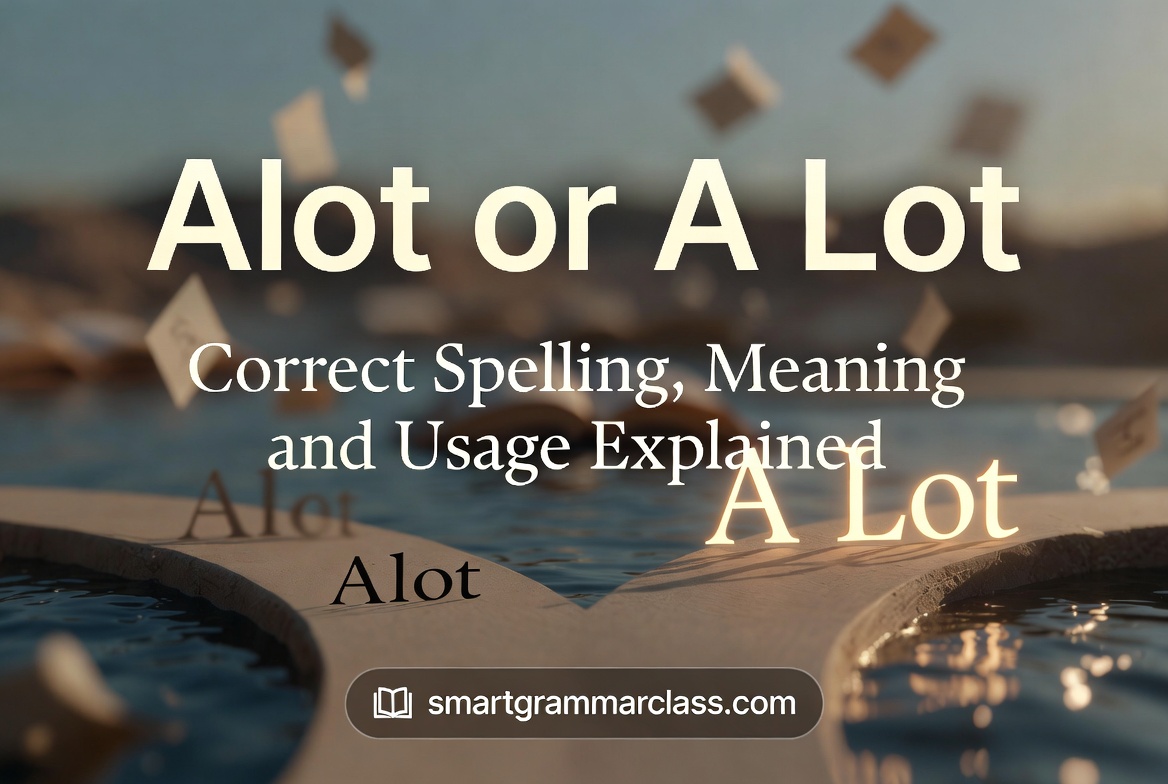
Many writers and students still struggle with the common question of alot vs a lot in English, because these words may sound right but are not always correct. I remember being paused mid sentence, wondering if that tiny phrase was right, and that same confusion still sneaks into emails, assignments, and even social media posts today.
The truth is simple: a lot is the correct spelling, while alot is an incorrectly spelled word often mistakenly used. This guide will clarify the meaning, usage, and spelling, helping you improve your professional writing and avoid embarrassment. Once you grasp the logic, you won’t second guess again, and your clarity in writing will naturally improve.
In the English language, a lot works as a phrase that shows a considerable number, quantity, or amount, and it can act like an adverb meaning a great deal or very much. It is commonly used and recognized as standard in every dictionary, while alot is not even listed as a proper entry. Some confuse it with allot, a different word and a verb meaning to assign or distribute, which shows how commonly confused terms can create errors.
The language is a tricky playground full of idiosyncrasies, but learning the difference helps in differentiating totally different meanings and function. My best tips are to break the phrase into two words, use real examples, and practice until it sticks. Over time, this simple habit will help you write confidently, avoid error, and polish your overall writing with better understanding and fewer common error slips.
Also read this: Peek vs Peak: Meaning Differences, Usage Rules and Examples 2026
Quick Answer: Is It “Alot” or “A Lot”?
Let’s settle this right away.
- “A lot” is correct
- “Alot” is incorrect
- There are no exceptions
That’s it. Simple.
Still, people keep writing “alot” every day. Why? Because it sounds like one word when spoken fast.
Here’s a quick visual guide:
| Form | Correct? | Example |
| A lot | ✅ Yes | I have a lot of work today |
| Alot | ❌ No | I have alot of work |
Think of it like this. If you want your writing to look polished and credible then “a lot” is your only safe choice.
What Does “A Lot” Actually Mean?
At its core, “a lot” means a large amount or a large number.
It works in many situations which makes it flexible but also easy to overuse.
How It Functions
“A lot” acts as a phrase. Not a single word. That matters.
You can use it with:
- Countable nouns
Example: A lot of books - Uncountable nouns
Example: A lot of water
Real Examples
- You have a lot of opportunities ahead
- She spends a lot of time practicing
- They made a lot of progress this year
Notice how natural it sounds. That’s why people rely on it so often.
However, there’s a catch. Overusing it can make your writing feel vague.
Why Do People Write “Alot”?
Here’s where things get interesting.
People don’t write “alot” because they’re careless. They write it because English can be tricky.
The Real Reasons
- Speech blends the words together
When you say “a lot” quickly it sounds like one word - Typing shortcuts take over
Fast typing leads to merged words - Pattern confusion
Words like “already” or “almost” train your brain to expect one word
Compare Similar Confusions
| Incorrect Form | Correct Form |
| Alot | A lot |
| Alright | All right |
| Everyday | Every day |
Here’s a helpful way to think about it.
If the phrase still makes sense when you separate the words then it should stay separated.
The Origin of “A Lot” And Why It Stayed Two Words
Language evolves. Some words merge over time. Others don’t.
“A lot” falls into the second category.
Where It Comes From
The word “lot” originally meant:
- A portion
- A share
- A piece of something
Over time people started using “a lot” to mean “a large portion.”
Why It Never Became “Alot”
Unlike words that fused together naturally “a lot” kept its structure because:
- It still behaves like a phrase
- Each word carries meaning
- It fits standard grammatical patterns
Simple Analogy
Think of these:
- A piece
- A bunch
- A group
You wouldn’t write “apiece” in the same context. The same logic applies here.
British vs American English: Any Difference?
This part is refreshingly simple.
There is no difference.
- US English uses “a lot”
- UK English uses “a lot”
- “Alot” is wrong in both
Quick Comparison Table
| Region | Correct Form |
| United States | A lot |
| United Kingdom | A lot |
| Australia | A lot |
No regional loopholes exist. No exceptions hide in dialects.
If you write “alot” anywhere it will stand out as incorrect.
When You Should Use “A Lot” vs Better Alternatives
Here’s where your writing can level up.
“A lot” works well. Still, it often lacks precision.
Why It Can Be Weak
- It’s vague
- It doesn’t add detail
- It can sound repetitive
Stronger Alternatives
Use these when you want clarity:
- Many → for countable items
- Much → for uncountable items
- Numerous → more formal tone
- Several → more specific
- A great deal → slightly formal
- Plenty → conversational
Example Transformations
| Weak Sentence | Improved Version |
| I have a lot of ideas | I have many ideas |
| She drinks a lot of water | She drinks plenty of water |
| They made a lot of changes | They made several key changes |
Real Writing Upgrade
Instead of saying:
You need a lot of practice
Try:
You need consistent daily practice
See the difference? It feels sharper and more intentional.
Common Mistakes With “A Lot”
Mistakes happen even among experienced writers. Let’s fix the most common ones.
Writing “Alot”
This is the biggest issue.
- Incorrect: I have alot to finish
- Correct: I have a lot to finish
Missing “Of”
People often forget the full phrase.
- Incorrect: A lot people came
- Correct: A lot of people came
Using It as an Adjective
“A lot” is not an adjective.
- Incorrect: He is a lot smarter person
- Better: He is much smarter
Overusing It
Repeating “a lot” weakens your writing.
Bad example:
- I have a lot of work and a lot of ideas and a lot of plans
Better version:
- I have several projects strong ideas and clear plans
Real-Life Examples You Can Copy
Let’s bring this into everyday use.
Casual Conversations
- You’ll learn a lot if you stay curious
- I saved a lot of money this year
- We had a lot of fun last weekend
Professional Writing
- The team gathered a lot of user feedback
- This strategy delivers a lot of value
- We observed a lot of improvement over time
Academic Tone
- The study analyzed a lot of data points
- Researchers collected a lot of evidence
These examples show how flexible the phrase can be. Still, remember to replace it when precision matters.
Memory Trick: Never Miss It Again
You don’t need complex grammar rules. A simple trick works every time.
The Replacement Test
If you can replace “a lot” with:
- A bunch
- A large amount
Then your usage is correct.
Examples
- I ate a bunch of food → I ate a lot of food
- She has a large amount of work → She has a lot of work
If the sentence breaks after replacement then something is off.
“A Lot” in Search Trends and Real Usage (2026 Data)
Even though “alot” is incorrect people still search for it.
What Data Shows
- “A lot” dominates formal writing
- “Alot” appears frequently in search queries
- Grammar tools flag “alot” instantly
Why This Matters
Search behavior reveals real confusion. People want quick answers. They want clarity.
Google Trends Insight
You’ll notice something interesting. “Alot” spikes in searches while “a lot” dominates usage.
That gap tells a story. People know the correct form once they see it.
Case Study: How One Small Mistake Impacts Credibility
Imagine two job applications.
Candidate A
I have alot of experience managing teams
Candidate B
I have a lot of experience managing teams
Same meaning. Different impression.
What Happens
- Recruiters notice small errors instantly
- “Alot” signals weak attention to detail
- Trust drops even if skills are strong
Result
Candidate B looks more polished. More reliable.
One tiny space makes a big difference.
Practical Writing Tips to Avoid This Mistake
Let’s make this permanent.
Use Spell Check
Most tools flag “alot” immediately.
Slow Down While Typing
Fast typing leads to merged words.
Read Out Loud
If it sounds like two words then write it that way.
Build Awareness
Once you notice the mistake you won’t repeat it.
Advanced Insight: Why Simplicity Wins
Good writing feels effortless. It flows.
Using “a lot” correctly is part of that flow. Still, strong writing goes further.
Replace Vagueness With Precision
Instead of:
- A lot of improvement
Try:
- Significant improvement
Replace Repetition With Variety
Mix your vocabulary:
- Many
- Several
- Numerous
- Countless
This keeps your writing engaging.
FAQs
What is the correct spelling: alot or a lot?
The correct spelling is a lot. The word alot is an incorrectly spelled word and is not recognized in any standard dictionary, so it should always be avoided in proper English writing.
Why do people often use alot instead of a lot?
Many people make this common error because the two words in a lot are often pronounced together, making it sound like a single word. This leads to confusion, especially in fast writing like emails or social media posts.
What is the meaning of a lot in a sentence?
The meaning of a lot refers to a great amount, large number, or considerable number of something. It can describe both quantity and amount, and is commonly used in everyday English language.
Is allot the same as alot or a lot?
No, allot is a different word with a different function. It is a verb that means to assign or distribute, and it should not be confused with a lot, which is a phrase used to express quantity.
How can writers and students avoid this common question mistake?
The best way to avoid error is to remember that a lot is always written as two words. Simple tips like double-checking your spelling, practicing with examples, and focusing on clarity will help writers and students write confidently without second guess.
Conclusion
In the end, understanding the difference between alot and a lot is essential for clear and professional writing in the English language. The correct spelling is always a lot, which expresses a great amount, large number, or considerable number, while alot remains an incorrectly spelled word that should be avoided. By focusing on proper usage, practicing with real examples, and applying simple tips, writers and students can improve their spelling, enhance clarity, and write confidently without making this common error again.

Emma Brooke is a dedicated grammar expert and language educator with a strong passion for helping learners master the English language with clarity and confidence. With years of hands-on experience in teaching grammar, writing, and communication skills, she specializes in breaking down complex language rules into simple, practical explanations.
At Smart Grammar Class, Emma focuses on creating accurate, easy-to-understand, and well-researched content that supports students, professionals, and everyday learners in improving their writing and speaking skills. Her approach combines real-world usage, clear examples, and structured guidance to ensure learners not only understand grammar rules but can apply them effectively.
Emma is committed to maintaining high editorial standards, ensuring every piece of content is reliable, up-to-date, and aligned with modern English usage. Her work reflects a deep understanding of language learning challenges and a mission to make grammar accessible to everyone.