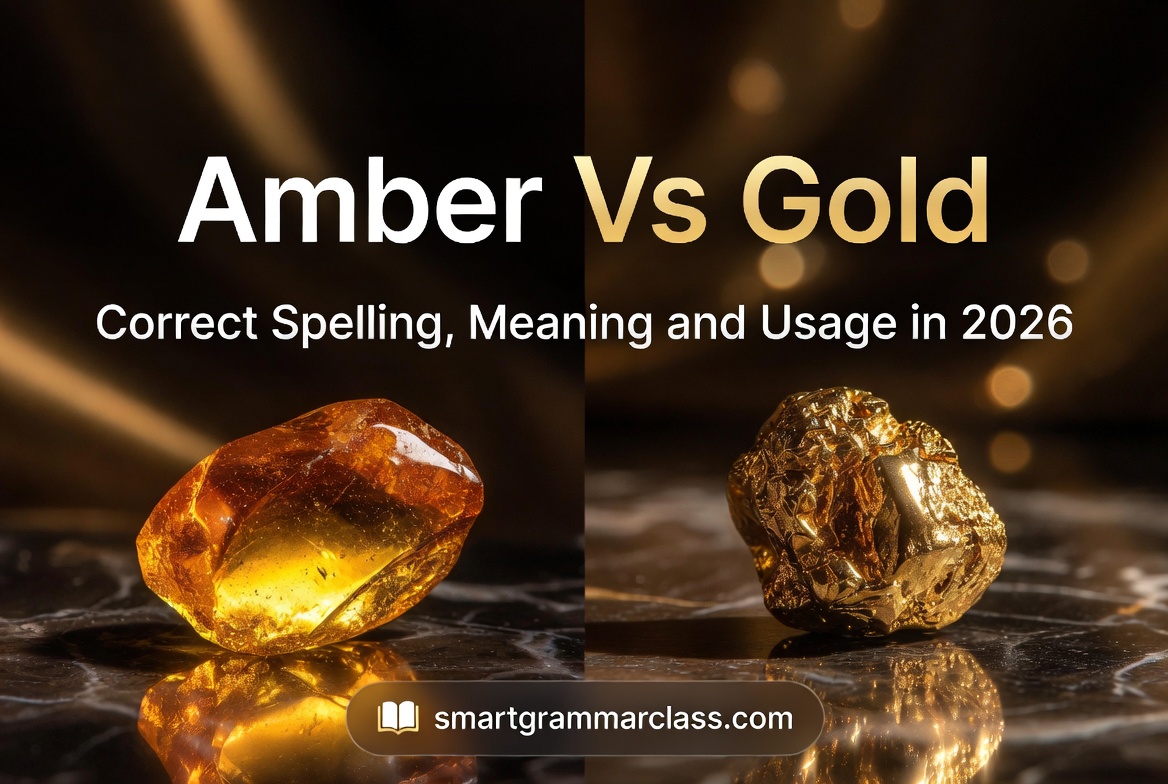
Understanding amber vs gold requires clear meaning and basic comparison today. We explore differences, uses, and how to tell apart in detail. Both materials show strong visual similarity with warm tones and yellow tones.
However amber forms from fossilized tree resin while gold is precious metal. Collectors often value amber for inclusions and natural glowing appearance. Meanwhile gold represents luxury, wealth, elegance, and high durability value.
Material composition defines amber and gold properties and origin clearly. We study formation from ancient trees and deep Earth processes. Rarity, luster, and durability influence overall value and worth perception.
Amber shows translucent resinous glow with honey undertones and inclusions. Gold displays shiny metallic reflectiveness with strong golden highlights appearance. Understanding amber vs gold helps buyers avoid confusion and overpaying mistakes.
Also read this: Cacoon or Cocoon: Correct Spelling Meaning and Usage in 2026
What Amber Means
Amber is not a mineral and it is not a metal. It is fossilized tree resin that has hardened over millions of years. Long ago, certain trees released sticky resin to protect themselves from damage. Over time, that resin buried itself under sediment, lost volatile compounds, and slowly turned into amber.
Because amber begins as organic material, it belongs to a special category called organic gemstones. That alone separates it from most traditional gemstones, which form in rock. Amber can be transparent, cloudy, or rich in color. It often contains tiny air bubbles, plant matter, or even prehistoric insects.
Key traits of amber
- Organic in origin
- Lightweight
- Warm to the touch
- Often translucent
- Can contain inclusions
- Usually softer than stone or metal
Amber feels almost alive in the hand. That warmth gives it a very different character from gold. It has a softer visual appeal too. Instead of a sharp metallic flash, amber tends to glow from within.
What Gold Means
Gold is a natural metallic element. Its chemical symbol is Au, and its atomic number is 79. Unlike amber, gold is not an organic material. It is a precious metal that forms through powerful geologic events and is later concentrated into veins or deposits in the Earth’s crust.
Gold has long been prized for its beauty, rarity, and durability. It does not rust. It does not tarnish easily. It bends rather than breaks. That combination makes it valuable for jewelry, coins, electronics, and investment products.
Key traits of gold
- Metallic element
- Very dense
- Highly malleable
- Opaque and reflective
- Corrosion-resistant
- Valuable as a store of wealth
Gold has a presence that amber does not. It feels solid and heavy. It catches light in a bright metallic way. It looks expensive because, in a very real sense, it is.
Is Amber a Stone or a Metal?
Amber is neither a stone nor a metal.
That is where many people get confused. It looks gem-like, so some people call it a stone. It also appears in jewelry with gold settings, so others assume it behaves like metal. Neither idea is correct.
Amber is best described as an organic gemstone. It comes from tree resin rather than minerals or metals. That makes it unique in the gem world. It belongs in the same broad family as jet and pearl in the sense that all three have organic origins.
Gold, on the other hand, is unquestionably a metal. It is one of the most recognizable precious metals on Earth.
How Amber Is Formed
Amber starts as resin from trees. Resin is sticky and protective. A tree releases it after injury or stress. That resin can trap insects, pollen, tiny leaves, or bits of bark before it hardens.
From there, a long transformation begins.
The formation process
- Resin leaks from a tree
- The resin traps debris or small organisms
- It hardens on or near the tree
- Sediment covers it
- Heat and pressure alter its structure
- Volatile compounds escape over time
- The material becomes fossilized amber
This process takes an extremely long time. In many cases, amber is tens of millions of years old. Some well-known amber deposits date back to the Cretaceous period.
Amber’s age gives it both scientific and aesthetic value. Scientists study inclusions to learn about ancient ecosystems. Collectors admire it because each piece tells a different story.
Why amber often contains inclusions
Amber is famous for preserving tiny scenes from ancient life. A mosquito frozen in amber is not just a dramatic image from movies. It is a real thing. The sticky resin could trap small organisms almost instantly, then preserve them with surprising detail.
That is one reason amber has been so fascinating for centuries. It is not just pretty. It is a time capsule.
How Gold Is Formed
Gold forms in a completely different way. It does not come from trees or living systems. It comes from extreme cosmic and geological events.
A large share of Earth’s gold is believed to have originated in cataclysmic astrophysical events such as neutron star collisions and supernova processes. That gold later became part of the material that formed Earth. Over time, geological processes concentrated it into veins, nuggets, and deposits.
The formation process
- Gold forms in space during extreme stellar events
- It becomes part of the material that formed Earth
- Geological activity moves and concentrates it
- Hot fluids carry gold through rock fractures
- The gold deposits in veins or placer deposits
- Mining extracts it from rock or sediment
This is why gold deposits are scattered and uneven. You do not find gold everywhere. Instead, nature concentrated it in specific places over long spans of time.
Gold’s formation story gives it a kind of dramatic prestige. Amber comes from trees. Gold comes from the furnace of the cosmos and the pressure of the planet.
Amber vs Gold at a Glance
Here is a simple comparison that makes the contrast easy to see.
| Feature | Amber | Gold |
| Origin | Fossilized tree resin | Natural metallic element |
| Category | Organic gemstone | Precious metal |
| Color | Yellow, orange, brown, honey | Metallic yellow |
| Weight | Very light | Very heavy |
| Shine | Soft, resin-like glow | Bright metallic luster |
| Transparency | Often translucent | Opaque |
| Hardness | Soft and scratch-prone | Soft for a metal but still durable |
| Conductivity | Non-conductive | Highly conductive |
| Value | Usually lower than gold | Much higher and market-driven |
| Common use | Jewelry, collectibles, art | Jewelry, investment, electronics |
This table tells the story fast. Amber and gold may share color family traits, but that is where the similarity mostly ends.
Physical Differences Between Amber and Gold
Color
Amber usually appears in shades of yellow, orange, honey, cognac, and brown. Some pieces look almost cherry-like or deep greenish if they contain unusual impurities. Its color often looks warm and earthy.
Gold shows a distinct metallic yellow tone. It has a bright reflective quality that amber does not. Pure gold has a rich, warm yellow shade, while alloys can lean toward white, pink, or green depending on the metal mix.
Amber glows softly. Gold shines directly.
Weight
This is one of the easiest ways to notice the difference.
Amber is very light. A piece can look substantial and still feel surprisingly easy to hold. Gold is the opposite. Even a small gold item often feels heavier than expected because gold has a very high density.
If you pick up two pieces of similar size, the gold one will almost always feel much heavier.
Hardness
Amber is soft. It can scratch fairly easily and may chip or crack under pressure. It does not rank high on the Mohs scale compared with many gemstones.
Gold is also relatively soft compared with some metals and stones, but it is still much more durable in practical use. Pure gold can bend and deform, which is one reason jewelry often uses alloys rather than pure 24K gold for everyday wear.
Shine
Amber does not sparkle in the way metal does. It has a gentle internal glow, especially when polished. That glow feels organic and smooth.
Gold reflects light. It has a mirror-like metallic shine that catches the eye immediately. That shiny surface is one of the main reasons gold has symbolized wealth for centuries.
Transparency
Amber may be transparent, translucent, or opaque. Some pieces let light pass through beautifully. Others look cloudy or contain visible specks.
Gold is always opaque. Light does not pass through it.
That difference matters a lot. If a material seems to let light shine through the edges or deeper layers, amber is far more likely than gold.
Chemical Composition of Amber and Gold
The chemical story behind amber and gold is completely different.
Amber consists mainly of organic compounds built from carbon, hydrogen, and oxygen. Since amber began as tree resin, its chemical makeup reflects its biological origin. It is not a single pure substance. It is a complex fossil material.
Gold is a pure chemical element. In its natural state, gold consists of atoms of Au. That purity contributes to its stability and value.
Quick chemistry comparison
| Aspect | Amber | Gold |
| Type | Organic fossil material | Element |
| Main components | Carbon, hydrogen, oxygen | Au atoms |
| Purity | Variable and complex | Elemental in native form |
| Reactivity | Can be damaged by heat and solvents | Very low reactivity |
| Conductivity | Poor | Excellent |
Gold’s chemistry makes it ideal for electronics and long-term storage. Amber’s chemistry makes it fragile in a completely different way. It is beautiful but vulnerable.
Uses of Amber and Gold
Common uses of amber
Amber has many uses, especially in decorative and collectible settings.
- Jewelry such as pendants, bracelets, and earrings
- Beads and carved ornaments
- Antique and heritage items
- Scientific study of prehistoric life
- Decorative art and museum displays
Amber works well in pieces that celebrate natural beauty. Its internal patterns and inclusions make each stone feel personal.
Common uses of gold
Gold has a much broader industrial and financial role.
- Fine jewelry
- Coins and bullion
- Central bank reserves
- Electronics and circuit components
- Dentistry
- Aerospace and precision instruments
- Luxury decoration
Gold’s use stretches beyond beauty. It has real performance value because it conducts electricity well and resists corrosion. That makes it useful where reliability matters.
Price Comparison: Amber vs Gold
Gold is usually far more expensive than amber. That is not only because gold is rare. It is also because the demand for gold remains high across investment, jewelry, and industry.
Amber is valued based on several factors:
- Color
- Clarity
- Size
- Age
- Presence of inclusions
- Origin
- Condition
Still, even high-quality amber usually costs much less than gold by weight.
Gold pricing depends on the global market and the purity of the item. Pure gold has a much higher and more stable market value than amber. Gold’s density also means even a small item contains a lot of material value.
Practical example
A small amber pendant may cost a modest amount depending on craftsmanship and quality. A small gold pendant of the same size can cost many times more because the metal itself carries substantial intrinsic value.
That difference is why counterfeit or mislabeled items can be so misleading. A golden-looking object is not automatically valuable gold.
How to Identify Amber and Gold
This is where practical knowledge matters.
Check the weight
Hold the item in your hand. Gold feels dense and heavy for its size. Amber feels light.
This test is simple but useful. If a piece looks large but weighs almost nothing, amber is a strong possibility.
Check the temperature
Amber tends to feel warmer fairly quickly in your hand. Gold remains cool longer and then slowly adjusts to your skin temperature.
That difference comes from their material structure. Amber does not store heat the same way metal does.
Look at the surface
Amber often has a softer glow and may show tiny imperfections or natural inclusions. Gold has a clean metallic shine if polished.
Scratch test
This test can help but it should be used carefully. Amber scratches more easily than gold. Even a careful touch can leave a mark if the surface is soft.
Gold is tougher in appearance but still not scratch-proof. Pure gold is soft enough to mark under pressure, which is why jewelry makers often use alloys.
Professional testing
When the stakes are high, professional testing is the smart move.
Common methods include:
- Density testing
- Acid testing for gold
- Refractive and optical testing for amber
- Spectroscopy
- Microscopic inspection
- X-ray fluorescence for gold composition
Professional testing gives the most reliable result. Guesswork is risky when the item may be valuable.
Similarities Between Amber and Gold
Even though the two materials are very different, they share a few surface-level traits.
- Both have long historical significance
- Both appear in luxury jewelry
- Both are often associated with prestige
- Both can be polished for attractive presentation
- Both are sold in collectible and ornamental markets
That overlap explains why confusion happens so often. A warm golden amber bead and a piece of polished yellow gold can look similar in certain lighting. The similarities stop there, but the visual resemblance can still fool people.
10 Key Differences Between Amber and Gold
Here is the cleanest way to separate them.
- Amber is fossilized resin. Gold is a metal.
- Amber is organic. Gold is elemental.
- Amber is lightweight. Gold is dense.
- Amber may be transparent. Gold is opaque.
- Amber feels warm and soft. Gold feels heavy and solid.
- Amber can contain insects or plant matter. Gold cannot.
- Amber has lower market value. Gold is far more valuable.
- Amber scratches more easily. Gold resists wear better in daily use.
- Amber glows softly. Gold reflects with metallic brilliance.
- Amber comes from ancient trees. Gold comes from cosmic and geologic processes.
Those ten points cover the heart of the issue. If you remember nothing else, remember this: amber and gold may share color families, but they belong to totally different worlds.
Real-World Case Studies
Case study: jewelry buyer confusion
A buyer sees a yellow pendant online and assumes it is gold because the color looks rich and warm. The price seems too good to be true, and it is. The pendant turns out to be amber set in a gold-colored frame.
The lesson is simple. Color alone does not prove material value. Weight, shine, and professional verification matter just as much.
Case study: antique collector mistake
An antique collector finds a bead necklace with a deep honey tone. It looks old and valuable. The seller describes it as “golden amber,” which adds to the confusion. After testing, the necklace is confirmed to be amber with no gold content in the beads themselves.
The collector learns a valuable lesson: decorative language can blur material identity. Always verify what the object actually is.
Case study: museum interpretation
Museums often display amber because it preserves ancient life. Gold objects often appear in displays about power, trade, and wealth. The two materials tell completely different stories, even if both attract attention for their beauty.
Amber tells a biological and prehistoric story. Gold tells a geological and economic one.
Why Amber and Gold Matter in Different Ways
Amber appeals to people who love natural history, unique inclusions, and warm organic beauty. It feels intimate and old in a way few materials can match.
Gold appeals to people who want durability, lasting value, and timeless status. It works as both ornament and asset.
That difference in purpose explains their long histories.
Amber is often treasured for what it contains. Gold is treasured for what it is.
Amber preserves the past. Gold stores value in the present.
Buying Tips for Amber and Gold
When shopping for either material, keep these points in mind.
- Ask for material verification
- Check the weight before buying
- Look for inclusions in amber
- Confirm purity marks in gold jewelry
- Buy from trusted sellers
- Request lab or professional certification for expensive items
- Compare prices against market norms
- Avoid vague terms like “golden stone” unless the seller explains exactly what that means
A little caution can save a lot of trouble. Some sellers use descriptions that sound flattering but say very little.
FAQS
What is the meaning of amber vs gold?
The meaning of amber vs gold lies in their natural identity and origin. Amber is fossilized tree resin formed from ancient trees, while gold is a precious metal shaped by deep Earth processes. Both differ in origin, formation, and natural properties.
What are the main differences between amber and gold?
The key differences between amber and gold include composition, weight, and appearance. Amber is a light organic material with translucent glow, while gold is a heavy metallic material with shiny metallic shine. Their material composition defines durability, rarity, and overall value.
How can you tell apart amber vs gold easily?
To understand how to tell apart amber vs gold, check visual similarity, weight, and texture. Amber shows a warm glow with honey undertones and inclusions, while gold reflects strong metallic luster and golden highlights. Their appearance and density make identification easier.
What are the common uses of amber and gold?
The uses of amber and gold differ in jewelry, decorative objects, and fashion. Amber is popular in antique pieces and interior design due to its warm tones and organic glow. Gold is widely used in luxury jewelry items, coins, and symbols of wealth and elegance.
Which is more valuable: amber or gold?
The value and worth of amber and gold depend on rarity, durability, and buyer demand. Gold is highly valued for currency, luxury, and long-term investment stability. Amber holds collectible worth due to inclusions like insects and plant matter, making it unique for collectors.
Conclusion
In conclusion, understanding amber vs gold requires clear awareness of their meaning, differences, and real-world uses. While amber is a fossilized tree resin with a warm glow and organic origin, gold is a precious metal known for metallic shine, durability, and value. Their composition and formation highlight distinct natural processes and properties. Knowing how to tell apart them helps avoid confusion, misjudge value, and overpay in jewelry or decorative objects. Ultimately, both carry unique aesthetic appeal, but serve different purposes in luxury, fashion, and wealth.

Emma Brooke is a dedicated grammar expert and language educator with a strong passion for helping learners master the English language with clarity and confidence. With years of hands-on experience in teaching grammar, writing, and communication skills, she specializes in breaking down complex language rules into simple, practical explanations.
At Smart Grammar Class, Emma focuses on creating accurate, easy-to-understand, and well-researched content that supports students, professionals, and everyday learners in improving their writing and speaking skills. Her approach combines real-world usage, clear examples, and structured guidance to ensure learners not only understand grammar rules but can apply them effectively.
Emma is committed to maintaining high editorial standards, ensuring every piece of content is reliable, up-to-date, and aligned with modern English usage. Her work reflects a deep understanding of language learning challenges and a mission to make grammar accessible to everyone.