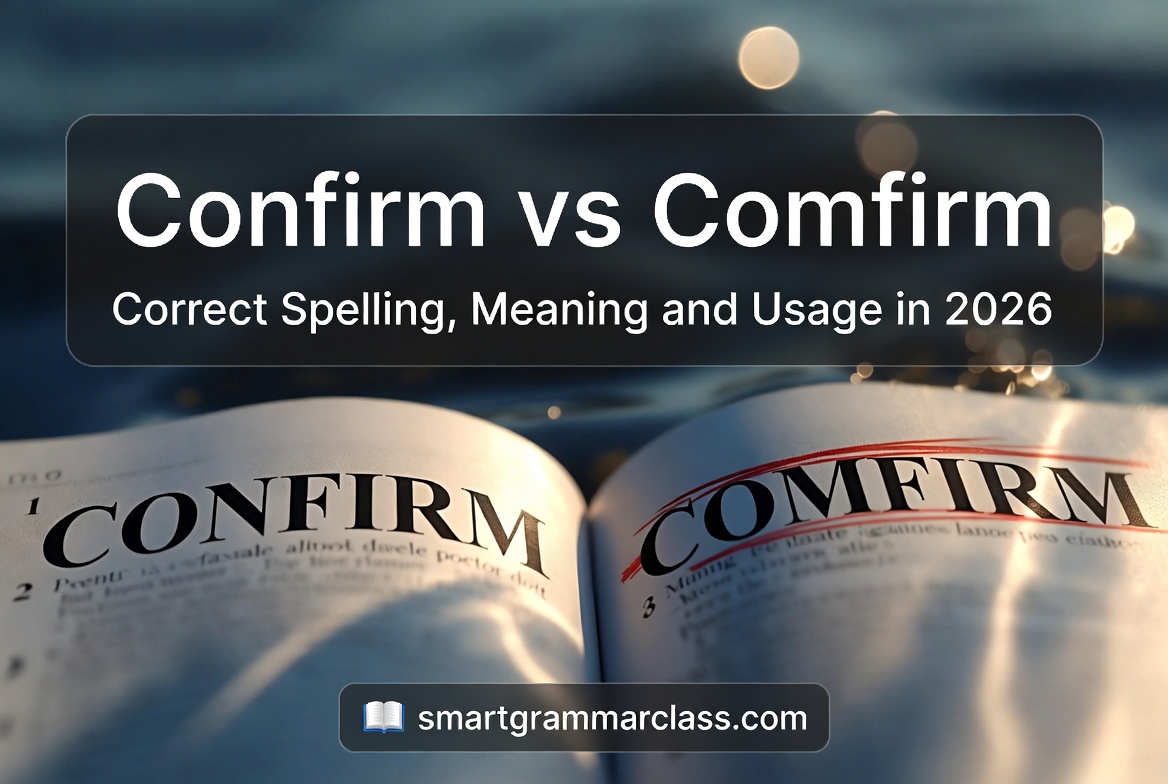
Many people confuse confirm and comfirm, creating a common misspelling during everyday writing. Understanding confirm vs comfirm improves English language confidence through proper correct spelling and correct usage.
This guide explains the meaning of confirm, definition, pronunciation, and essential usage rules clearly. You will also understand why comfirm remains an incorrect spelling and not a word.
Whether preparing a formal email, business document, report, or school assignment, accurate English grammar strengthens communication. Learn the difference between confirm and comfirm using practical examples, example sentences, and useful grammar tips.
We also share proofreading techniques, spelling tips, and writing improvement methods that avoid spelling errors. By the end, you will confidently confirm details, confirm information, and choose the correct word in standard English.
Also read this: Halt Vs Hault: Correct Spelling, Meaning, and Usage in 2026
The Short Answer
Here’s the quick answer:
| Word | Correct? | Meaning |
| Confirm | ✅ Yes | To verify, establish as true, approve, or make certain |
| Comfirm | ❌ No | Misspelling of confirm |
Whenever you need to indicate verification, approval, validation, or certainty, use confirm.
Never use comfirm in formal or informal writing.
Correct Examples
- Please confirm your attendance.
- The hotel confirmed our reservation.
- Can you confirm these details?
- She confirmed the appointment yesterday.
Incorrect Examples
- Please comfirm your attendance.
- The hotel comfirmed our reservation.
- Can you comfirm these details?
Every example above should use confirm instead.
Confirm Vs Comfirm at a Glance
Many spelling mistakes occur because letters become transposed during typing. That is exactly what happens with comfirm.
The letters n and m sit close together in the word structure which causes people to swap them accidentally.
| Feature | Confirm | Comfirm |
| Correct English spelling | Yes | No |
| Found in dictionaries | Yes | No |
| Accepted in academic writing | Yes | No |
| Accepted in business writing | Yes | No |
| Common typing error | No | Yes |
| Should you use it? | Yes | Never |
A useful memory trick is simple:
The word contains “firm.”
When you confirm something, you make it firm, certain, or established.
That connection makes the spelling easier to remember.
What Does Confirm Mean?
The verb confirm means to establish that something is true, accurate, valid, or certain.
People use it every day in both formal and casual communication.
Depending on the situation, confirm can mean:
- Verify information
- Approve a decision
- Validate facts
- Establish certainty
- Support evidence
- Finalize arrangements
- Acknowledge receipt
Simple Definition
To confirm means to remove doubt.
Once something is confirmed, uncertainty disappears.
Everyday Example
Imagine you book a flight.
You receive an email from the airline stating that your seat has been reserved.
That email confirms your booking.
Without confirmation, you might still wonder whether the reservation exists.
Origin of the Word Confirm
The word confirm comes from Latin.
It originates from:
- con- meaning together or completely
- firmare meaning to strengthen or make firm
This origin helps explain the modern meaning.
When you confirm something, you strengthen confidence in its truth or accuracy.
That core meaning has remained remarkably consistent for centuries.
Why Do People Misspell Confirm as Comfirm?
Spelling mistakes rarely happen without a reason.
Several factors contribute to the popularity of the misspelling comfirm.
Letter Transposition
This is the most common cause.
Writers accidentally reverse the order of letters.
Instead of typing:
confirm
they type:
comfirm
The fingers move quickly and the brain often fails to notice the switch.
Typing Speed
Fast typists frequently make transposition errors.
The mistake becomes even more common when writing emails or messages under pressure.
Visual Similarity
At a glance, both spellings look plausible.
Many readers skim words rather than analyzing every letter.
As a result, the error can slip through proofreading.
Autocorrect Dependence
People increasingly rely on spell-check software.
When autocorrect fails to catch a typo, writers may assume the spelling is correct.
Habit
A spelling mistake repeated often enough can become a habit.
Fortunately, habits can be corrected.
How to Remember the Correct Spelling
Simple memory techniques often work best.
Remember the Word “Firm”
Notice the ending:
Confirm = Con + Firm
When you confirm something, you make it firm.
The spelling suddenly becomes logical.
Visual Method
Picture the word written like this:
CON + FIRM
The structure becomes easier to recall.
Reading Method
Each time you encounter the word in books, articles, emails, or websites, pay attention to the spelling.
Repeated exposure strengthens memory.
Proofreading Trick
Search documents for “comfirm” before sending important messages.
Many professionals use this method to catch errors instantly.
How to Pronounce Confirm
The standard American pronunciation is:
kuhn-FURM
Phonetic form:
/kənˈfɜːrm/
Syllable Breakdown
- con
- firm
The second syllable receives the stress.
Common Pronunciation Mistakes
Some speakers place equal emphasis on both syllables.
Others pronounce the first syllable too strongly.
Native speakers typically stress the second syllable more heavily.
When to Use Confirm
The word appears in countless situations.
Understanding those contexts helps improve writing accuracy.
Confirming Information
People often confirm facts before making decisions.
Examples:
- Confirm a phone number
- Confirm an address
- Confirm statistics
- Confirm research findings
Confirming an Appointment
Businesses confirm appointments daily.
Examples include:
- Doctor visits
- Interviews
- Meetings
- Consultations
Example:
“Please confirm your appointment by Friday.”
Confirming an Email
Many organizations ask recipients to confirm receipt.
Example:
“Kindly confirm that you received this email.”
Confirming Attendance
Events often require confirmation.
Examples:
- Weddings
- Conferences
- Seminars
- Business meetings
Example:
“Please confirm your attendance before June 30.”
Confirming Reservations
Travel companies frequently use this term.
Examples:
- Hotel bookings
- Restaurant reservations
- Flight tickets
- Rental cars
Confirming Orders
Online stores send confirmation messages after purchases.
Examples:
- Order confirmation
- Shipping confirmation
- Delivery confirmation
Confirming Identity
Security systems use confirmation procedures regularly.
Examples:
- Identity verification
- Account authentication
- Banking security checks
Examples of Confirm in Everyday Sentences
Real-world examples make usage easier to understand.
Business Examples
- The manager confirmed the project deadline.
- HR confirmed my interview schedule.
- The client confirmed the contract terms.
School Examples
- The teacher confirmed the exam date.
- The principal confirmed the event schedule.
- The university confirmed admission.
Travel Examples
- The airline confirmed my seat assignment.
- The hotel confirmed our reservation.
- The agency confirmed the itinerary.
Healthcare Examples
- The clinic confirmed the appointment.
- The lab confirmed the test results.
- The doctor confirmed the diagnosis.
Personal Examples
- She confirmed dinner plans.
- He confirmed his arrival time.
- They confirmed participation in the event.
Examples of Incorrect Usage
The following sentences contain the common spelling error.
| Incorrect | Correct |
| Please comfirm your booking. | Please confirm your booking. |
| I will comfirm tomorrow. | I will confirm tomorrow. |
| Can you comfirm this information? | Can you confirm this information? |
| The hotel comfirmed our room. | The hotel confirmed our room. |
| She forgot to comfirm attendance. | She forgot to confirm attendance. |
Every example demonstrates the same issue.
The correct spelling is always confirm.
Common Phrases That Use Confirm
The word appears in many standard expressions.
Frequently Used Phrases
- Confirm receipt
- Confirm attendance
- Confirm identity
- Confirm booking
- Confirm reservation
- Confirm payment
- Confirm registration
- Confirm details
- Confirm appointment
- Confirm order
- Confirm availability
- Confirm enrollment
- Confirm delivery
- Confirm participation
- Confirm acceptance
These phrases appear regularly in business and personal communication.
Words Commonly Confused with Confirm
Some words share similar meanings but carry different nuances.
Confirm vs Verify
Verify focuses on checking accuracy.
Confirm focuses on establishing certainty.
Example:
- Verify the data.
- Confirm the results.
Confirm vs Approve
Approval involves permission.
Confirmation involves certainty.
Example:
- The manager approved the proposal.
- The manager confirmed the meeting date.
Confirm vs Validate
Validation often refers to proving legitimacy.
Confirmation usually means establishing truth.
Comparison Table
| Word | Primary Meaning |
| Confirm | Establish as true |
| Verify | Check accuracy |
| Approve | Give permission |
| Validate | Prove legitimacy |
| Affirm | State positively |
Confirm as Different Parts of Speech
The word family extends beyond the base verb.
Confirm
Verb
Example:
“I confirm the information.”
Confirms
Verb
Example:
“She confirms the schedule.”
Confirmed
Past tense and adjective
Examples:
- The reservation was confirmed.
- He is a confirmed expert.
Confirming
Present participle
Example:
“They are confirming the details.”
Confirmation
Noun
Example:
“We received confirmation today.”
Common Forms of Confirm
| Form | Example |
| Confirm | Please confirm attendance. |
| Confirms | She confirms every detail. |
| Confirmed | The booking was confirmed. |
| Confirming | We are confirming availability. |
| Confirmation | Confirmation arrived by email. |
Mastering these forms improves both speaking and writing.
Synonyms of Confirm
Using synonyms prevents repetitive writing.
Common Synonyms
- Verify
- Validate
- Authenticate
- Establish
- Corroborate
- Certify
- Substantiate
- Affirm
- Reinforce
- Support
Example Usage
Instead of writing:
“The report confirmed the findings.”
You might write:
“The report corroborated the findings.”
Or:
“The report validated the findings.”
Each alternative adds variety while preserving meaning.
Antonyms of Confirm
Antonyms express the opposite idea.
Common Antonyms
- Deny
- Reject
- Refute
- Contradict
- Disprove
- Challenge
- Question
- Invalidate
Example
Confirmed:
“The evidence confirmed the theory.”
Refuted:
“The evidence refuted the theory.”
The meaning changes dramatically.
Confirm in Business Writing
Few words appear more frequently in professional communication.
Business environments depend on clarity and certainty.
Common Uses
- Confirm meetings
- Confirm invoices
- Confirm deliveries
- Confirm contracts
- Confirm appointments
- Confirm deadlines
Sample Business Sentence
“Please confirm receipt of this document before the end of the day.”
This sentence is concise, professional, and widely accepted.
Why Businesses Use Confirm So Often
Business decisions require certainty.
Without confirmation:
- Deadlines become unclear.
- Orders may fail.
- Meetings get missed.
- Communication breaks down.
Confirmation acts as a safeguard against misunderstandings.
Confirm in Academic Writing
Researchers frequently use confirm when discussing evidence.
Examples
- Data confirmed the hypothesis.
- Results confirmed earlier findings.
- Evidence confirmed the conclusion.
Academic writing values precision.
The word helps authors communicate confidence in findings without exaggeration.
Mini Case Study
Researchers conduct a study involving 5,000 participants.
Initial observations suggest a trend.
After analyzing the data, the researchers discover consistent evidence.
At that stage, they can reasonably state that the results confirmed the original hypothesis.
The word signals evidence-based certainty.
Confirm in Digital Communication
Technology has made confirmation a daily occurrence.
Many online interactions rely on confirmation systems.
Examples
- Email confirmation
- Account confirmation
- Order confirmation
- Payment confirmation
- Registration confirmation
- Identity confirmation
Common Digital Workflow
User Registration
↓
Email Sent
↓
User Clicks Link
↓
Email Confirmed
↓
Account Activated
Without confirmation steps, security risks increase substantially.
Grammar Tips for Using Confirm
Even though the spelling is simple, writers occasionally misuse the word grammatically.
Use the Correct Tense
Present:
- I confirm the details.
Past:
- I confirmed the details.
Future:
- I will confirm the details.
Maintain Subject-Verb Agreement
Correct:
- She confirms attendance.
Incorrect:
- She confirm attendance.
Prefer Active Voice
Active voice improves readability.
Weak:
- The reservation was confirmed by the hotel.
Stronger:
- The hotel confirmed the reservation.
The second version sounds clearer and more natural.
Avoid Redundant Phrases
Wordy:
- Please confirm and verify the information.
Better:
- Please confirm the information.
Often one verb is enough.
Common Mistakes Writers Make
Several recurring errors appear in everyday writing.
Misspelling the Word
The most obvious mistake remains:
- Comfirm ❌
- Confirm ✅
Using the Wrong Synonym
Sometimes writers choose a synonym that changes meaning.
For instance:
- Approve does not always mean confirm.
- Verify does not always mean confirm.
Context matters.
Overusing the Word
Repetition weakens writing.
Instead of using confirm repeatedly, alternate with:
- Verify
- Validate
- Authenticate
- Corroborate
when appropriate.
Quick Recap
Before finishing, remember these key points:
- Confirm is the correct spelling.
- Comfirm is always incorrect.
- The word means to verify, establish, approve, or make certain.
- It appears frequently in business, academic, and digital communication.
- The easiest memory trick is to remember the word firm inside confirm.
- Confirmation removes doubt and creates clarity.
FAQs
What is the correct spelling, confirm or comfirm?
The correct spelling is confirm, while comfirm is an incorrect spelling, common misspelling, and misspelled word. In standard English, confirm is the recognized word found in every English dictionary and used in both formal and everyday communication.
What is the meaning of confirm in the English language?
The meaning of confirm is to verify, validate, authenticate, or establish truth and establish certainty about something. As a verb in English grammar, it is commonly used to confirm information, confirm details, confirm identity, and provide confirmation with confidence.
What is the difference between confirm and comfirm?
The difference between confirm and comfirm is simple because confirm is the correct word, whereas comfirm is not a word in correct English. This spelling comparison highlights a typing mistake caused by letter transposition, leading to a common spelling error.
How can I avoid the spelling mistake between confirm and comfirm?
Using proofreading, proofreading techniques, grammar tips, and spelling tips helps avoid spelling errors and improves writing accuracy. Regular editing, copy editing, and writing improvement also strengthen English writing, especially for students, professionals, and writers.
Where should I use the word confirm correctly?
Use confirm in business writing, business communication, formal email, report, application, confirmation email, text message, and everyday conversation. It is also correct when you confirm appointment, confirm booking, confirm reservation, confirm attendance, confirm order, confirm payment, confirm registration, confirm receipt, or confirm request.
Conclusion
Choosing confirm instead of comfirm ensures correct spelling, stronger English grammar, and clear communication in every situation. Understanding the difference between confirm and comfirm, proper correct usage, and the meaning of confirm helps you avoid every spelling mistake and common misspelling with confidence. Whether you are creating English writing, a formal email, business document, or school assignment, using the correct word improves writing accuracy, professionalism, and writing skills. By applying simple grammar tips, proofreading, and spelling tips, you can write confidently in standard English and consistently avoid spelling errors.

Emma Brooke is a dedicated grammar expert and language educator with a strong passion for helping learners master the English language with clarity and confidence. With years of hands-on experience in teaching grammar, writing, and communication skills, she specializes in breaking down complex language rules into simple, practical explanations.
At Smart Grammar Class, Emma focuses on creating accurate, easy-to-understand, and well-researched content that supports students, professionals, and everyday learners in improving their writing and speaking skills. Her approach combines real-world usage, clear examples, and structured guidance to ensure learners not only understand grammar rules but can apply them effectively.
Emma is committed to maintaining high editorial standards, ensuring every piece of content is reliable, up-to-date, and aligned with modern English usage. Her work reflects a deep understanding of language learning challenges and a mission to make grammar accessible to everyone.