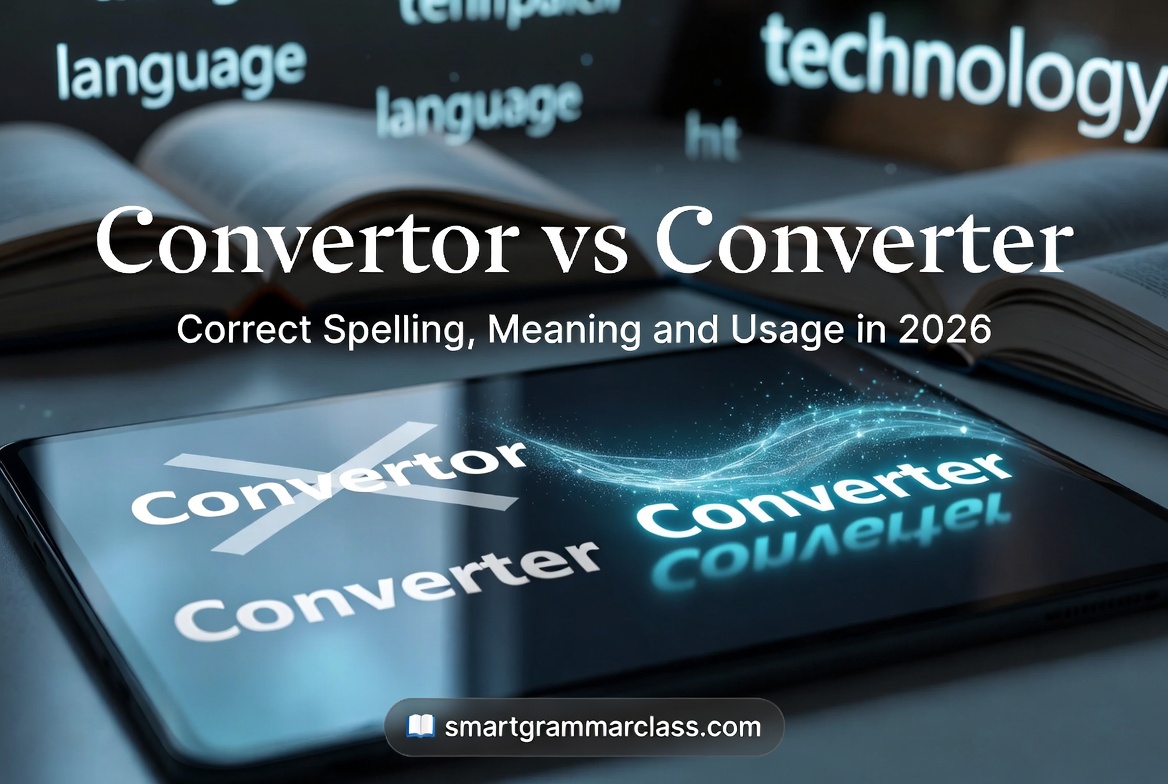
In 2026, many writers face Convertor vs Converter spelling confusion worldwide. The difference between convertor and converter spelling confusion affects professional writing clarity today. Most dictionaries show converter as correct standard spelling in English language.
However, convertor still appears in technical contexts and regional English variant usage. Understanding meaning, usage, and context helps avoid common language confusion issues. Correct spelling improves trust in academic writing, business documents, and digital tools.
The term converter dominates modern applications across engineering and software industries. Electrical devices and signal processing often rely on conversion meaning accuracy. Students, engineers, and developers use correct usage rules in technical documents.
Historical contexts show spelling differences across British English and American English. Search engines and apps often correct misspelling between convertor and converter instantly. Clear interpretation ensures accurate communication in professional and academic writing fields.
Also read this: Powerfull vs Powerful: Correct Spelling, Meaning, and Usage in 2026
Convertor vs Converter: What’s the Difference?
At first glance, these words look almost identical. They also share the same root idea. Both describe something that changes one form into another. Yet modern English strongly favors one spelling over the other.
Quick Definition of Converter
A converter is a device, tool, system, or software program that changes something from one format, state, or type into another.
Examples include:
- Video converters
- Currency converters
- Power converters
- PDF converters
- Catalytic converters
The word appears everywhere in modern communication because it sounds natural and follows standard English word formation patterns.
Quick Definition of Convertor
A convertor also refers to something that converts one form into another. However, this spelling appears far less often today. You usually find it in:
- Older engineering manuals
- Specialized electrical systems
- Historical machinery terminology
- Certain industrial publications
Although dictionaries still recognize the word, it has become uncommon in general writing.
Side-by-Side Comparison
| Feature | Converter | Convertor |
| Modern usage | Extremely common | Rare |
| Preferred in US English | Yes | No |
| Seen in software names | Frequently | Almost never |
| Used in engineering | Yes | Sometimes |
| Search popularity | Very high | Very low |
| Recommended for general writing | Yes | Usually no |
The difference may seem small, but word preference shapes readability. Readers instantly recognize converter because they encounter it daily.
Why “Converter” Became the Standard Spelling
Language evolves naturally. Certain spellings survive because they sound smoother, fit grammar patterns better, and gain wider public acceptance. That is exactly what happened with converter.
English Word Formation Plays a Big Role
Many English nouns end with “-er” when describing a person or thing performing an action.
Examples include:
- Writer
- Builder
- Reader
- Printer
- Scanner
Because of this pattern, converter feels more familiar to English speakers. The spelling matches the way modern English naturally builds agent nouns.
Technology Helped Popularize “Converter”
The digital era pushed the word into mainstream use. Software companies, electronics brands, and online tools consistently adopted converter instead of convertor.
Common examples include:
| Modern Product Type | Standard Industry Term |
| Video software | Video converter |
| Travel accessory | Power converter |
| Online tool | Currency converter |
| Audio software | Audio converter |
| File utility | PDF converter |
Millions of people now encounter the word daily. That exposure strengthened the spelling even more.
Search Engines Favor “Converter”
Search behavior reveals a clear trend. People overwhelmingly search for:
- “video converter”
- “currency converter”
- “file converter”
- “converter meaning”
Very few users search for “convertor” unless they work in a technical field. As a result, publishers and websites naturally optimize content around the more common spelling.
Dictionaries Support Both Words
Major dictionaries still list both spellings. However, most reference guides identify converter as the preferred modern form.
That distinction matters.
A word can technically exist without being the best choice for everyday writing. Think of it like an old road that still appears on a map but no longer handles regular traffic.
Where “Convertor” Still Appears
Even though converter dominates modern English, convertor did not disappear completely.
Certain industries still preserve the older spelling because of tradition, technical precision, or historical naming systems.
Electrical Engineering Uses
One of the most famous examples involves the rotary convertor. This machine converted electrical energy between alternating current and direct current during earlier industrial periods.
Older engineering textbooks often used:
- Rotary convertor
- Synchronous convertor
- Mercury arc convertor
Modern engineers usually prefer updated terminology, but historical references still contain these spellings.
Industrial Documentation
Some industrial sectors continue using “convertor” because older machinery and patents originally adopted that term.
For example:
| Industry | Older Terminology |
| Heavy machinery | Convertor housing |
| Steel manufacturing | Convertor furnace |
| Electrical systems | Power convertor |
| Industrial automation | Signal convertor |
These examples survive mainly due to legacy documentation.
Academic and Historical Writing
Researchers discussing historical equipment often preserve original terminology to maintain accuracy.
Imagine writing about a 1920s electrical system. Changing “convertor” to “converter” could alter the authenticity of the historical source.
That is why the older spelling still appears occasionally in archives and technical journals.
Converter Meaning Across Different Industries
One reason the word remains so popular is its versatility. A converter appears in dozens of industries and technologies.
The core meaning always stays similar. Something changes one thing into another.
Still, the exact function varies widely depending on context.
Converter in Technology and Software
Technology uses the word constantly. In fact, most people first encounter it through software tools.
Common Software Converters
| Converter Type | Purpose |
| Video converter | Changes video formats |
| Audio converter | Converts sound files |
| PDF converter | Changes documents into PDFs |
| Image converter | Alters image formats |
| File converter | Transforms data formats |
For example, a video converter may transform an MP4 file into AVI or MOV format.
These tools became essential because modern devices support different file standards.
Why Software Uses “Converter”
Software companies prefer converter because:
- It sounds modern
- Users instantly recognize it
- Search engines favor it
- The spelling feels more natural
Very few technology companies use “convertor” today because it appears outdated.
Converter in the Automotive Industry
Cars contain several important converters. Drivers may not notice them often, but these components play critical roles.
Catalytic Converter
The catalytic converter reduces harmful emissions before gases leave the exhaust system.
It converts:
- Carbon monoxide into carbon dioxide
- Nitrogen oxides into nitrogen
- Hydrocarbons into water vapor
Without catalytic converters, modern vehicles would release far more pollution.
Torque Converter
Automatic transmissions rely on a torque converter to transfer engine power smoothly.
This device allows the engine to continue running even when the car stops completely.
Drivers experience:
- Smoother acceleration
- Easier gear shifting
- Improved driving comfort
Why Automotive Industries Avoid “Convertor”
Automotive manufacturers overwhelmingly use “converter.” Service manuals, repair shops, dealerships, and parts suppliers almost never use “convertor.”
Consistency matters in global industries. One standard spelling reduces confusion.
Converter in Electronics and Power Systems
Electronics depend heavily on conversion systems. Modern devices constantly transform electrical signals and voltages.
Popular Electrical Converters
| Converter Type | Main Function |
| AC converter | Converts alternating current |
| DC converter | Converts direct current |
| Voltage converter | Changes voltage levels |
| Signal converter | Modifies signal formats |
| Frequency converter | Alters electrical frequency |
Travelers use voltage converters regularly when visiting countries with different electrical systems.
For example:
- US outlets often use 120V
- Many European countries use 230V
Without a voltage converter, devices may fail or overheat.
Renewable Energy Uses
Solar energy systems rely heavily on converters.
Solar panels generate direct current electricity. Homes typically use alternating current. Power converters bridge that gap efficiently.
Modern renewable energy systems would struggle without advanced conversion technology.
Common Mistakes People Make
Many writers accidentally misuse these terms because both spellings technically exist.
However, small language mistakes can hurt readability and professionalism.
Mistake: Using “Convertor” in Everyday Writing
This happens frequently because spellcheck tools sometimes fail to flag it.
For example:
❌ “I downloaded a video convertor.”
Although not technically impossible, the sentence feels outdated and awkward.
Modern readers expect:
✅ “I downloaded a video converter.”
The second version looks cleaner and more natural.
Mistake: Assuming Both Words Mean Different Things
Some people think a converter and convertor perform entirely different jobs.
Usually, they do not.
The difference mostly involves:
- Preferred spelling
- Industry tradition
- Historical terminology
The core meaning remains nearly identical.
Mistake: Mixing Technical and General Language
Technical industries sometimes preserve unusual spellings. That does not mean general audiences should copy them.
Imagine writing a travel blog that says:
“Bring a power convertor when visiting Europe.”
Readers may assume the sentence contains a typo.
Context matters enormously in language.
Convertor vs Converter in Real Sentences
Examples make grammar rules easier to understand. Here is how modern English typically uses these words.
Correct Uses of “Converter”
- I installed a new video converter yesterday.
- The mechanic replaced the catalytic converter.
- You need a voltage converter for international travel.
- This PDF converter works surprisingly fast.
- The audio converter supports multiple file formats.
These examples sound natural because modern English strongly prefers this spelling.
Correct Uses of “Convertor”
- The museum displayed a rotary convertor from 1910.
- Engineers repaired the industrial convertor system.
- The technical manual referenced a synchronous convertor.
Notice something important here.
Almost every example belongs to specialized or historical contexts.
That pattern explains the modern language divide perfectly.
Which Spelling Should You Use in 2026?
Most writers only need one simple rule.
Use “Converter” Almost Everywhere
Choose converter for:
- Blogs
- School assignments
- Business writing
- Marketing content
- Product descriptions
- Technical guides
- Website copy
- Software references
This spelling feels modern, professional, and widely accepted.
Use “Convertor” Only in Specialized Contexts
You may use convertor when:
- Quoting historical documents
- Discussing older engineering systems
- Referencing legacy machinery
- Preserving official technical terminology
Outside those situations, the spelling rarely helps readers.
Quick Memory Trick
A simple trick makes this easy:
If regular readers will see the word, use “converter.”
That rule works almost every time.
Why Spelling Accuracy Matters More Than People Think
Some people dismiss spelling variations as unimportant. However, small language choices shape credibility.
Readers subconsciously judge writing quality within seconds.
Professionalism Matters
Imagine two software products:
- Fast Video Converter
- Fast Video Convertor
Most users instantly trust the first one more.
Why?
Because familiarity creates confidence.
SEO Performance Matters Too
Search engines rely heavily on language patterns and user behavior.
Since most users search for “converter,” content using that spelling often performs better in search visibility.
Benefits include:
- Better keyword relevance
- Higher click-through rates
- Improved user trust
- Stronger semantic recognition
That advantage becomes significant in competitive industries.
Historical Evolution of Converter and Convertor
Language history explains why both spellings survived.
Early English Usage
During earlier centuries, English spelling lacked standardization. Writers frequently used multiple forms of the same word.
Examples included:
- Adviser and advisor
- Judgement and judgment
- Connection and connexion
Convertor and converter followed a similar path.
Industrial Revolution Influence
Engineering industries expanded rapidly during the late 19th and early 20th centuries.
Technical documents often used:
- Convertor
- Motor-generator convertor
- Rotary convertor
Those spellings became embedded within industrial systems.
Modern Standardization
As global publishing expanded, industries gradually standardized language.
Software companies, educators, publishers, and manufacturers overwhelmingly adopted converter.
That consistency eventually shaped mainstream English usage.
Real-World Case Study: Why Brands Prefer “Converter”
Branding experts understand how language affects consumer trust.
Imagine launching two identical apps.
App Name Example
| Option | Public Perception |
| Smart File Converter | Modern and trustworthy |
| Smart File Convertor | Unfamiliar and outdated |
Users naturally gravitate toward familiar language.
Even tiny spelling differences influence clicks, downloads, and conversions.
That psychological effect explains why modern brands avoid unusual spellings unless absolutely necessary.
How Dictionaries Treat Convertor vs Converter
Most dictionaries now follow a similar pattern.
What Dictionaries Usually Say
| Word | Dictionary Status |
| Converter | Preferred spelling |
| Convertor | Variant spelling |
This distinction matters because “variant” does not equal “recommended.”
A dictionary may recognize a word while still favoring another form for modern communication.
Why Writers Should Care
Readers value clarity more than technical correctness.
If one spelling feels unfamiliar, readers pause mentally. That interruption weakens flow and engagement.
Strong writing removes friction.
That is why professional writers choose the most recognizable form whenever possible.
The Psychology Behind Familiar Words
Human brains process familiar language faster.
That principle affects:
- Reading speed
- Trust levels
- Memory retention
- User engagement
Familiarity Creates Confidence
When readers instantly recognize a word, they continue reading smoothly.
However, unfamiliar spellings trigger hesitation.
For example:
- Converter feels modern
- Convertor feels questionable
Even if readers cannot explain why, the emotional reaction still happens.
Good writing respects reader psychology.
Industries That Almost Always Use “Converter”
Several industries standardized the spelling completely.
Technology
Examples include:
- File converter
- Media converter
- Data converter
Automotive
Examples include:
- Catalytic converter
- Torque converter
Travel Accessories
Examples include:
- Voltage converter
- Plug converter
Finance
Examples include:
- Currency converter
- Crypto converter
These industries rarely use “convertor” anymore.
Rare Situations Where “Convertor” Still Makes Sense
Although uncommon, the older spelling remains acceptable in a few specific situations.
Historical Equipment Documentation
Museums and archives often preserve original terminology exactly as written.
Legacy Engineering Systems
Some industrial systems still carry official names containing “convertor.”
Direct Quotations
When quoting old manuals or technical papers, accuracy matters more than modernization.
Outside those cases, “converter” remains the smarter choice.
Easy Rule for Students and Writers
Most grammar confusion disappears with one straightforward guideline.
The Safe Modern Choice
Use converter if you are writing for:
- Online audiences
- Businesses
- Customers
- Students
- General readers
This spelling works almost everywhere.
The Technical Exception
Use convertor only when discussing:
- Historical engineering
- Legacy industrial systems
- Original technical terminology
That exception covers nearly every legitimate use case.
FAQs
What is the difference between Convertor vs Converter in 2026?
The difference between Convertor vs Converter mainly comes from spelling and language confusion in modern English. In most professional writing, converter dominates as the correct spelling, while convertor is often seen as a misspelling. This creates frequent confusion for writers and professionals in daily use.
Which is the correct spelling between convertor and converter?
The correct spelling in standard English is converter, based on accepted English variant, British English, and American English rules. The word convertor is less common and usually appears due to spelling confusion or error in accurate writing.
What is the meaning and usage of a converter in different contexts?
A converter refers to something that performs conversion meaning in different context and industry applications. It is widely used in electrical devices, digital tools, and modern applications, especially in technical fields and engineering contexts.
Why do people confuse convertor vs converter in professional writing?
The confusion arises from language differences, historical contexts, and variations in usage rules across regions. Many students, marketers, and business owners misunderstand definitions due to unclear interpretation and inconsistent grammar confusion.
Where is the term converter commonly used in modern industries?
The term converter is widely used in software products, apps, search engines, and mechanical devices involving signal conversion. In industry, engineering, and academic usage, it ensures professional scenarios require correct term application for clear communication.
Conclusion
In understanding Convertor vs Converter, the key takeaway is clear correct spelling and proper usage in modern English writing. The term converter is widely accepted as the correct term in English language, while convertor often appears as a misspelling in everyday use. This difference creates confusion for writers across academic writing, business owners, and engineers in technical documents. Choosing the right form improves professional communication, strengthens writing clarity, and ensures accurate interpretation in modern English contexts.

Emma Brooke is a dedicated grammar expert and language educator with a strong passion for helping learners master the English language with clarity and confidence. With years of hands-on experience in teaching grammar, writing, and communication skills, she specializes in breaking down complex language rules into simple, practical explanations.
At Smart Grammar Class, Emma focuses on creating accurate, easy-to-understand, and well-researched content that supports students, professionals, and everyday learners in improving their writing and speaking skills. Her approach combines real-world usage, clear examples, and structured guidance to ensure learners not only understand grammar rules but can apply them effectively.
Emma is committed to maintaining high editorial standards, ensuring every piece of content is reliable, up-to-date, and aligned with modern English usage. Her work reflects a deep understanding of language learning challenges and a mission to make grammar accessible to everyone.