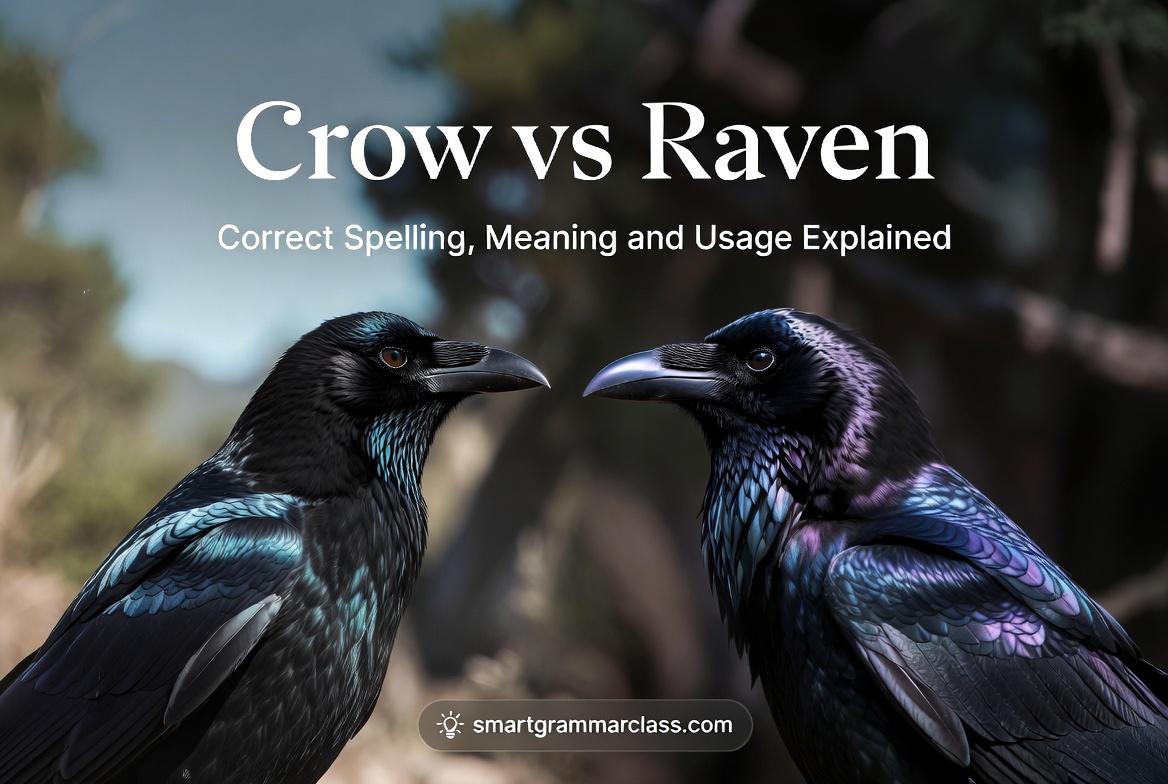
When I first tried to tell a crow from a raven, it felt confusing because both are black bird types with a dark, mysterious look often linked to stories and myths. But once you understand the basics, the difference becomes easier to spot without a second guess.
Both belong to the crow family called corvidae, which also includes the magpie and jay, showing how colourful and smart each corvid can be despite their funereal appearance. On a sunny day, watch how their shadow, feet, and how the bird flies or lands on a tree can start to reveal the truth.
The biggest clue is size and shape. Common Ravens are larger, often compared to a Red-tailed Hawk, with a bigger wingspan around 117 cm, while American Crows are smaller at about 92 cm and more widespread across the continental United States and North America. Look closely at the tail feathers: a raven has longer middle feathers forming a wedge-shaped tail, while a crow shows a fan shape when it spreads.
Their voice and sound also differ, making the easiest way to tell them apart to listen to their call. In terms of behavior, ravens travel in pairs, while crows gather in groups or flocks, so even from far away, their physical features, thicker bill, glossy black feathers, and intelligent actions make these distinct species less identical than they first seem.
Also read this: Onto or Into: Correct Spelling, Meaning and Usage Explained 2026
Crow or Raven Quick Answer ⚡
Let’s clear things up right away.
- Crows are smaller and more social
- Ravens are larger and more solitary
- Crows make sharp “caw” sounds
- Ravens produce deep croaking calls
Here’s a quick comparison you can scan in seconds:
| Feature | Crow | Raven |
| Size | About the size of a pigeon or small hawk | Closer to a hawk or small eagle |
| Beak | Slim and straight | Thick and curved |
| Tail shape | Fan-shaped | Wedge-shaped |
| Sound | High-pitched caw | Deep croak |
| Social style | Flocks | Pairs or alone |
If it looks massive and sounds like it swallowed gravel it’s probably a raven.
What Is a Crow and What Is a Raven
Both crows and ravens belong to the Corvus genus. That means they’re close relatives. Think of them like cousins rather than strangers.
What is a Crow
Crows are medium-sized black birds found almost everywhere. Cities farms highways parks you name it. They’ve adapted incredibly well to human environments.
Some key facts:
- Species example: American crow (Corvus brachyrhynchos)
- Average length: 16 to 21 inches
- Wingspan: Around 33 to 39 inches
- Habitat: Urban areas fields forests
Crows are problem solvers. They use tools. They recognize human faces. Some studies show they even hold grudges.
What is a Raven
Ravens are the heavyweight members of the same family. Bigger. Bolder. More mysterious.
Key facts:
- Species example: Common raven (Corvus corax)
- Average length: 22 to 27 inches
- Wingspan: Up to 51 inches
- Habitat: Mountains forests remote areas
Ravens feel almost mythological when you see one. Their size alone makes them stand out.
The Real Differences Between Crow and Raven 🔍
Now let’s dig deeper. This is where most people finally see the distinction.
Physical Differences
Start with size. It’s the easiest giveaway.
- A crow looks compact and balanced
- A raven looks oversized and powerful
If you’re unsure imagine this:
A crow looks like a regular bird. A raven looks like it could carry secrets.
Beak Shape
- Crow beaks are narrow and straight
- Raven beaks are thick curved and heavier
Ravens also have shaggy throat feathers called “hackles” which puff up when they call.
Tail Shape in Flight
This one is gold for identification.
| Bird | Tail Shape in Flight |
| Crow | Fan-shaped |
| Raven | Wedge or diamond |
If the tail forms a sharp point it’s a raven. No guesswork needed.
Behavior and Intelligence
Both birds rank among the smartest animals on Earth. But they behave differently.
Crows
- Travel in large groups called murders
- Thrive in noisy environments
- Constantly communicate with each other
Ravens
- Prefer pairs or solitude
- Spend more time gliding and observing
- Show playful behavior like aerial tricks
Fun fact: Ravens have been seen sliding down snowy roofs just for fun. Not survival. Pure entertainment.
Voice and Sound Patterns
Close your eyes and listen. You’ll know instantly.
Crow Sound
- Sharp
- Repetitive
- Classic “caw caw”
Raven Sound
- Deep
- Rough
- Almost like a croaking growl
Think of it like this:
- Crow = loud chatter
- Raven = gravelly whisper
Side-by-Side Comparison Table 📊
Here’s a detailed breakdown for quick reference.
| Trait | Crow | Raven |
| Scientific group | Corvus | Corvus |
| Size | Medium | Large |
| Wingspan | Up to 39 inches | Up to 51 inches |
| Weight | 11 to 21 ounces | 24 to 57 ounces |
| Habitat | Cities farms suburbs | Forests mountains wilderness |
| Social behavior | Highly social | Mostly solitary |
| Flight style | Frequent flapping | Soaring and gliding |
| Lifespan | 7 to 15 years | 10 to 25 years |
How to Identify a Crow or Raven in the Wild
Spotting the difference gets easier with practice. Use this step-by-step method next time you’re outside.
Step-by-Step Identification
- Look at size first
- Observe flight pattern
- Check the tail shape
- Listen carefully to the sound
Real-Life Scenario
Imagine you’re walking through a park.
You see a black bird perched on a lamppost. It calls loudly. Several others respond.
- Medium size
- Loud cawing
- Group behavior
That’s a crow.
Now picture a different scene.
A single large bird glides silently over a hillside. It lets out a deep croak.
- Massive wings
- Solo flight
- Low sound
That’s a raven.
Common Beginner Mistakes
- Judging only by color
- Ignoring tail shape
- Overestimating size from a distance
- Assuming location alone decides
Always combine at least two clues before deciding.
Symbolism and Cultural Meaning 🌑
Crows and ravens carry powerful meanings across cultures. They aren’t just birds. They’re symbols.
Crow Symbolism
Crows often represent:
- Intelligence
- Adaptability
- Transformation
In many cultures they act as messengers between worlds.
Raven Symbolism
Ravens lean more toward mystery.
- Wisdom
- Death and rebirth
- Secrets and prophecy
In Norse mythology Odin had two ravens named Huginn and Muninn. They traveled the world and brought back knowledge.
Why They Appear in Stories
Writers love these birds for a reason.
- Their black color adds drama
- Their intelligence adds depth
- Their behavior feels almost human
From poems to movies they create atmosphere instantly.
Crow vs Raven in Language and Everyday Use ✍️
Language reflects how we see these birds.
Common Crow Expressions
- “Eat crow” meaning admit a mistake
- “As the crow flies” meaning straight distance
Crows show up in practical everyday phrases.
Common Raven Usage
Ravens appear more in:
- Literature
- Poetry
- Dark storytelling
They carry emotional weight.
Why Word Choice Matters
Using “raven” instead of “crow” can change tone completely.
- Crow feels familiar
- Raven feels dramatic
Choose wisely depending on context.
Common Mistakes People Make 🚫
Even experienced bird watchers slip up sometimes.
Most Frequent Errors
- Calling every large black bird a raven
- Ignoring sound clues
- Misjudging size without comparison
- Confusing juvenile birds
Quick Fix Tips
- Always compare with nearby objects
- Listen before you look
- Watch how the bird moves
Simple habits make a huge difference.
Crow vs Raven in Search Trends and Popularity 🌍
Interest in “crow vs raven” spikes regularly especially during seasonal changes and cultural events.
Key Observations
- Higher searches around Halloween
- Increased curiosity during bird migration periods
- Strong interest from students and writers
What This Means
People aren’t just curious. They want clear answers fast.
That’s why simple comparisons outperform complex explanations.
Which One Should You Use
Still unsure which word fits your situation
Here’s a practical guide.
Use “Crow” When
- Referring to common city birds
- Writing casually
- Describing group behavior
Use “Raven” When
- Emphasizing size or mystery
- Writing creatively
- Describing solitary birds
Quick Decision Table
| Situation | Best Choice |
| Urban setting | Crow |
| Dark storytelling | Raven |
| Scientific context | Either depending on species |
| Casual conversation | Crow |
Real-World Case Study: Spotting the Difference in Action
A wildlife photographer documented birds across two regions.
Location One: City Environment
- Frequent sightings of medium-sized birds
- Loud group calls
- Feeding near garbage bins
Conclusion: Crows dominate urban spaces.
Location Two: Mountain Region
- Rare but larger birds
- Silent gliding behavior
- Deep vocalizations
Conclusion: Ravens thrive in remote areas.
This real-world contrast makes identification easier.
Hidden Facts Most People Don’t Know
Let’s go beyond basics.
- Crows can remember human faces for years
- Ravens can mimic sounds including human speech
- Both species hold funerals for their dead
- Ravens can solve multi-step puzzles faster than some primates
These aren’t just birds. They’re thinkers.
FAQs
What is the main difference between a crow and a raven?
The main difference is in their size, shape, and behavior. A raven is larger, has a thicker bill, and a wedge-shaped tail, while a crow is smaller with a fan-shaped tail. Their voice and call also sound very different.
How can I spot a crow or raven from far away?
From far away, look at the wingspan, tail feathers, and how the bird flies. A raven glides more and has a longer, pointed tail, while a crow flaps more and shows a rounded tail.
Are crows and ravens part of the same family?
Yes, both belong to the crow family called corvidae, which also includes the magpie and jay. These birds are closely related and known for being highly intelligent.
Do crows and ravens behave differently in groups?
Yes, their behavior is quite different. Crows are usually seen in groups or flocks, especially in cities, while ravens prefer to travel in pairs and stay in quieter areas.
What is the easiest way to tell them apart?
The easiest way is to listen to their sound. A crow makes a clear “caw” call, while a raven has a deeper, rough, and more mysterious voice, which helps quickly reveal which species you are seeing.
Conclusion
In the end, knowing the crow and raven difference becomes simple with a little observation and practice. By focusing on their size, tail, voice, and behavior, you can quickly spot and understand these intelligent birds without any confusing moments. Though they may look like the same black bird at first, their physical features and sound clearly reveal that they are distinct species with their own unique presence in nature.

mma Rose is a skilled grammar expert and language educator dedicated to helping learners improve their English with clarity and confidence. With extensive experience in teaching grammar, writing, and communication, she specializes in simplifying complex language rules into easy, practical explanations.
At Smart Grammar Class, Emma creates well-researched, accurate, and user-friendly content designed for students, professionals, and everyday learners. Her teaching approach focuses on real-life examples, clear structure, and actionable guidance, enabling readers to apply grammar rules effectively in both writing and speaking.
Emma is committed to maintaining high editorial standards, ensuring every article is trustworthy, up-to-date, and aligned with modern English usage. Her goal is to make grammar simple, accessible, and useful for everyone.