The confusion between seal vs seel often troubles English learners worldwide today. These homophones create frequent spelling confusion and common spelling errors in English language. Understanding correct spelling, meaning differences, and definitions improves everyday usage clarity.
Many English learners struggle with grammar and writing clarity in professional writing. Clear examples, example sentences, and word usage help explain proper context usage. Both words share identical pronunciation as sound-alike words affecting word choice and communication.
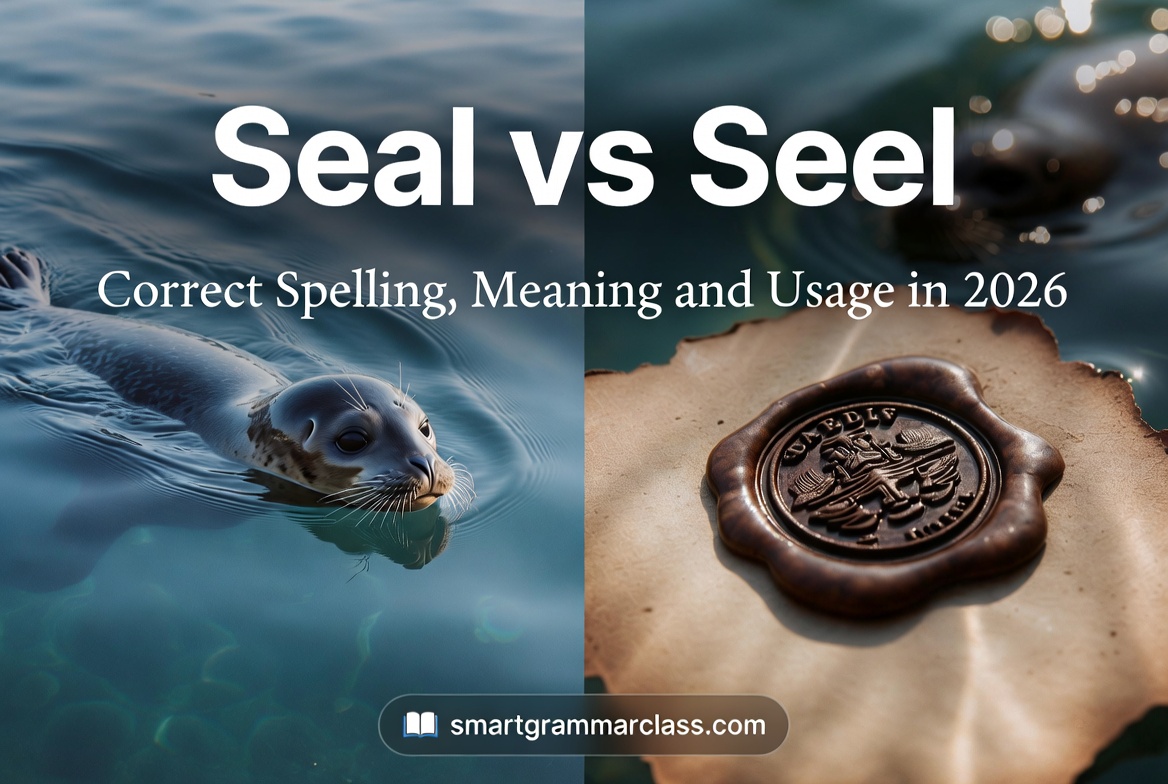
The word seal has multiple meanings including seal (noun) and seal (verb). It can refer to a marine mammal living in the ocean and cold regions. It also describes wax seal, stamp, and document authentication in formal writing contexts.
The rare word seel meaning appears in historical texts and medieval language usage. Understanding usage difference and spelling comparison improves professional clarity in writing.
Also read this: Tapped vs Taped: Correct Spelling, Meaning, and Usage in 2026
Seal vs Seel: What’s the Difference?
The easiest way to understand the distinction is through a direct comparison.
| Feature | Seal | Seel |
| Word Type | Noun and Verb | Verb |
| Modern Usage | Very Common | Extremely Rare |
| Everyday English | Yes | No |
| Historical Usage | Yes | Yes |
| Specialized Meaning | No | Yes |
| Pronunciation | Seel | Seel |
| Main Meaning | Close, secure, stamp, marine animal | Close the eyes of a hawk or falcon |
Although they sound the same, these words belong to different parts of the English vocabulary. One appears in daily communication while the other belongs to a niche historical tradition.
What Does Seal Mean?
The word seal is one of the most versatile words in English. Depending on context, it can function as both a noun and a verb.
Seal as a Noun
As a noun, seal commonly refers to:
- A marine mammal
- An official stamp
- A mark of authenticity
- A device that prevents leakage
- A symbol of approval
For example:
- The seal swam gracefully through icy waters.
- The document carried the company’s official seal.
- The jar’s rubber seal prevented air from entering.
Seal as a Verb
As a verb, seal means to close, secure, finalize, or confirm something.
Examples include:
- Seal the envelope before mailing it.
- The contractor sealed the roof against water damage.
- They sealed the business agreement yesterday.
In each example, the idea involves closing, protecting, or making something official.
Origin and Etymology of Seal
The word seal traces its roots back to Old French and Latin. Over centuries, it developed meanings associated with authentication, closure, protection, and confirmation.
Because societies needed ways to verify documents and secure containers, the word became deeply embedded in legal, commercial, and everyday language.
Today, it remains one of the most frequently used English words.
What Does Seel Mean?
Unlike seal, seel is rarely encountered in modern English.
Definition of Seel
Traditionally, seel means:
To sew or close the eyelids of a hawk or falcon temporarily.
Historically, falconers used this technique during the training process. The practice helped calm birds and reduce distractions.
While the term may sound unusual today, it once had a specific purpose in falconry culture.
Origin and History of Seel
The word emerged from older Germanic and Middle English linguistic traditions.
For centuries, falconry served as an important sport among nobles and aristocrats. During that era, specialized vocabulary developed around bird handling and training.
Seel became one of those technical terms.
As falconry declined in everyday society, the word gradually disappeared from common usage.
Why Most English Speakers Never Use Seel
Most people never encounter the word because:
- Falconry is a specialized hobby.
- Modern writing rarely discusses historical bird-training methods.
- Contemporary English favors simpler vocabulary.
- Many dictionaries classify the term as archaic or rare.
As a result, most English speakers can go their entire lives without seeing the word.
Is Seel a Real Word?
Yes. Seel is absolutely a real English word.
However, being a real word does not mean it is commonly used.
Many English words remain technically correct while appearing only in:
- Historical documents
- Academic studies
- Literary works
- Falconry manuals
- Linguistic discussions
Seel falls into that category.
When Seel Is Correct
You should use seel only when discussing:
- Falconry history
- Bird-training techniques
- Historical literature
- Archaic language studies
Outside those contexts, seal is almost always the intended word.
Seal vs Seel Pronunciation
One reason people confuse these words is pronunciation.
How to Pronounce Seal
Seal is pronounced:
/siːl/
It rhymes with:
- Feel
- Wheel
- Meal
- Deal
How to Pronounce Seel
Seel is also pronounced:
/siːl/
It shares the exact same pronunciation.
Do They Sound the Same?
Yes.
Seal and seel are perfect homophones.
A homophone is a word that sounds identical to another word but has a different meaning and spelling.
Other examples include:
| Word 1 | Word 2 |
| Flower | Flour |
| Pair | Pear |
| Sea | See |
| Knight | Night |
| Seal | Seel |
Because they sound identical, spelling becomes the only clue.
When to Use Seal
Most writers will use seal regularly.
Everyday Writing Situations
Seal appears in countless situations.
Business Documents
Companies often seal contracts and agreements.
Examples:
- The merger was sealed after months of negotiations.
- The agreement was sealed with signatures.
Packaging and Containers
Manufacturers use seals to prevent contamination.
Examples:
- Break the safety seal before opening.
- The vacuum seal preserves freshness.
Construction and Home Maintenance
Builders use sealants and protective coatings.
Examples:
- Seal the windows before winter.
- The driveway needs sealing.
Personal Communication
People frequently seal letters and packages.
Examples:
- Please seal the envelope.
- Seal the box with tape.
Common Phrases Using Seal
Several popular expressions contain the word.
Seal the Deal
Means to finalize an agreement.
Example:
- The discount helped seal the deal.
Signed, Sealed, and Delivered
Means something is completed and ready.
Example:
- The project is signed, sealed, and delivered.
Seal of Approval
Means official acceptance or endorsement.
Example:
- The product earned the organization’s seal of approval.
Under Seal
A legal expression indicating confidentiality.
Example:
- Certain court records remain under seal.
When to Use Seel
The occasions for using seel are extremely limited.
Falconry Discussions
This remains the primary context.
Example:
- Historical trainers sometimes seel young hawks during training.
Historical Research
Researchers studying medieval hunting practices may encounter the term.
Example:
- The manuscript described how falconers seel birds.
Literary References
Some older texts include the word.
Writers analyzing historical literature occasionally discuss its meaning and significance.
Outside these situations, using seel would usually be incorrect.
Seal vs Seel in Sentences
Examples help clarify proper usage.
Correct Examples of Seal
- Seal the package before shipping it.
- The mechanic checked the engine seal.
- We need to seal the cracks in the wall.
- The king’s seal appeared on the document.
- The deal was sealed during lunch.
- Seal the food container tightly.
- The company seal verified authenticity.
- Workers sealed the road surface.
- The envelope was carefully sealed.
- The seal protected the contents from moisture.
- The lawyer sealed the records.
- The waterproof seal prevented leaks.
- The official seal confirmed legitimacy.
- They sealed the partnership yesterday.
- The conservation team studied a seal colony.
Correct Examples of Seel
- Medieval falconers sometimes seel young hawks.
- Historical records describe how trainers would seel birds.
- The ancient manual explained how to seel a falcon.
- Some scholars debate when trainers should seel hunting birds.
- The text referenced a method used to seel hawks.
- Falconry apprentices learned how to seel birds safely.
- The practice of seeling became controversial.
- Researchers examined techniques used to seel falcons.
- Historical hunters occasionally seel birds before transport.
- The manuscript preserved instructions to seel raptors.
Incorrect Examples
Incorrect:
- Please seel the envelope.
Correct:
- Please seal the envelope.
Incorrect:
- The company placed its seel on the certificate.
Correct:
- The company placed its seal on the certificate.
Why People Confuse Seal and Seel
Several factors contribute to confusion.
Identical Pronunciation
The biggest reason is their identical sound.
When people hear the word spoken, they cannot determine the spelling without context.
Similar Letter Structure
Both words contain:
- Four letters
- The same vowel combination
- The same ending sound
This similarity increases spelling mistakes.
Typing Errors
Writers often type quickly.
A simple substitution of “ea” and “ee” creates confusion.
Limited Exposure to Seel
Most people recognize seal immediately.
Because seel appears rarely, many assume it is either incorrect or a variant spelling.
Common Mistakes and How to Avoid Them
Understanding frequent errors helps improve accuracy.
Mistake: Using Seel for Everyday Meanings
Many writers mistakenly substitute seel when discussing closure or security.
Wrong:
- Seel the container.
Correct:
- Seal the container.
Mistake: Thinking Both Words Are Interchangeable
They are not interchangeable.
Each word has a separate meaning.
Mistake: Assuming Seel Is a Modern Alternative
It is not.
Seal remains the standard modern spelling.
Quick Memory Trick
A simple memory aid can help.
Seal secures.
Both words begin with “se.”
The additional “a” can remind you of actions involving closure, authentication, and approval.
When discussing anything related to securing or closing something, choose seal.
Seal vs Seel in Grammar and Usage
Grammar provides another useful distinction.
Parts of Speech
| Word | Noun | Verb |
| Seal | Yes | Yes |
| Seel | No | Yes |
Seal functions more flexibly.
Verb Forms of Seal
| Form | Example |
| Base | Seal |
| Past | Sealed |
| Present Participle | Sealing |
| Past Participle | Sealed |
Examples:
- Seal the envelope.
- She sealed the package.
- They are sealing the roof.
Verb Forms of Seel
| Form | Example |
| Base | Seel |
| Past | Seeled |
| Present Participle | Seeling |
| Past Participle | Seeled |
These forms rarely appear outside historical writing.
Seal vs Similarly Confused Words
Several other words cause confusion.
Seal vs Ceil
Ceil means to cover a ceiling.
Example:
- Workers will ceil the room tomorrow.
Seal vs Sale
Sale refers to the exchange of goods.
Example:
- The store announced a major sale.
Seal vs Sill
Sill refers to a window ledge.
Example:
- Place the flowerpot on the sill.
Seel vs See
See means to observe.
Example:
- I see the mountain.
Although these words sound similar in some accents, their meanings differ significantly.
Historical Usage and Evolution
Language changes constantly.
Seal and seel followed very different paths.
Development of Seal
Seal expanded into multiple areas:
- Commerce
- Government
- Law
- Construction
- Manufacturing
- Communication
Its usefulness helped it remain common.
Development of Seel
Seel remained tied to falconry.
As fewer people practiced falconry, the word lost relevance.
Many specialized terms disappear when their associated activities become less common.
Modern Popularity
Today, seal appears millions of times more frequently than seel in books, articles, websites, and conversations.
This gap continues to widen.
Seal vs Seel in Literature and Historical Documents
Historical sources provide fascinating insights.
Seal in Literature
Writers use seal extensively.
Common literary themes include:
- Official authority
- Commitment
- Security
- Finality
The symbolism often represents trust and permanence.
Seel in Historical Works
Older hunting manuals frequently contain references to seel.
These texts document medieval and early modern bird-training practices.
Because falconry played a prominent role in aristocratic culture, the vocabulary became highly specialized.
Modern Appearances
Today, seel appears mainly in:
- Historical research
- Linguistic studies
- Falconry discussions
- Archival documents
Meanwhile, seal remains active across nearly every category of modern English.
Quick Recap: Seal vs Seel
Before moving to the FAQs, here’s a concise summary.
| Question | Answer |
| Which word is common? | Seal |
| Which word is rare? | Seel |
| Are they pronounced the same? | Yes |
| Can they be interchanged? | No |
| Which word should most writers use? | Seal |
| Does seel still exist? | Yes |
| Is seel common today? | No |
| Is seal used daily? | Yes |
FAQs
What is seal vs seel difference?
The difference between seal vs seel lies in correct spelling and usage in modern English. Seal is widely used in everyday communication, while seel is a rare historical term causing spelling confusion among English learners. Understanding meaning differences helps improve writing clarity and reduces grammar mistakes.
Are seal vs seel homophones?
Yes, seal vs seel are homophones because they share identical pronunciation in the English language. This often leads to homophone confusion and incorrect word usage in writing. Knowing proper context usage improves communication and prevents misunderstanding.
Which is the correct spelling: seal or seel?
The correct spelling in modern usage is seal, not seel. Many users mistakenly write seel due to spelling confusion and sound-alike words. Proper word choice ensures clarity in formal writing and professional communication.
What does seal mean in English?
Seal has multiple meanings including a marine mammal found in cold oceans and regions. It also refers to stamp, wax seal, and document authentication used in official communication. These varied definitions show its importance in everyday usage.
What does seel mean in language history?
Seel is an archaic term found in historical texts and old English usage. It was used in specialized contexts such as falconry, meaning to sew shut eyes. Its seel meaning is now rare but important in linguistics studies.
What are the meaning differences between seal and seel?
The meaning differences between seal vs seel are significant in modern grammar. Seal refers to animals, closure, or authentication, while seel is a historical word with limited use. Understanding these differences improves writing accuracy and communication skills.
How is seal used in example sentences?
Seal is commonly used in examples such as sealing an envelope or observing a marine animal. In example sentences, it can describe secure closure, stamp, or animal context. Proper word usage enhances writing clarity and reduces grammar mistakes.
Why does seal vs seel cause spelling confusion?
Seal vs seel causes spelling confusion because both sound identical and are sound-alike words. This leads to frequent spelling errors among learners and professionals. Learning correct spelling and context helps improve writing confidence.
Is seal related to marine mammal or document authentication?
Yes, seal refers both to a marine mammal and to document authentication tools like a stamp or wax seal. These different meanings depend on context usage. Understanding both improves professional and academic writing clarity.
Why does seel appear in historical texts?
Seel appears in historical texts due to its usage in Middle English and Old French influences. It is considered a rare or archaic term in modern English usage practice. Studying its etymology helps understand language evolution and structure.
Conclusion
In summary, understanding seal vs seel helps eliminate common spelling confusion and improves overall writing clarity in the English language. The correct spelling seal has multiple definitions, while seel meaning is mostly found in historical texts and rare usage contexts. Learning their meaning differences supports better word choice, reduces grammar mistakes, and strengthens professional communication skills. Clear context usage ensures accurate usage in both formal writing and everyday communication.

Emma Brooke is a dedicated grammar expert and language educator with a strong passion for helping learners master the English language with clarity and confidence. With years of hands-on experience in teaching grammar, writing, and communication skills, she specializes in breaking down complex language rules into simple, practical explanations.
At Smart Grammar Class, Emma focuses on creating accurate, easy-to-understand, and well-researched content that supports students, professionals, and everyday learners in improving their writing and speaking skills. Her approach combines real-world usage, clear examples, and structured guidance to ensure learners not only understand grammar rules but can apply them effectively.
Emma is committed to maintaining high editorial standards, ensuring every piece of content is reliable, up-to-date, and aligned with modern English usage. Her work reflects a deep understanding of language learning challenges and a mission to make grammar accessible to everyone.