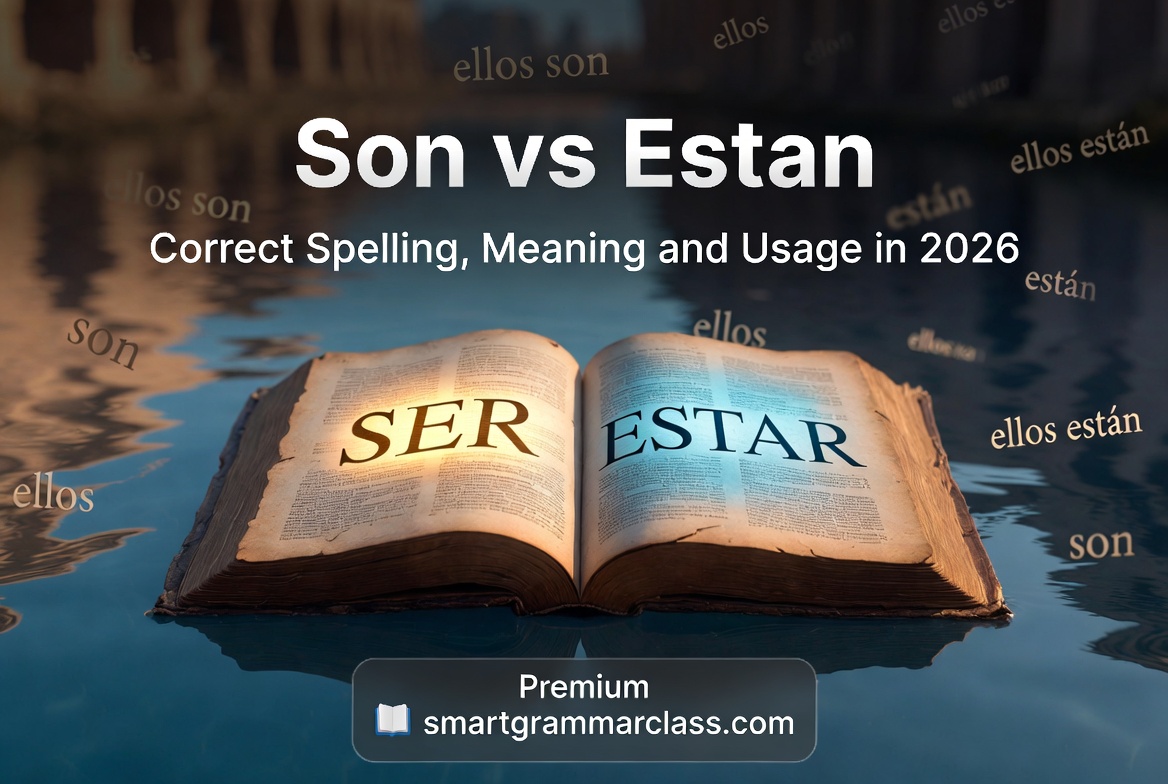
Many Spanish learners confuse son and están in daily communication. Understanding ser and estar is essential for Spanish grammar mastery. These Spanish verbs change meaning based on usage in context and situation. The difference between ser vs estar defines identity vs condition in sentences.
Permanent traits and temporary states help explain natural communication and clarity. Without proper understanding, learners face learner confusion and miscommunication in Spanish sentences. Correct usage of ser and estar describes location, emotions, and physical traits. Examples like Ellos son altos and Las manzanas son rojas show identity.
Sentences such as apples are red and Los niños están cansados express states. Ellos están en la playa describes beach location and changing conditions clearly. Mastering permanent vs temporary conditions improves Spanish communication and sentence structure. This distinction supports Spanish proficiency improvement, comprehension, and correct usage practice.
Also read this: Icycle vs Icicle: Correct Spelling, Meaning, and Usage in 2026
Son vs Están: The Fastest Way to Tell Them Apart
If you only remember one thing from this article, keep this:
- Son = identity, origin, profession, time, general facts
- Están = location, temporary condition, mood, ongoing state
That is the cleanest rule. It works in most real sentences. It also keeps you from guessing.
Here is the idea in plain English:
- Son answers the question, “What is it?”
- Están answers the question, “Where are they?” or “How are they right now?”
That tiny difference matters a lot.
| Word | Verb | Core Meaning | Common Use | Example |
| son | ser | identity or essential trait | nationality, profession, facts, time | They are students. |
| están | estar | location or temporary state | place, emotion, health, ongoing situation | They are tired. |
The accent in están matters too. Without it, estan is not the correct standard spelling. In formal writing, the accent mark should stay.
What Does Son Mean in Spanish?
Son is the third-person plural form of ser in the present tense. It means “they are” or “you all are” depending on the context. It is used for people and things in the plural.
Think of ser as the verb for identity. It points to what something is at a deep level or as a general fact. That is why son shows up in sentences about names, professions, origins, and descriptions that do not change often.
Examples:
- Son doctores.
They are doctors. - Son de México.
They are from Mexico. - Son las ocho.
It is eight o’clock. - Son inteligentes.
They are intelligent.
Notice the pattern. These sentences tell you what something is. They do not describe a temporary mood. They do not describe a location. They give you identity or a stable fact.
What Son Usually Expresses
Here are the main jobs son performs:
- Identity
Son amigos.
They are friends. - Origin
Son de Perú.
They are from Peru. - Profession
Son ingenieros.
They are engineers. - General description
Son altos.
They are tall. - Time and date
Son las cinco.
It is five o’clock. - Ownership or relationship in some fixed expressions
These use structure patterns that native speakers learn by repetition.
Why Son Feels So Stable
A useful mental trick is this: son often points to something that feels permanent or defining. A person can change jobs. Still, when you describe them in the present as “they are doctors,” that sentence presents a role or identity. Spanish treats that as part of ser territory.
That is why a sentence like:
- Ellos son felices.
can mean they are happy in a general sense or as a usual trait.
But if the happiness is temporary or tied to the moment then están often fits better:
- Ellos están felices.
That means they are happy right now.
One letter. Big difference.
What Does Están Mean in Spanish?
Están is the third-person plural form of estar in the present tense. It means “they are” or “you all are” depending on the context. Unlike son, it focuses on condition, location, or temporary status.
If ser is the identity verb, estar is the state verb. It tells you where something is or how something is doing at the moment.
Examples:
- Están en casa.
They are at home. - Están cansados.
They are tired. - Están listos.
They are ready. - Están trabajando.
They are working. - Están felices hoy.
They are happy today.
What Están Usually Expresses
Están covers these core ideas:
- Physical location
Están en la escuela.
They are at school. - Temporary condition
Están enfermos.
They are sick. - Emotion or mood
Están preocupados.
They are worried. - Ongoing action
Están estudiando.
They are studying. - Resulting state
Están abiertos.
They are open.
This is why estar feels more like a snapshot. It captures a moment. A person can be sad now and fine later. A store can be open at noon and closed at night. A package can be lost today and found tomorrow. That flexibility is what están carries.
Why the Accent in Están Matters
The accent mark is not decoration. It is part of the word.
- están = correct Spanish form
- estan = missing the accent mark
In casual typing people sometimes skip accents. In correct writing you should not. If the goal is clean and accurate Spanish then the accent belongs there.
Son vs Están: The Core Grammar Rule
The easiest way to use these words correctly is to ask one question before you write the sentence:
Am I describing identity or condition?
If the answer is identity, use son.
If the answer is condition or location, use están.
That is the backbone of the rule.
Use Son When You Mean
- who someone is
- what something is
- where someone comes from
- what time it is
- a general truth
- a lasting characteristic
Use Están When You Mean
- where someone or something is
- how someone feels right now
- what state something is in
- what is happening right now
- a temporary condition
This difference is easy to see in pairs:
- Son inteligentes.
They are intelligent.
This sounds like a general trait. - Están inteligentes.
This is unusual in standard everyday speech unless you mean they are acting smart or looking sharp in a specific situation. - Son en la casa.
Wrong.
“In the house” is location so están works better. - Están en la casa.
They are in the house.
That is the kind of contrast that helps the rule stick.
Son vs Están in Real Sentences
Grammar gets easier when you stop treating it like a chart and start treating it like language people actually use. Here are real examples with short explanations.
Examples with Son
- Mis padres son médicos.
My parents are doctors.
This describes profession. - Ellos son de España.
They are from Spain.
This gives origin. - Las clases son a las nueve.
The classes are at nine.
This talks about time. - Los estudiantes son responsables.
The students are responsible.
This suggests a general trait. - Esas casas son grandes.
Those houses are big.
This describes a lasting quality.
Examples with Están
- Mis padres están en casa.
My parents are at home.
This gives location. - Ellos están cansados.
They are tired.
This is temporary condition. - Las clases están canceladas.
The classes are canceled.
This is a current state. - Los estudiantes están listos.
The students are ready.
This is a temporary condition. - Esas casas están vacías.
Those houses are empty.
This describes a current state.
A Simple Comparison
Look at these pairs:
- Son felices vs están felices
- Son enojados vs están enojados
- Son abiertos vs están abiertos
- Son profesores vs están profesores
The first word in each pair usually feels like a trait or identity. The second feels like a condition or moment.
That difference gives you the clue.
Son vs Están: A Clear Table for Quick Review
| Situation | Use son | Use están |
| Identity | Yes | No |
| Profession | Yes | No |
| Origin | Yes | No |
| Time | Yes | No |
| General description | Yes | Sometimes no |
| Location | No | Yes |
| Temporary feeling | No | Yes |
| Physical state | No | Yes |
| Ongoing action | No | Yes |
A table like this works because it turns a fuzzy rule into a fast decision tool. When you are unsure, test the sentence against the table. Ask yourself whether the sentence is describing a fixed fact or a temporary situation.
If it is a fact then son probably works.
If it is temporary then están probably works.
How to Use Son in a Sentence
Using son correctly is not hard once you know the patterns. The word usually appears before a noun or adjective in a sentence about identity or a general truth.
Common Structures with Son
- Subject + son + noun
Ellos son estudiantes. - Subject + son + adjective
Ellos son amables. - Subject + son + de + place
Ellos son de Argentina. - Son las + time
Son las siete.
More Examples
- Los perros son fieles.
- Mis vecinos son arquitectos.
- Ellos son de Chile.
- Son las dos y media.
- Las reglas son claras.
When Son Sounds Natural
Use son when the sentence feels like a label, a fact, or a broad description. Think of a name tag. That is the vibe.
A person can be tired today and energetic tomorrow. Those are states.
A person can be a teacher. That is identity.
- Son maestros. = identity
- Están cansados. = state
That contrast is the heart of the decision.
How to Use Están in a Sentence
Están often appears with location words, adjectives about temporary states, or continuous actions.
Common Structures with Están
- Subject + están + en + place
Ellos están en la oficina. - Subject + están + adjective
Ellos están nerviosos. - Subject + están + participle
Ellos están ocupados. - Subject + están + gerund
Ellos están trabajando.
More Examples
- Los libros están sobre la mesa.
- Mis amigos están contentos hoy.
- Los niños están jugando afuera.
- Las puertas están cerradas.
- Las luces están encendidas.
When Están Sounds Natural
Use están when the sentence feels like a camera snapshot. It shows what is happening now or what something looks like at this moment.
A room can be open now and closed later.
A person can be calm now and upset later.
A team can be ready now and not ready ten minutes later.
That temporary feel is the signal.
Son vs Están: Common Mistakes to Avoid
Many learners do not fail because they do not know the words. They fail because English teaches them one habit and Spanish expects another.
Mistake One: Using Son for Location
Wrong:
- Ellos son en la escuela.
Right:
- Ellos están en la escuela.
Why?
Because location belongs to estar, not ser.
Mistake Two: Using Están for Identity
Wrong:
- Ellos están médicos.
Right:
- Ellos son médicos.
Why?
A profession is identity. That belongs to ser.
Mistake Three: Ignoring the Accent in Están
Wrong:
- estan cansados
Right:
- están cansados
Why?
The accent is part of the correct spelling in standard Spanish.
Mistake Four: Translating Too Literally from English
English says “are” for almost everything. Spanish does not. That is where many beginners slip.
- “They are at home” → están en casa
- “They are teachers” → son maestros
Same English verb. Different Spanish verb.
Mistake Five: Trusting Vibes Instead of Grammar
Sometimes learners choose based on what sounds “close enough.” That is risky. Spanish uses a real system. Learn the system and the answers become much easier.
Context Matters More Than Memorization
Rules help. Context wins.
A sentence can change meaning with one small shift. That is why Spanish learners should read the whole sentence before choosing son or están. Do not isolate the adjective and guess. Look at the meaning behind it.
Example: Happy
- Ellos son felices.
They are happy people.
This can sound like a stable trait. - Ellos están felices.
They are happy now.
This sounds more temporary.
Example: Open
- La tienda es abierta.
This is not the usual everyday choice in most cases. - La tienda está abierta.
The store is open.
This is the normal sentence because open or closed is a current state.
Example: Ready
- Ellos son listos.
This means they are smart or clever. - Ellos están listos.
They are ready.
Same word. Different verb. Different meaning.
That is why context matters so much.
Son vs Están: Exceptions and Special Cases
Spanish has a few tricky spots. These are not random. They are just the places where English habits can mislead you.
Temporary vs Permanent Feelings
Some adjectives can work with both verbs. The meaning changes a little.
- Él es aburrido.
He is boring.
This sounds like a general trait. - Él está aburrido.
He is bored.
This sounds like a current feeling.
That is a classic example. The adjective looks the same. The verb changes the meaning.
Health Conditions
Health often uses estar because it is temporary.
- Estoy enfermo.
- Ellos están resfriados.
But not every condition works the same way. Some descriptions are more stable and can lean toward identity depending on the sentence. That is why context stays important.
Location with Events
Events usually use ser when talking about the time they take place.
- La reunión es a las tres.
- La fiesta es el sábado.
But the physical location of people or things uses estar.
- Ellos están en la reunión.
So time with events often goes to ser while physical location goes to estar.
Idiomatic Expressions
Some phrases simply follow the language as it is used. You do not build them piece by piece. You learn them as a unit.
Examples often depend on fixed usage patterns. That is why memorizing the logic helps, but exposure helps too.
A Practical Decision Tree for Son vs Están
When you are stuck, use this quick sequence:
- Is the sentence about a person or thing being in a place?
Use están. - Is it about a temporary condition or feeling?
Use están. - Is it about profession, identity, origin, or time?
Use son. - Is it a general fact or stable description?
Use son. - Does the adjective change meaning depending on the verb?
Check context carefully.
That little process saves time. It also trains your mind to think like a Spanish speaker instead of translating word by word.
Son vs Están in Everyday Life
It helps to see how these words work in real situations instead of isolated grammar drills.
At School
- Los alumnos son curiosos.
They are curious students.
This sounds like a general trait. - Los alumnos están cansados.
They are tired.
This is a temporary state after class or exams.
At Work
- Ellos son contadores.
They are accountants. - Ellos están ocupados.
They are busy.
At Home
- La familia es de Colombia.
The family is from Colombia. - La familia está en casa.
The family is at home.
In a Store
- La tienda es pequeña.
The store is small. - La tienda está cerrada.
The store is closed.
That last pair is useful because it shows a common real-world pattern. A store can be small as a lasting description. Closed is just the current state.
Son vs Están: Mini Case Study
A student named Ana keeps writing sentences like these:
- Mis amigos son enojados.
- La cena es lista.
- Ellos son en casa.
At first glance the sentences look almost right. The problem is the verb choice. Ana is using son everywhere because she sees “are” in English and reaches for the first Spanish option.
Here is how the correction works:
- Mis amigos están enojados.
They are angry right now. - La cena está lista.
Dinner is ready. - Ellos están en casa.
They are at home.
Why did the fix happen?
Because each sentence needed a state or location. Not identity. Not a permanent trait. Once Ana learned to ask that one question, her accuracy jumped fast.
This is a common learning pattern. The mistake is not random. It comes from treating Spanish like English with different words. That does not work here. Spanish grammar has its own logic and the logic is reliable once you learn it.
Helpful Memory Tricks for Son vs Están
Memory tricks should not replace grammar. They should make the grammar easier to remember.
Trick One: Son = “State of the Self”
This is not a formal rule. It is just a memory hook. Son often connects to what someone is as a person or thing.
Trick Two: Están = “in a certain state”
That one is closer to the real meaning. Están often tells you where something is or how it is right now.
Trick Three: Ask “Forever or for now?”
- If it feels like forever or at least long-term then son may fit.
- If it feels like for now then están usually fits.
Trick Four: Identity vs Snapshot
- Son = identity card
- Están = photo taken right now
That comparison is simple and sticky. It helps in the moment when your brain wants to freeze.
Son vs Están: Common Patterns You Should Know
Here are some patterns that show up over and over.
Son + professions
- Son doctores
- Son abogados
- Son chefs
Son + origin
- Son de Brasil
- Son de Italia
- Son de aquí
Son + time
- Son las nueve
- Son las dos
- Son las siete y media
Están + location
- Están en la cocina
- Están en el parque
- Están aquí
Están + emotional state
- Están felices
- Están tristes
- Están preocupados
Están + physical condition
- Están enfermos
- Están cansados
- Están listos
Están + ongoing action
- Están hablando
- Están corriendo
- Están estudiando
When you see these patterns often enough, your brain starts recognizing them before you consciously think about grammar. That is the goal.
Son vs Están: Simple Practice Exercises
Practice helps the rule settle in. Try these mentally before checking the answers.
Choose Son or Están
- Ellos ___ en el jardín.
- Mis primos ___ médicos.
- Las cajas ___ pesadas hoy.
- Son las cuatro.
- La maestra ___ muy amable.
- Los niños ___ jugando.
- Mis padres ___ de Argentina.
- La puerta ___ abierta.
Answers
- están
- son
- están
- son
- es
- están
- son
- está
That last set shows something useful. Sometimes you need es or está rather than son or están. The same rule still applies. You just need the singular form when the subject is singular.
Son vs Están: Quick Cheat Sheet
| Clue | Use son | Use están |
| Profession | Yes | No |
| Origin | Yes | No |
| Time | Yes | No |
| Identity | Yes | No |
| Location | No | Yes |
| Temporary mood | No | Yes |
| Current condition | No | Yes |
| Ongoing action | No | Yes |
Keep this in front of you when you practice. It cuts out guesswork.
Son vs Están: How to Build Real Accuracy
If you want this distinction to feel natural then repetition alone is not enough. You need the right kind of repetition.
Read Short Spanish Sentences
Short examples help your brain see the pattern faster.
Compare Pairs
Look at two sentences side by side:
- Ellos son altos.
- Ellos están cansados.
The contrast teaches faster than a long explanation.
Say the Sentences Out Loud
Speaking makes the pattern stick. Your ear starts catching what looks right and what sounds off.
Write Your Own Examples
Use people and things from your own life:
- My brother is a teacher.
- My friends are at school.
- The kitchen is clean.
- The kids are tired.
Then translate them into Spanish with the correct verb.
Focus on Meaning First
Do not hunt for the right word mechanically. Ask what the sentence is really saying. Identity or state. Permanent or temporary. Place or trait. That simple habit does more than memorizing a chart.
Son vs Están: Why This Difference Matters
This is more than a grammar quiz. The choice changes tone and meaning.
A single verb can make a sentence sound like a permanent label or a temporary condition. That matters in conversation. It matters in writing. It matters in translation too.
For example:
- Él es serio.
He is serious.
This feels like a trait. - Él está serio.
He is serious right now.
This feels situational.
That is a real shift. Native speakers feel it instantly. Learners can feel it too once they stop treating the words as random.
The best part is that the system is consistent. Spanish is not trying to trick you. It is giving you a precise way to talk about reality. One verb handles what things are. The other handles what things are like at the moment.
That is elegant. And practical.
FAQs
What is the difference between son and están in Spanish?
The words son and están come from ser and estar, two core parts of Spanish grammar. The concept of ser vs estar helps learners understand meaning and usage in context. Son describes identity or lasting qualities, while están describes changing conditions or states.
When should I use ser vs estar correctly?
Use ser vs estar based on whether you describe permanent traits or temporary states. Ser is used for identity and inherent meaning, while estar focuses on condition or situation. This rule improves clarity in Spanish sentences and communication.
Can you give examples of son and están in sentences?
Examples like Ellos son altos and Las manzanas son rojas show identity and stable qualities. Meanwhile, Los niños están cansados and Las manzanas están maduras show temporary conditions. These Spanish examples improve comprehension and correct usage.
How does estar describe location in Spanish?
The verb estar is used for location description and changing situations. For example, Ellos están en la playa explains beach location clearly. This helps learners understand contextual meaning and avoid miscommunication in daily communication.
When do we use ser for identity and profession?
Ser expresses identity, nationality, profession, and inherent traits that remain stable. It is used in sentences like Ellos son estudiantes to define long-lasting qualities. This strengthens understanding of Spanish communication and correct sentence formation.
How do ser and estar express emotions and physical traits?
Ser describes permanent characteristics, while estar shows emotion state or temporary feelings. For example, being tired uses Los niños están cansados. This difference improves understanding of condition meaning and natural expression.
Why do Spanish learners confuse son and están?
Many Spanish learners face learner confusion due to similar meanings in translation. The difference between permanent vs temporary usage creates mistakes in Spanish communication. This often leads to miscommunication risk in early learning stages.
What are the grammar rules for ser and estar usage?
Spanish grammar rules explain when to use ser for identity and estar for condition. Understanding usage in context helps learners avoid incorrect sentence patterns. This supports clearer language understanding and improved grammatical accuracy.
How can I improve Spanish proficiency with ser and estar?
Regular practice of Spanish sentences using ser vs estar improves Spanish proficiency improvement. Learning patterns like identity vs condition helps reduce errors. Consistent exposure strengthens comprehension and speaking improvement in real conversations.
How does sentence structure change with ser and estar?
Correct sentence structure depends on choosing ser or estar properly. Misuse can lead to unnatural sentences and confusion in meaning shift. Mastering Spanish verb system improves clarity, comprehension, and natural communication flow.
Conclusion
In conclusion, mastering son and están is essential for understanding ser and estar in Spanish grammar. The correct use of ser vs estar improves clarity in Spanish sentences and everyday communication. Learners gain better control of identity vs condition, avoiding confusion between permanent traits and temporary states. This distinction strengthens Spanish communication, language understanding, and accurate usage in context. With consistent practice, learners improve Spanish proficiency improvement and achieve more natural and confident expression.

mma Rose is a skilled grammar expert and language educator dedicated to helping learners improve their English with clarity and confidence. With extensive experience in teaching grammar, writing, and communication, she specializes in simplifying complex language rules into easy, practical explanations.
At Smart Grammar Class, Emma creates well-researched, accurate, and user-friendly content designed for students, professionals, and everyday learners. Her teaching approach focuses on real-life examples, clear structure, and actionable guidance, enabling readers to apply grammar rules effectively in both writing and speaking.
Emma is committed to maintaining high editorial standards, ensuring every article is trustworthy, up-to-date, and aligned with modern English usage. Her goal is to make grammar simple, accessible, and useful for everyone.