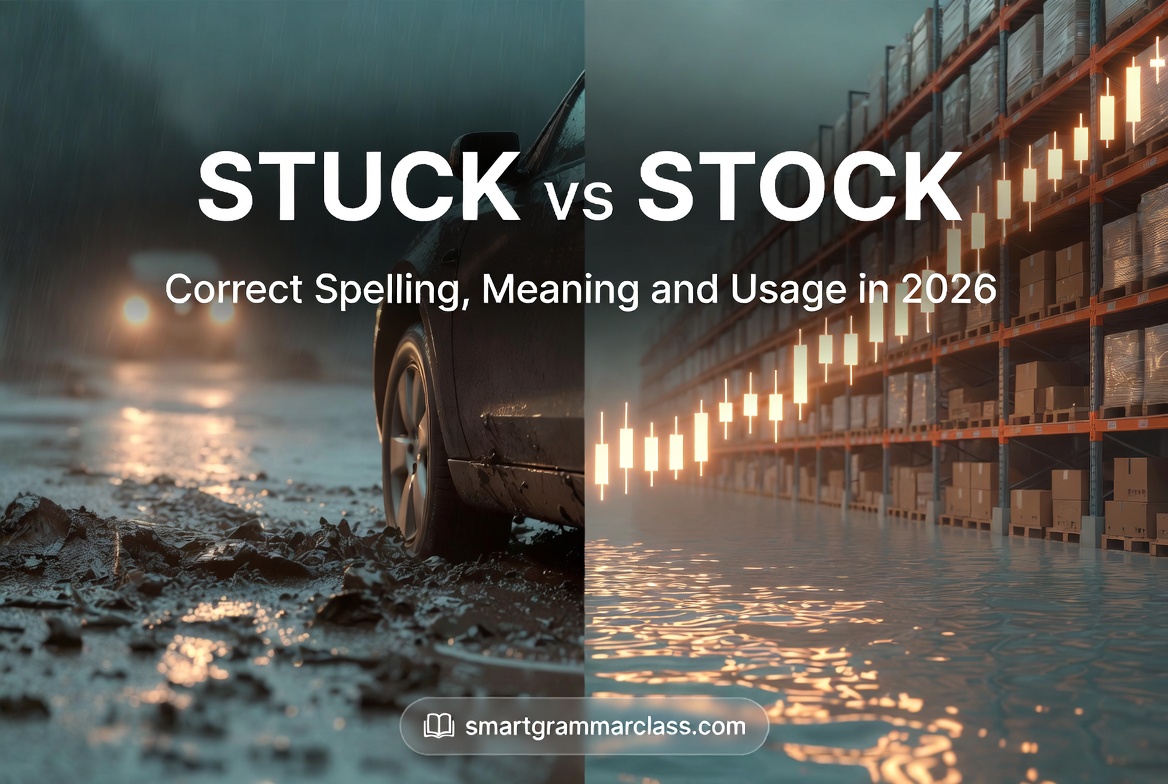
The confusion between stuck vs stock often appears in everyday English usage. Both words have similar sounds and sound similarity, causing pronunciation similarity issues and correct spelling confusion. However, they show different meanings and a clear difference depending on context and meaning.
Stuck usually refers to unable to move, stuck situation, emotional state, and mental state experiences. Stock relates to supply, goods, materials, stock market, investments, and cooking stock contexts. A clear guide improves understanding difference and reduces confusion in practical communication use.
In real usage, traffic jam, elevator stuck, and job stuck show everyday situations. Writers often confuse stucked, stocked, and proper word forms in speech and writing. Memory tricks and examples help learning usage, reducing grammar confusion and spelling confusion effectively.
Context in physical, financial, and creative writing improves understanding difference and clarity. Businesses, invest, investment, restock shelves, and product availability clarify stock usage. English language learning ensures everyday English uses proper word choice and mistake avoidance.
Also read this: Coming vs Comming: Correct Spelling, Meaning, and Usage in 2026
Stuck vs Stock Meaning Explained in 2026
Stuck vs Stock: What Each Word Really Means
Before using these words correctly, you need a strong grip on what they actually mean in modern English.
Define Stuck in Simple Terms
The word stuck describes a situation where movement or progress stops.
It often shows:
- Physical restriction
- Emotional blockage
- Mental confusion
- Situational limitation
Think of it as a “no exit” condition.
Core idea of “stuck”
- You cannot move forward
- You cannot change position easily
- You feel trapped in a situation
Everyday meaning examples
- A car stuck in mud
- A person stuck in traffic
- A student stuck on a math problem
- Someone stuck in overthinking
Common word pairings
- Stuck in
- Stuck on
- Stuck with
Each pairing changes meaning slightly but keeps the idea of restriction.
Define Stock in Simple Terms
The word stock carries multiple meanings depending on context.
At its core, it refers to:
- Supply of goods
- Financial shares
- Stored ingredients
- General reserves
Core idea of “stock”
- Something stored or available
- Something owned or traded
- Something prepared in advance
Main categories of stock usage
- Business inventory
- Financial markets
- Cooking base liquids
- General reserves
Everyday meaning examples
- A store keeps stock of products
- A person buys stock in a company
- A chef prepares chicken stock
- A warehouse holds stock items
Stuck vs Stock Meaning Comparison Table
Understanding differences becomes easier when you see them side by side.
| Feature | Stuck | Stock |
| Core meaning | Unable to move or progress | Stored supply or financial shares |
| Category | Action or condition | Noun with multiple domains |
| Context | Physical, emotional, mental | Business, finance, cooking |
| Usage tone | Problem or limitation | Resource or value |
| Example | Stuck in traffic | Stock in a store |
This table helps lock the difference in memory quickly.
How To Use Stuck vs Stock in Real Sentences
Correct usage depends on context. The structure of the sentence often reveals the right word.
How To Use “Stuck” in Sentences
The word stuck usually appears as part of a verb phrase.
Common sentence patterns
- Subject + is/was + stuck + preposition
- Subject + got stuck + location or situation
Examples in real life
- I got stuck in traffic for two hours
- She is stuck in a difficult decision
- The key got stuck in the lock
- He feels stuck in his job
Emotional usage examples
- I feel stuck in life right now
- They are stuck in a cycle of worry
Physical usage examples
- The door is stuck shut
- The elevator got stuck between floors
How To Use “Stock” in Sentences
The word stock behaves more like a noun in most cases.
Common sentence patterns
- Subject + has + stock
- Store + keeps + stock
- Company + issues + stock
Business examples
- The store has enough stock for the weekend
- We need to restock inventory
- The warehouse manages large stock levels
Finance examples
- He bought stock in a tech company
- The stock price increased today
- Investors track stock performance closely
Cooking examples
- The soup uses chicken stock as a base
- Vegetable stock adds flavor to dishes
Stuck vs Stock Examples in Real Usage
Seeing both words in real sentences makes differences crystal clear.
Mixed comparison examples
- I am stuck in traffic vs The store is out of stock
- She feels stuck in her routine vs The shop restocked its stock
- The door is stuck vs The warehouse tracks stock levels
Each pair shows how meaning shifts completely.
Common Mistakes With Stuck vs Stock
Writers often confuse these words because they look similar. The spelling difference is small but the meaning gap is large.
Mistake: Using “Stuck” When You Mean “Stock”
This usually happens in business writing.
Incorrect examples
- We need more stuck in the warehouse
- The store has low stuck levels
Correct versions
- We need more stock in the warehouse
- The store has low stock levels
Mistake: Using “Stock” When You Mean “Stuck”
This happens in casual speech or rushed writing.
Incorrect examples
- I am stock in traffic
- The door is stock
Correct versions
- I am stuck in traffic
- The door is stuck
Mistake: Ignoring Context
Context matters more than spelling speed.
If the sentence involves movement or restriction, “stuck” is usually correct.
If it involves supply, ownership, or finance, “stock” is correct.
Context-Based Understanding of Stuck vs Stock
The same word can feel natural in one field and completely wrong in another.
Financial Context
In finance, stock refers to ownership in companies.
Key ideas
- Shares represent ownership
- Stock value changes daily
- Investors track trends closely
Example
- She invested in stock to build long-term wealth
Transportation Context
In movement-related situations, stuck dominates.
Example situations
- Traffic jams
- Broken vehicles
- Blocked roads
Example
- The bus is stuck due to heavy rain
Mechanical Context
Machines often get stuck due to faults or obstruction.
Examples
- Printer stuck mid-page
- Gear stuck inside engine
- Button stuck on device
Creative Context
Writers sometimes use stock differently.
It can mean common phrases or repeated material.
Example
- Stock characters appear in many stories
Meanwhile, stuck appears in emotional storytelling.
Example
- The character feels stuck in his past
Memory Tricks to Remember Stuck vs Stock
Simple tricks help avoid confusion in real writing.
Visual Trick
- Stuck = something frozen or trapped
- Stock = shelves full of items
Picture:
- A car stuck in mud
- A warehouse full of boxes
Sound Trick
- “Stuck” sounds sharp and stopped
- “Stock” sounds steady and stored
Context Trick
Ask this question before choosing:
- Does it involve movement or blockage
- Does it involve supply or ownership
That answer usually solves it instantly
Practice Case Studies: Real-Life Usage
Case Study 1: Retail Store Error
A small shop owner wrote:
- “We are stuck of goods in storage”
This caused confusion in customer messaging.
Correct version
- “We are out of stock in storage”
Lesson:
Inventory always uses stock language.
Case Study 2: Travel Blog Mistake
A travel writer wrote:
- “Tourists got stock in airport delays”
Readers misunderstood the message.
Correct version
- “Tourists got stuck in airport delays”
Lesson:
Movement issues always use stuck.
Case Study 3: Finance Article Confusion
A finance beginner wrote:
- “He invested in stuck of Tesla”
This changed meaning completely.
Correct version
- “He invested in stock of Tesla”
Lesson:
Finance always uses stock.
Quick Reference Cheat Sheet
| Situation | Use Stuck | Use Stock |
| Traffic | Yes | No |
| Inventory | No | Yes |
| Emotional state | Yes | No |
| Finance | No | Yes |
| Mechanical issue | Yes | No |
| Cooking base | No | Yes |
Common Idioms and Special Usage
Stuck Expressions
- Stuck in a rut
- Stuck on someone
- Stuck between choices
Stock Expressions
- Stock up on supplies
- Stock market rise
- In stock or out of stock
FAQs
What is the correct spelling between stuck vs stock in 2026?
The correct spelling depends on usage, as stuck vs stock are two different meanings. In English language, stuck is used for unable to move or trapped, while stock refers to supply, goods, and investments. Understanding the difference helps avoid confusion in everyday communication.
What do stuck and stock mean in simple terms?
Stuck describes a stuck situation, emotional state, or inability to progress. Stock refers to supply, materials, or financial investments like the stock market. Both words share sound similarity but have different meanings in context.
Why do stuck and stock sound similar in English?
The confusion comes from similar sounds, vowel sounds, and pronunciation similarity. Despite sounding alike, stuck vs stock carry completely different meanings. This often leads to confusion in speech and everyday English usage.
How is stuck used in real-life situations?
Stuck is used in cases like traffic jam, elevator stuck, or job stuck situations. It can also reflect mental state or emotional state such as stress or indecision. These examples show a clear physical context and real-life usage.
How is stock used in finance and daily life?
Stock relates to supply, goods, and materials, especially in businesses. It also includes financial investments, stock market, and investment opportunities. Companies often restock shelves to maintain product availability for customers.
What is the main difference between stuck vs stock?
The key difference lies in context and meaning. Stuck shows unable to move or blocked progress, while stock refers to goods, supply, or investments. Understanding physical context and financial context helps improve clarity.
What are common mistakes in stuck vs stock usage?
Common mistakes include writing stucked instead of stuck and stocked in wrong contexts. These errors create spelling confusion and affect clarity. Correct usage improves writing and prevents mistake in communication.
How can memory tricks help understand stuck vs stock?
Memory tricks help learners distinguish stuck vs stock using simple associations. Think of stuck as being trapped and stock as stored goods or investments. This improves understanding difference and reduces confusion in learning usage.
How does context change the meaning of stuck and stock?
Context plays a major role in meaning. In physical context, stuck refers to being trapped, while in financial context, stock relates to investments. Creative writing also uses both differently for clear understanding difference.
How do stuck vs stock improve communication clarity?
Using correct words improves clear communication in writing and speech. Understanding stuck vs stock avoids confusion and enhances everyday English. Proper usage ensures better examples, accuracy, and stronger language learning skills.
Conclusion
The confusion between stuck vs stock often comes from sound similarity but clear contextual difference in the English language. Understanding correct spelling, meaning, and usage helps avoid mistakes in everyday English. Learning their difference improves clarity and reduces confusion in communication. With proper practice, learners can master both terms and use them accurately in real situations.

Emma Brooke is a dedicated grammar expert and language educator with a strong passion for helping learners master the English language with clarity and confidence. With years of hands-on experience in teaching grammar, writing, and communication skills, she specializes in breaking down complex language rules into simple, practical explanations.
At Smart Grammar Class, Emma focuses on creating accurate, easy-to-understand, and well-researched content that supports students, professionals, and everyday learners in improving their writing and speaking skills. Her approach combines real-world usage, clear examples, and structured guidance to ensure learners not only understand grammar rules but can apply them effectively.
Emma is committed to maintaining high editorial standards, ensuring every piece of content is reliable, up-to-date, and aligned with modern English usage. Her work reflects a deep understanding of language learning challenges and a mission to make grammar accessible to everyone.