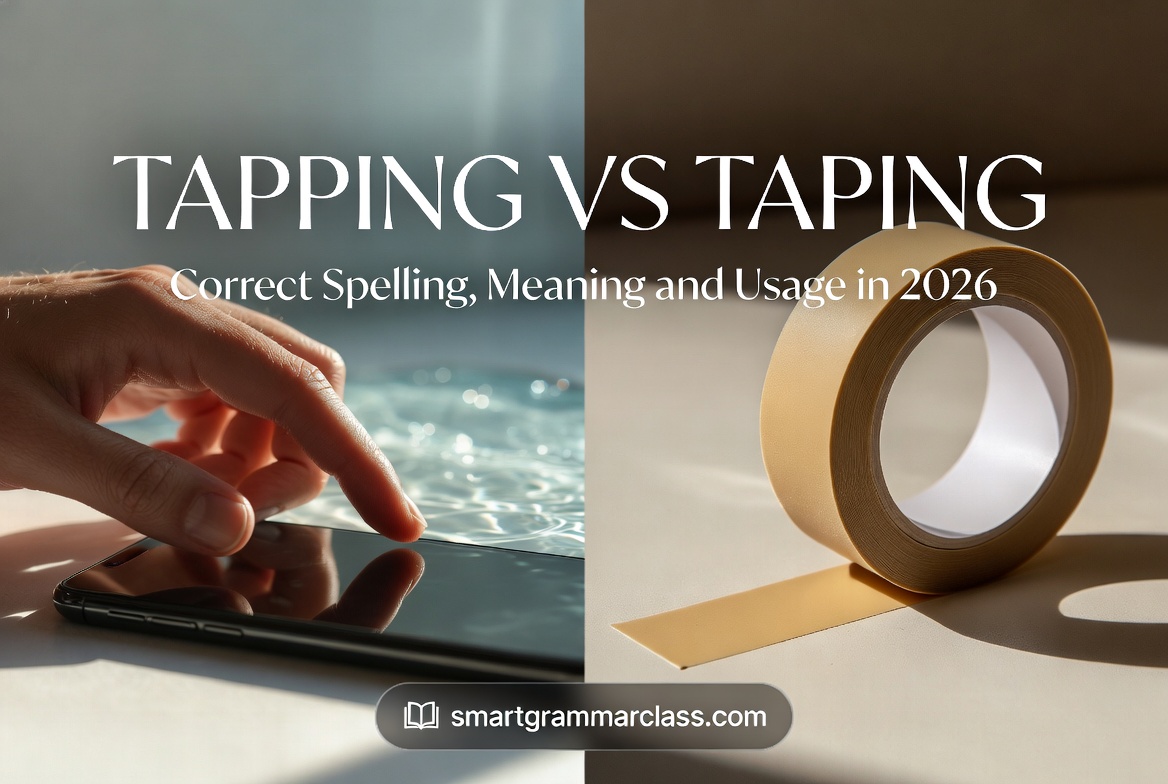
The confusion between tapping vs taping often appears in English language writing. Understanding spelling, meaning, and usage helps avoid miscommunication in writing. In usage in 2026, grammar and communication demand strong clarity and precision.
Tapping refers to lightly striking or repeated touch on surfaces or screens. Taping involves applying adhesive tape for securing, wrapping, and box sealing. Many learners check dictionary usage due to similar spelling and context confusion.
The tapping vs taping difference depends on context and practical usage examples. Tapping includes rhythmic tapping, tapping screen actions, and light contact motions. Taping meaning includes securing with tape, packaging, and recording media contexts.
Practical examples and usage guide improve understanding through comparison table clarity. Common mistakes in grammar rules lead to error prevention and writing accuracy. Professional writing and everyday language require clear communication and correct context sentences.
Also read this: Emaculate vs Immaculate: Correct Spelling, Meaning, and Usage in 2026
Tapping vs Taping: Quick Answer
Here is the fastest way to tell them apart.
Tapping means touching lightly, hitting lightly, or accessing something through a connection.
Taping means using tape to hold something in place or to record something.
Simple examples:
- She is tapping the screen.
- He is taping the box shut.
A short memory trick helps:
- If a finger, tool, or repeated touch is involved, think tapping.
- If adhesive tape is involved, think taping.
That one rule solves most confusion.
Why Tapping and Taping Get Mixed Up So Often
These two words confuse people for a few very ordinary reasons.
First, they sound almost identical in everyday speech. The difference is only one letter on the page, so the ear does not always help the hand.
Second, both words show up in modern life constantly. Phones are tapped. Packages are taped. Joints are taped. Keys are tapped. The words live in similar spaces, so people start blending them together.
Third, speed causes mistakes. In texts, notes, emails, and social media captions, people type quickly and trust autocorrect too much. That is how “I’m taping the screen” slips in when the writer means tapping.
The confusion is not about intelligence. It is about habit. Once the pattern is clear, the mistake becomes easy to avoid.
What Does Tapping Mean?
Tapping has several related meanings, but they all share one idea: light contact or access through touch.
Tapping as Light Physical Contact
This is the most familiar use.
- Tapping a table with your fingers
- Tapping someone on the shoulder
- Tapping glass to get attention
The action is usually light, quick, and controlled. It is not a hard hit. It is a small contact meant to signal something.
Tapping as Repeated Interaction
This meaning appears often in casual language and body movement.
- Tapping a pen on a desk
- Tapping a foot during a long wait
- Tapping a rhythm with your fingers
Here, the action often repeats. It may show impatience, rhythm, thought, or nervous energy.
Tapping in Technology
Modern devices made this word even more common.
- Tapping a phone screen
- Tapping an app icon
- Tapping a menu option
In digital use, tapping means using a fingertip to select or open something. It is the mobile-world version of clicking.
Tapping in Technical and Industrial Contexts
This word also appears in specialized fields.
- Tapping a resource or supply line
- Tapping a signal in electronics
- Tapping a data stream in computing
Here, tapping means accessing or drawing from something in a controlled way. The action is still about contact or connection, but the meaning becomes more technical.
What Does Taping Mean?
Taping is much more concrete. It always involves tape in some form.
Taping as Securing or Binding
This is the everyday meaning most people use.
- Taping a package before shipping
- Taping paper to a board
- Taping cables together
The goal is usually to hold something in place, seal it, or organize it.
Taping in Medical and Sports Settings
This is a big one, and people often see it in athletic training.
- Taping an ankle for support
- Taping a wrist before a game
- Taping muscles with athletic tape
In these cases, taping provides structure, stability, or injury support.
Taping as Recording
This older but still valid meaning comes from media and broadcasting.
- Taping an interview
- Taping a performance
- Taping a live show
Even though digital recording is now standard, people still use the word “taping” in media contexts.
Taping as Surface Protection
Taping is also common in home and repair work.
- Taping edges before painting
- Taping a crack temporarily
- Taping exposed wires
This use is practical and physical. It is about protection, insulation, or short-term fixing.
Tapping vs Taping: The Core Difference
The easiest way to remember the difference is to think in terms of action.
Tapping is an action of touch.
Taping is an action of adhesive use or recording.
Here is a clear comparison.
| Word | Main Idea | Common Use | Key Visual |
| Tapping | Touch or access | Screens, surfaces, rhythm, signals | A finger touching lightly |
| Taping | Tape or recording | Packages, wounds, cables, shows | Tape holding something in place |
Another quick rule helps:
- Tapping usually involves motion or contact.
- Taping usually involves tape or a recording process.
That is the whole game.
How to Use Tapping in a Sentence
The best way to learn a word is to see it in real sentences. Tapping works in several settings.
Everyday Sentences with Tapping
- She kept tapping her pen while thinking.
- He was tapping the table with his fingers.
- Someone was tapping on the window.
These examples show light contact. Nothing heavy. Nothing sticky. Just touch.
Technology Sentences with Tapping
- I’m tapping the app to open it.
- She started tapping the screen to scroll.
- He is tapping the notification to read the message.
This is modern and extremely common. On phones, tablets, and smartwatches, tapping is the normal action.
Technical Sentences with Tapping
- The engineer is tapping the signal for testing.
- The company is tapping new data sources.
- The system can tap into unused capacity.
These examples are more specialized, but they all keep the same central idea: controlled access through contact or connection.
How to Use Taping in a Sentence
Taping almost always means using tape or recording something.
Everyday Sentences with Taping
- She is taping the box shut.
- He is taping the cables together.
- They are taping paper to the wall.
These examples are physical and practical. Tape is doing the work.
Medical and Sports Sentences with Taping
- The trainer is taping the athlete’s ankle.
- The nurse is taping the bandage in place.
- She needs taping before the match.
In this setting, taping is about support, protection, and control.
Media Sentences with Taping
- The crew is taping the interview.
- They were taping the concert for broadcast.
- The studio is taping a new episode today.
This usage can feel a little old-school, but it is still correct and widely understood.
More Examples of Tapping and Taping in Sentences
Sometimes side-by-side examples make the difference stick.
- He is tapping the door lightly.
- He is taping the door shut for storage.
- She was tapping the rhythm on the desk.
- She was taping a poster to the wall.
- The user is tapping the screen to select a file.
- The technician is taping the wires to keep them neat.
- The child kept tapping his foot.
- The nurse was taping the child’s wrist after the exam.
Notice the pattern. Tapping is the action of contact. Taping is the action of applying tape or recording.
Common Mistakes to Avoid
People make a few predictable mistakes with these words.
Using Tapping and Taping Interchangeably
This is the biggest error. The words are not interchangeable. They may sound alike, but they do different jobs.
Wrong:
- She is taping the screen.
Correct:
- She is tapping the screen.
Wrong:
- He was tapping the box shut.
Correct:
- He was taping the box shut.
Choosing the Wrong Word by Sound Alone
Sound can trick you. If you only listen and do not check meaning, the wrong word slips in easily.
Forgetting the Role of Tape
If tape is not involved, taping probably does not belong in the sentence.
Using Tapping When You Mean Recording
A lot of people still say “taping” for recording because of older media language. That is fine. But “tapping” is not the right word there.
Tips to Avoid Common Mistakes
A few habits can make the difference easy to remember.
- Ask whether the action is a touch or a tape job.
- Replace the word mentally with “light touch” or “adhesive use.”
- Check whether the sentence is about a screen, a surface, or a signal.
- Check whether the sentence is about packaging, bandaging, or recording.
A fast test helps:
- If you can imagine a finger touching something, think tapping.
- If you can imagine tape being pulled from a roll, think taping.
That tiny pause saves a lot of editing later.
Context Matters More Than Guessing
Context is the real key. A word can only be understood correctly when you look at the sentence around it.
Industrial Applications
In manufacturing or engineering, both words can appear in different ways.
- Tapping may refer to accessing a system, signal, or resource.
- Taping may refer to securing materials or labeling parts.
A factory manual must be precise. One wrong word can make the instruction sound off.
Medical Applications
Medical writing uses both terms often, but the meanings are distinct.
- Taping supports joints, muscles, and wounds.
- Tapping can refer to a diagnostic action or light contact.
Athletic taping is especially common in sports medicine. Tapping, by contrast, is more likely to appear in examination or communication contexts.
Electrical Applications
Electrical work demands exact language.
- Tapping can refer to connecting to a circuit or signal.
- Taping often means insulating, bundling, or securing wires.
One word describes access. The other describes coverage or fixation.
DIY Projects
Home projects bring both terms into the same room.
- Tapping a nail lightly into place
- Taping a wall before painting
- Tapping a screw to align it
- Taping a package for shipping
DIY language is full of small physical actions. That makes context extra important.
Exceptions to Watch For
Most of the time, the rule is simple. Still, a few special uses can make people pause.
Medical and Athletic Language
“Taping” has a strong meaning in sports and healthcare. It is not just wrapping tape around something casually. It often refers to a planned support method.
Resource and Technical Language
“Tapping” can mean accessing something hidden or controlled. This is common in engineering, electronics, and data systems.
Recording Language
“Taping” still survives in media language even though digital recording has replaced older tape equipment in many cases. The word remains valid.
These are not exceptions to the spelling rule. They are just special contexts where the words show up more often.
Case Study: Sports Medicine in Real Life
A high school basketball player rolls an ankle during practice. The trainer applies taping to support the joint before the next game. That taping helps stabilize movement and reduce strain.
Later the coach taps the player on the shoulder and gives a quiet instruction before the second half.
Both words appear in the same story, but they do very different jobs.
- Taping supports the ankle.
- Tapping is the light physical touch on the shoulder.
This kind of example is useful because it shows how easily the words can live in the same space without meaning the same thing.
Case Study: Office and Technology Use
A project manager reviews a mobile app prototype. She keeps tapping through the screens while checking the flow. Later, the design team finishes taping a printed mockup to the meeting room wall.
Again, the words look similar. The context does the real work.
- Tapping means interacting with a device.
- Taping means attaching something with tape.
This is exactly why careful word choice matters in business writing. A single word can make a process sound polished or sloppy.
Case Study: Packaging and Shipping
A small business owner prepares a dozen orders. He tapes each box securely so nothing opens during transit. Then he taps the barcode scanner to confirm the shipment details.
The workflow includes both actions. One is adhesive. One is touch-based.
That is a practical reminder that the words are not enemies. They are just different.
Real-World Examples by Context
Industrial Context
- The technician is tapping into the control system.
- The worker is taping labels onto the shipment crates.
Medical Context
- The trainer is taping the athlete’s knee.
- The doctor is tapping the patient’s knee during an exam.
Electrical Context
- The engineer is tapping into the signal line.
- The electrician is taping the exposed wire.
DIY Context
- He is tapping the nail lightly into the frame.
- She is taping the edges before painting.
These examples show the logic in action. Once you see the pattern, the words stop feeling slippery.
Usage Comparison Table
| Context | Correct Word | Why |
| Touching a screen | Tapping | It is a light touch |
| Sealing a box | Taping | Tape is used |
| Recording an interview | Taping | It means recording |
| Light knock on a door | Tapping | It is a gentle contact |
| Supporting an ankle | Taping | Tape is used for support |
| Accessing a signal | Tapping | It means controlled access |
This table makes one thing very clear. The difference is not about style. It is about meaning.
Practice Exercises
A little practice makes the rule feel automatic.
Fill in the Blank
- She is ___ the screen to open the app.
- He is ___ the box before mailing it.
- The athlete needs ___ before the match.
- Someone was ___ on the window.
Multiple Choice
Choose the correct word.
- The nurse is (tapping / taping) the bandage.
- He keeps (tapping / taping) his pen on the desk.
- The crew is (tapping / taping) the concert.
- She is (tapping / taping) the cables together.
Answers
- tapping
- taping
- taping
- tapping
- taping
- tapping
- taping
- taping
If those felt easy, the distinction is starting to stick.
Tapping vs Taping in Everyday Writing
This difference matters in all kinds of writing.
In Emails
Professional writing needs precision.
- “I’m tapping the file” works if the person is touching a screen.
- “I’m taping the box” works if the person is sealing a package.
In Social Media
Captions often move fast, but the words still need to make sense.
- “Tapping through the app like crazy”
- “Taping my ankle before the game”
In Work Documents
Technical and workplace writing must be especially clear.
A wrong word can make instructions confusing, especially when the task involves physical steps, equipment, or medical support.
Quick Rules That Make the Difference Easy
A few rules cover almost every case.
- Use tapping for light touch.
- Use tapping for screen interaction.
- Use tapping for repeated small motions.
- Use taping for tape-based fixing.
- Use taping for wrapping, sealing, or securing.
- Use taping for recording content.
A good sentence check works like this:
- Does the sentence involve fingers, light contact, or interaction? Use tapping.
- Does the sentence involve tape or recording? Use taping.
That is the cleanest shortcut.
FAQs
What is the difference between tapping and taping in English language?
The difference between tapping vs taping lies in meaning, spelling, and usage in 2026. Tapping refers to light contact or rhythmic striking, while taping refers to using adhesive tape for securing or wrapping objects. Understanding this helps improve grammar and clear communication.
How is tapping used in everyday language and communication?
Tapping is commonly used in everyday language for actions like tapping a screen, tapping a table, or repeated tapping. It describes light contact, rhythmic tapping, and simple physical interaction. Proper context ensures writing accuracy and avoids miscommunication.
What does taping mean in practical and professional contexts?
Taping meaning involves applying tape for securing, wrapping, or box sealing in packaging tasks. It is also used in recording media, such as audio recording and video recording. In professional writing, correct word choice ensures precision and clarity.
Why do people confuse tapping vs taping in writing?
People confuse tapping vs taping due to similar sounding words and a small spelling difference. This often leads to errors in sentences and poor grammar rules application. Learning dictionary usage helps improve comprehension and reduces common mistakes.
How can learners avoid mistakes in tapping and taping usage?
Learners can avoid mistakes by understanding word meaning, definitions, and correct usage in different contexts. Practicing sentence patterns and reviewing examples improves writing precision. This strengthens communication clarity and prevents error prevention issues.
Conclusion
In conclusion, understanding tapping vs taping is essential for improving English language grammar and communication clarity in usage in 2026. The correct grasp of tapping as light contact or repeated touch and taping meaning as securing with adhesive tape improves word choice and writing accuracy. Clear knowledge of spelling, meaning, and usage reduces confusion and supports better clear communication in both everyday language and professional writing. Learning through examples and proper context strengthens precision and prevents miscommunication in real sentences.

Emma Brooke is a dedicated grammar expert and language educator with a strong passion for helping learners master the English language with clarity and confidence. With years of hands-on experience in teaching grammar, writing, and communication skills, she specializes in breaking down complex language rules into simple, practical explanations.
At Smart Grammar Class, Emma focuses on creating accurate, easy-to-understand, and well-researched content that supports students, professionals, and everyday learners in improving their writing and speaking skills. Her approach combines real-world usage, clear examples, and structured guidance to ensure learners not only understand grammar rules but can apply them effectively.
Emma is committed to maintaining high editorial standards, ensuring every piece of content is reliable, up-to-date, and aligned with modern English usage. Her work reflects a deep understanding of language learning challenges and a mission to make grammar accessible to everyone.