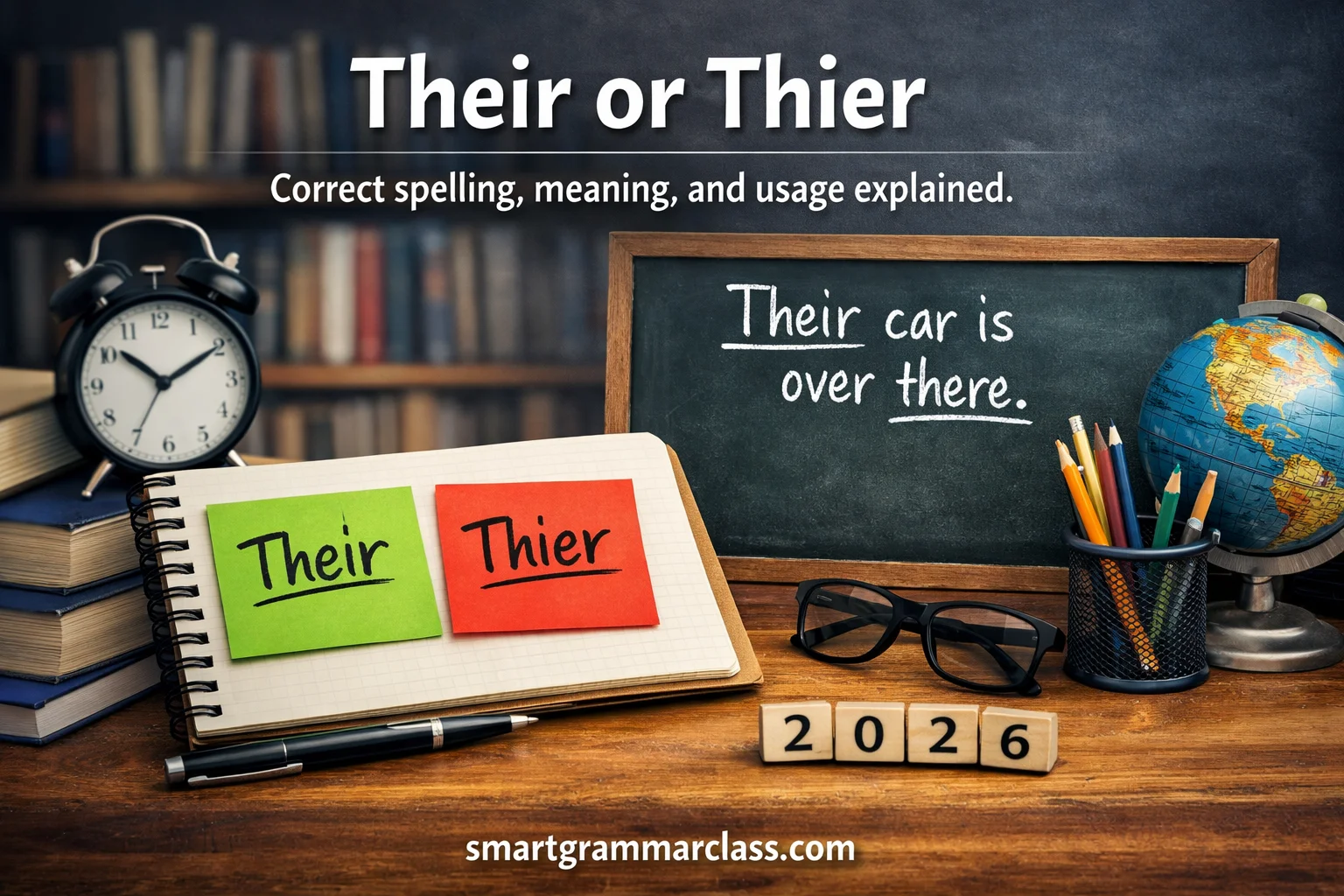
If you often feel confused between their and thier, you’re not alone. This spelling confusion is a very common spelling mistake in the English language, especially when typing fast in emails, blogs, or social media posts. The truth is simple: their is the correct spelling, while thier is an incorrect spelling and a common typo caused by a letter mix-up. In grammar, their is a possessive pronoun used to show ownership for a group, people, or even animals—like in “their car” or “their house.” Many learners, including both native speakers and non-native speakers, mix it up with there (for location) and they’re (a contraction of they are), which creates more confusion in English writing.
From my own experience working with students, writers, and even professionals, I’ve seen how this small typo can affect communication, clarity, and even trust, especially in school work or professional emails. For better writing confidence, it’s important to follow simple grammar rules and spelling rules, use spellcheck tools, and focus on proofreading and editing. Regular practice, simple exercises, and clear examples can help you remember the correct word and avoid the wrong word.
This small step improves content quality, boosts readability, and even helps with search engines and content ranking. Over time, you will learn, understand, and naturally use the right spelling, improving your writing skills, language skills, and overall vocabulary in everyday usage with better accuracy and effective communication—that’s how usage explained really works in 2026.
Also read this : Atleast or At Least: Correct Spelling and Meaning 2026
Their or Thier – Quick Answer That Clears Confusion Fast
Let’s keep this simple.
- “Their” is correct
- “Thier” is incorrect
- “Their” shows possession
- “Thier” is a spelling mistake with no accepted meaning
If you remember nothing else remember this. “Their” is the only correct form you should ever use.
A quick trick helps.
“Their” contains the word “heir.” Heirs inherit things. That connects directly to ownership.
Why This Confusion Happens So Often
At first glance this seems like a careless mistake. It’s not. There are real reasons why people mix up “their” and “thier.”
English spelling isn’t always logical. That’s part of the problem.
Here’s what causes the confusion:
- The “i before e” rule has exceptions
- Words like “weird” and “their” break the rule
- Fast typing leads to letter reversal
- Autocorrect sometimes misses context errors
- Similar sounding words increase mental load
Now add pressure. Maybe you’re writing an email quickly. Maybe you’re posting online. Your brain focuses on meaning. Your fingers handle spelling. That gap creates mistakes.
The Real Meaning of “Their” Explained Simply
“Their” is a possessive determiner. That sounds technical. It’s actually simple.
It shows that something belongs to a group.
Think of it like this. Replace “their” with “belonging to them.” If it still makes sense then you’re using it correctly.
Examples That Make It Clear
- Their car is parked outside
- Students forgot their homework
- The team celebrated their victory
- Dogs wag their tails
Each sentence answers one question.
Who does it belong to?
Why “Thier” Is Always Incorrect
Let’s be direct. “Thier” is not a word. It has no grammatical role. It has no accepted meaning.
You’ll still see it though.
Where does it appear?
- Text messages typed in a rush
- First drafts that haven’t been edited
- Social media comments
- Beginner writing
Here’s the problem. Once it appears in published content it becomes a credibility issue.
Why It Matters More Than You Think
- Readers notice spelling errors instantly
- Errors reduce trust in your content
- Search engines may rank content lower
- Professional communication suffers
Even a single typo can shift perception. Clean writing signals competence.
Their vs There vs They’re – The Trio That Trips Everyone
This is where confusion multiplies. These three words sound identical. They behave very differently.
Quick Comparison Table
| Word | Function | Meaning | Example |
| Their | Possessive | Belonging to them | Their house is large |
| There | Adverb or pronoun | Refers to place or existence | Put it over there |
| They’re | Contraction | Short for “they are” | They’re coming soon |
Simple Test That Always Works
- Replace “they’re” with “they are”
- If the sentence still works you’re correct
Example:
They’re happy → They are happy ✔
Visual Breakdown
- Their → ownership
- There → location
- They’re → action or state
Once you see it this way confusion fades fast.
Memory Tricks That Actually Stick
Forget long grammar lessons. These quick tricks stay with you.
Easy Mnemonics
- Their → contains “heir” → ownership
- There → contains “here” → location
- They’re → apostrophe → missing letters
Quick Mental Shortcut
Ask yourself:
- Is this about ownership? → use their
- Is this about place? → use there
- Can I say “they are”? → use they’re
Short checks like this save time. They also reduce hesitation.
Common Mistakes You Should Avoid Immediately
Even experienced writers slip into bad habits. Awareness fixes most of them.
Frequent Errors
- Writing “thier” instead of “their”
- Mixing “there” and “their” in one sentence
- Ignoring spellcheck suggestions
- Relying only on sound instead of meaning
Before and After Examples
| Incorrect Sentence | Correct Sentence |
| Thier car is broken | Their car is broken |
| They left there bags | They left their bags |
| Their going to the store | They’re going to the store |
| Put it in their | Put it in there |
See how small changes fix everything.
Real World Examples That Make It Click
You learn faster with real usage. Patterns stick better than rules.
Everyday Sentences
- Parents guide their children through challenges
- Businesses protect their customer data
- Writers refine their drafts before publishing
- Athletes train to improve their performance
Professional Context
- Companies monitor their financial growth
- Teams track their project milestones
- Leaders support their employees
Academic Context
- Students present their research findings
- Teachers evaluate their progress
Every example reinforces one idea. Ownership.
How Usage Has Evolved in Digital Writing
Language changes fast online. Some rules bend. This one doesn’t.
“Their” has remained consistent across:
- Blogs
- Emails
- Academic writing
- Social media
Meanwhile “thier” continues to appear only as an error.
Why Digital Writing Makes This More Important
- Content spreads quickly
- Errors get copied and repeated
- Readers skim instead of reading deeply
- First impressions matter more than ever
Clean spelling improves readability. It also improves engagement.
Search Trends and Usage Data Insights
Search behavior tells a story. People search for both terms. However the intent differs.
What the Data Shows
- “Their” dominates correct usage searches
- “Thier” appears mainly in correction queries
- Grammar searches spike during academic seasons
You can explore this yourself using:
https://trends.google.com
Search for “their vs thier.” You’ll notice a clear pattern. Most users want clarification.
What This Means for Writers
- Correct spelling improves SEO performance
- Readers trust accurate content more
- Clear writing increases time on page
Small details create big advantages.
Case Study: How One Small Error Impacts Credibility
Let’s look at a simple scenario.
Situation
Two blog posts cover the same topic.
Post A:
- Uses correct spelling
- Clean formatting
- Clear structure
Post B:
- Uses “thier” multiple times
- Contains inconsistent grammar
- Feels rushed
Results
| Factor | Post A | Post B |
| Reader Trust | High | Low |
| Time on Page | Longer | Shorter |
| Bounce Rate | Lower | Higher |
| SEO Ranking | Stronger | Weaker |
One small spelling mistake can ripple through the entire experience.
Practical Tips to Never Misspell “Their” Again
You don’t need perfect grammar skills. You need simple systems.
Daily Writing Habits
- Slow down during final review
- Read sentences out loud
- Use spellcheck tools
- Focus on meaning not just sound
Editing Checklist
Before publishing ask:
- Does this show ownership?
- Did I accidentally type “thier”?
- Can I replace it with “belonging to them”?
Tools That Help
- Grammarly
- Hemingway Editor
- Built in browser spellcheck
These tools catch mistakes early.
Advanced Insight: Why the Brain Reverses Letters
This goes deeper than typing errors.
Your brain processes words as patterns. It doesn’t read letter by letter. That’s why “thier” often slips through.
Cognitive Factors
- The brain prioritizes meaning over structure
- Familiar shapes get accepted quickly
- Fast reading reduces attention to detail
What This Means for You
You won’t catch every error during writing. That’s normal.
You catch them during editing.
Their in Formal vs Informal Writing
Good news. The rule stays the same everywhere.
Formal Writing
- Academic essays
- Business reports
- Professional emails
Use “their” correctly every time.
Informal Writing
- Text messages
- Social media
- Personal notes
Even here correct spelling improves clarity.
Consistency builds strong writing habits.
Subtle Nuances Most People Miss
Here’s where things get interesting.
“Their” can refer to:
- People
- Animals
- Objects
- Abstract groups
Examples
- The company updated their policy
- The committee announced their decision
- The team changed their strategy
Even singular entities can use “their” in modern English. This supports gender neutral language.
FAQs
What is the correct spelling: their or thier?
The correct spelling is their. The word thier is an incorrect spelling and a very common spelling mistake caused by a simple letter mix-up.
What does their mean in the English language?
In the English language, their is a possessive pronoun used to show ownership for people, a group, or animals, such as in “their car” or “their house.”
Why do people confuse their, there, and they’re?
This spelling confusion happens because these words sound the same but have different meaning and usage. There refers to a location, while they’re is a contraction of they are, which makes it tricky for many learners.
How can I avoid this common typo in writing?
To avoid this common typo, focus on grammar rules, use spellcheck tools, and practice proofreading and editing your emails, blogs, or social media posts regularly.
Why is correct usage of their important?
Using the correct usage of their improves clarity, builds trust, and strengthens communication. It also enhances content quality, readability, and overall writing confidence for students, writers, and professionals.
Conclusion
In conclusion, understanding the difference between their and thier is essential for clear and effective English writing. Since their is the correct spelling and thier is an incorrect spelling, using the right spelling helps avoid any spelling confusion and improves overall communication. By following simple grammar rules, practicing regularly, and focusing on correct usage, you can boost your writing skills, enhance readability, and build strong writing confidence in your everyday usage.

mma Rose is a skilled grammar expert and language educator dedicated to helping learners improve their English with clarity and confidence. With extensive experience in teaching grammar, writing, and communication, she specializes in simplifying complex language rules into easy, practical explanations.
At Smart Grammar Class, Emma creates well-researched, accurate, and user-friendly content designed for students, professionals, and everyday learners. Her teaching approach focuses on real-life examples, clear structure, and actionable guidance, enabling readers to apply grammar rules effectively in both writing and speaking.
Emma is committed to maintaining high editorial standards, ensuring every article is trustworthy, up-to-date, and aligned with modern English usage. Her goal is to make grammar simple, accessible, and useful for everyone.