When you have typed something like worse case scenario, you may have paused, wondering if it looks correct. This confusion is common among learners, even native speakers, because these confusing word pairs often confuse people who are searching for the right spelling. In this beginner-friendly grammar guide, I’ll explain why this mistake happens and how to remember the correct phrase.
As a student, writer, or professional, I’ve seen this error in emails, reports, and even websites, and fixing it can really improve your English writing and confidence. The simple explanation is that worse is a comparative word used to compare specific things, while worst is a superlative that shows the extreme possibility or worst possible thing in a situation.
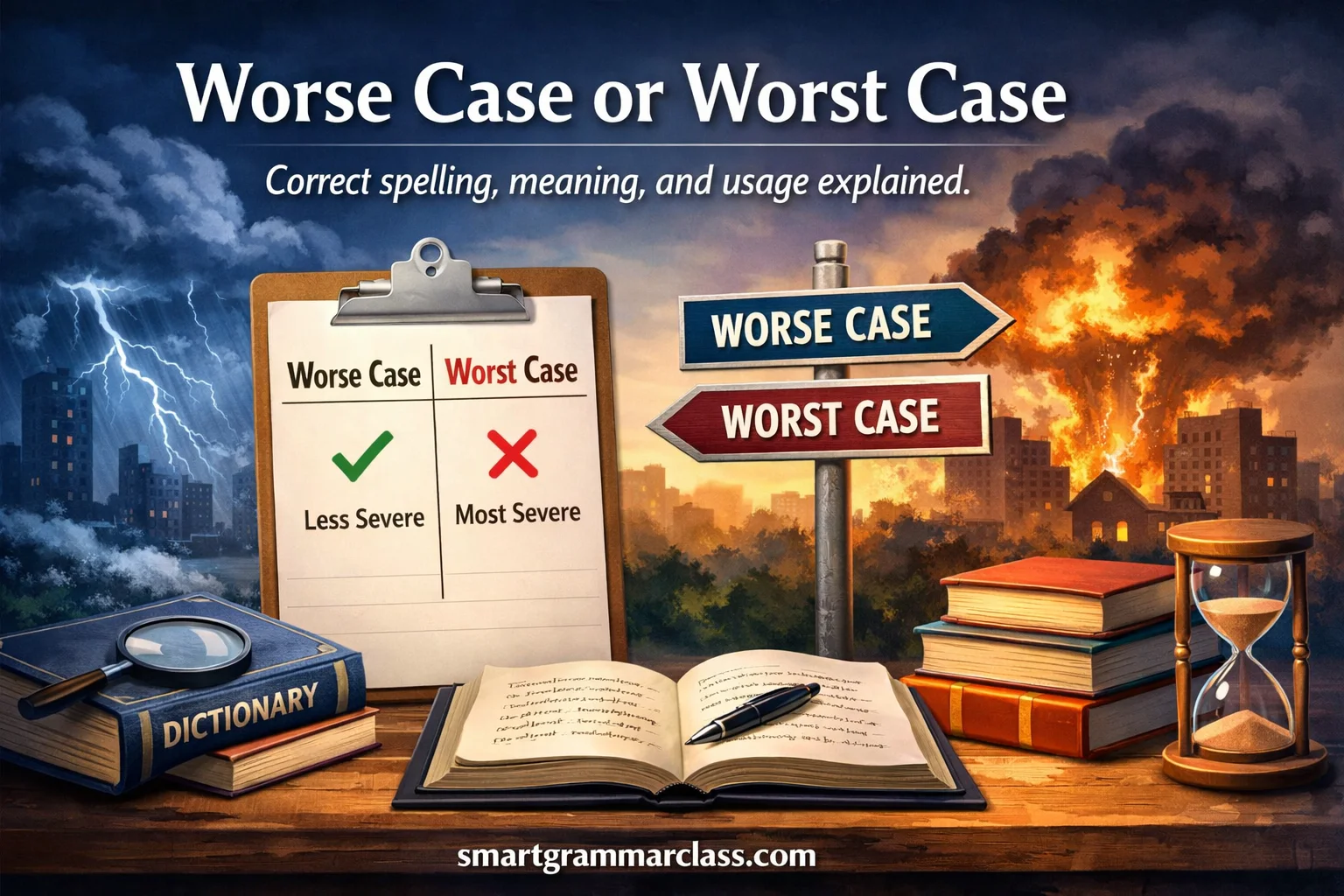
The correct phrase is always worst-case scenario, often used as a compound adjective and sometimes hyphenated as worst-case scenario in formal writing. Using worse case or worse-case scenario is an incorrect use in the English language, even though it sometimes pops up and feels off. The meaning of worst-case scenario is the most negative outcome you can imagine, something you should be prepared for in real-life situations.
Many students accidentally use the wrong phrase in essays and conversations, but with clear grammar rules, real examples, and a bit of practice exercises, you can master this expression. This guide breaks down the understanding difference so you can speak and write confidently, using proper English that truly indicates clarity—not confusion in vocal sound or writing.
Also read this : Their or Thier: Correct Spelling Meaning and Usage 2026
Instant Answer: Worse Case or Worst Case?
Here’s the truth.
- ✅ “Worst case” is correct
- ❌ “Worse case” is almost always wrong
If you’re talking about the most extreme negative outcome, you should always use worst case scenario.
Quick comparison
| Phrase | Correct | Why |
| Worst case scenario | ✅ Yes | Refers to the most extreme outcome |
| Worse case scenario | ❌ No | Incorrect grammar in this context |
Example:
- “Worst case, we delay the launch by a week.” ✔
- “Worse case, we delay the launch.” ✖
👉 Simple rule: If you mean the absolute worst outcome, use worst. Always.
📌 What “Worst Case” Actually Means
Let’s break it down without overcomplicating things.
Worst case refers to the most severe or unfavorable situation that could happen. It’s often used when planning, predicting risks, or preparing for uncertainty.
Where you’ll see it used
- Business planning
- Risk management
- Software testing
- Finance and investing
- Everyday conversations
Real-life examples
- “Worst case, we lose the client.”
- “Worst case, the system goes offline during peak hours.”
- “Worst case, we cancel the trip.”
Notice something? These sentences feel natural. That’s because worst case fits the context perfectly.
🧠 Why People Confuse “Worse” and “Worst”
This confusion isn’t random. It comes from how English handles comparison.
Both words come from the same root: bad. But they serve different roles.
Comparison levels explained
| Word | Type | Meaning | Example |
| Bad | Base | Negative quality | This is bad |
| Worse | Comparative | More bad than something else | This is worse than before |
| Worst | Superlative | The most bad of all | This is the worst outcome |
The key difference
- Worse compares two things
- Worst describes the extreme among many
👉 That’s why “worse case scenario” doesn’t work. You’re not comparing two scenarios. You’re talking about the absolute worst outcome.
⚡ The Only Time “Worse Case” Makes Sense
Here’s where things get interesting.
“Worse case” isn’t completely wrong. It’s just rare and often misunderstood.
You can use “worse” when making a direct comparison between two cases.
Example
- “This case is worse than the previous one.” ✔
In this sentence, “worse” compares two situations. That’s correct.
But here’s the catch
You cannot say:
- “Worse case scenario” ✖
Why? Because you’re not comparing anything. You’re describing a single extreme outcome.
👉 Think of it this way:
- Comparison → use worse
- Extreme outcome → use worst
🧭 Worst Case vs Worst-Case (Hyphen Rule)
This is where many writers slip up.
There’s a subtle difference between worst case and worst-case.
The rule is simple
- Worst case = noun phrase
- Worst-case = adjective
Examples
- “Prepare for the worst case.” ✔
- “We need a worst-case plan.” ✔
Quick trick
If the phrase describes something, use a hyphen.
If it stands alone, don’t.
Table for clarity
| Usage Type | Correct Form | Example |
| Noun phrase | worst case | Plan for the worst case |
| Adjective | worst-case | Worst-case scenario planning |
👉 This small detail can make your writing look polished and professional.
⚠️ Common Mistakes That Hurt Credibility
Let’s be honest. Small grammar mistakes can damage how people perceive your writing.
And “worse case scenario” is one of those mistakes.
Common errors
- Writing “worse case scenario” in professional emails
- Mixing “worse” and “worst” in the same sentence
- Using “worst case” without context
Examples
Incorrect:
- “In the worse case scenario, we lose everything.”
Correct:
- “In the worst case scenario, we lose everything.”
Why it matters
- It signals weak attention to detail
- It reduces trust in professional settings
- It makes content look unpolished
👉 Fixing this one mistake instantly improves your writing.
✍️ Real-World Examples You Actually Use
Let’s move beyond theory.
Here’s how worst case shows up in real situations.
Business
- “Worst case, revenue drops by 15 percent.”
- “Worst case, the deal falls through.”
Technology
- “Worst case, the server crashes during deployment.”
- “Worst case, users lose their data.”
Finance
- “Worst case, the investment loses value.”
- “Worst case, we break even.”
Everyday life
- “Worst case, we stay home.”
- “Worst case, we try again tomorrow.”
👉 Notice how flexible it is. You can use it almost anywhere.
📊 Usage Trends and Popularity
Data doesn’t lie.
Search trends clearly show that “worst case scenario” dominates usage.
What the data reveals
- “Worst case scenario” appears millions of times across books and web pages
- “Worse case scenario” shows up mostly as a mistake
- Search engines favor the correct version
Useful tools
Insight
If you use “worse case scenario,” your content risks looking incorrect. That can hurt rankings and credibility.
👉 Stick with what people actually search for: worst case.
🇺🇸 American English vs British English
Some grammar differences depend on region. This one doesn’t.
The truth
- American English uses worst case
- British English uses worst case
There’s no variation here.
👉 This is not a spelling difference. It’s a grammar rule.
🧩 Synonyms and Better Alternatives
Repeating “worst case” too often can make your writing feel flat.
Switch it up with alternatives.
Strong alternatives
- worst-case scenario
- worst possible outcome
- maximum risk situation
- extreme downside
- least favorable outcome
Examples
- “In the worst possible outcome, the project fails.”
- “The extreme downside includes losing all capital.”
👉 Variety keeps your writing engaging and sharp.
🧠 Pro Writing Tip: Sound Smarter Instantly
Want your writing to stand out?
Don’t just repeat phrases. Refine them.
Upgrade your sentences
Basic:
- “Worst case, we lose money.”
Better:
- “In the worst-case scenario, the investment turns negative.”
Why it works
- Adds clarity
- Sounds more professional
- Keeps readers engaged
👉 Small tweaks create a big impact.
📚 Mini Case Study: How One Phrase Changes Perception
Let’s compare two versions of the same message.
Version A
- “In the worse case scenario, the company might fail.”
Version B
- “In the worst-case scenario, the company could fail.”
What changes?
- Version A feels careless
- Version B feels precise and credible
👉 One word can shift how readers judge your expertise.
🔎 Quick Recap Cheat Sheet
Here’s everything you need in one place.
- Worst = extreme level → ✅ correct
- Worse = comparison → ⚠️ limited use
- Worst case = noun phrase
- Worst-case = adjective
- Worse case scenario = ❌ incorrect
👉 When in doubt, choose worst case.
FAQs
What is the correct phrase: worse case or worst case?
The correct phrase is worst case. It refers to the most extreme or negative situation possible, while worse case is grammatically incorrect in this context.
Why do people confuse worse and worst?
People often confuse them because both come from the same root word and sound similar. Worse is used for comparison between two things, while worst describes the highest level of something negative.
Is “worst-case scenario” always hyphenated?
Yes, when used before a noun, it is usually written as worst-case scenario with a hyphen. This makes it a compound adjective and keeps the meaning clear.
Can I use worse case in any situation?
No, worse case is not correct in standard English usage. You should always use worst case when talking about an extreme or negative possibility.
How can I remember the difference easily?
A simple trick is to remember that worst means the most extreme. If you are talking about the most negative outcome, always choose worst case instead of worse case.
Conclusion
In summary, understanding the difference between worse case and worst case is essential for clear and proper English. The correct phrase is always worst-case scenario, as it expresses the most extreme possibility in any situation, while worse case remains an incorrect use. By learning these simple grammar rules, using real examples, and practicing regularly, students, learners, and even native speakers can avoid this common mistake and write confidently in emails, reports, and everyday communication.

Emma Brooke is a dedicated grammar expert and language educator with a strong passion for helping learners master the English language with clarity and confidence. With years of hands-on experience in teaching grammar, writing, and communication skills, she specializes in breaking down complex language rules into simple, practical explanations.
At Smart Grammar Class, Emma focuses on creating accurate, easy-to-understand, and well-researched content that supports students, professionals, and everyday learners in improving their writing and speaking skills. Her approach combines real-world usage, clear examples, and structured guidance to ensure learners not only understand grammar rules but can apply them effectively.
Emma is committed to maintaining high editorial standards, ensuring every piece of content is reliable, up-to-date, and aligned with modern English usage. Her work reflects a deep understanding of language learning challenges and a mission to make grammar accessible to everyone.