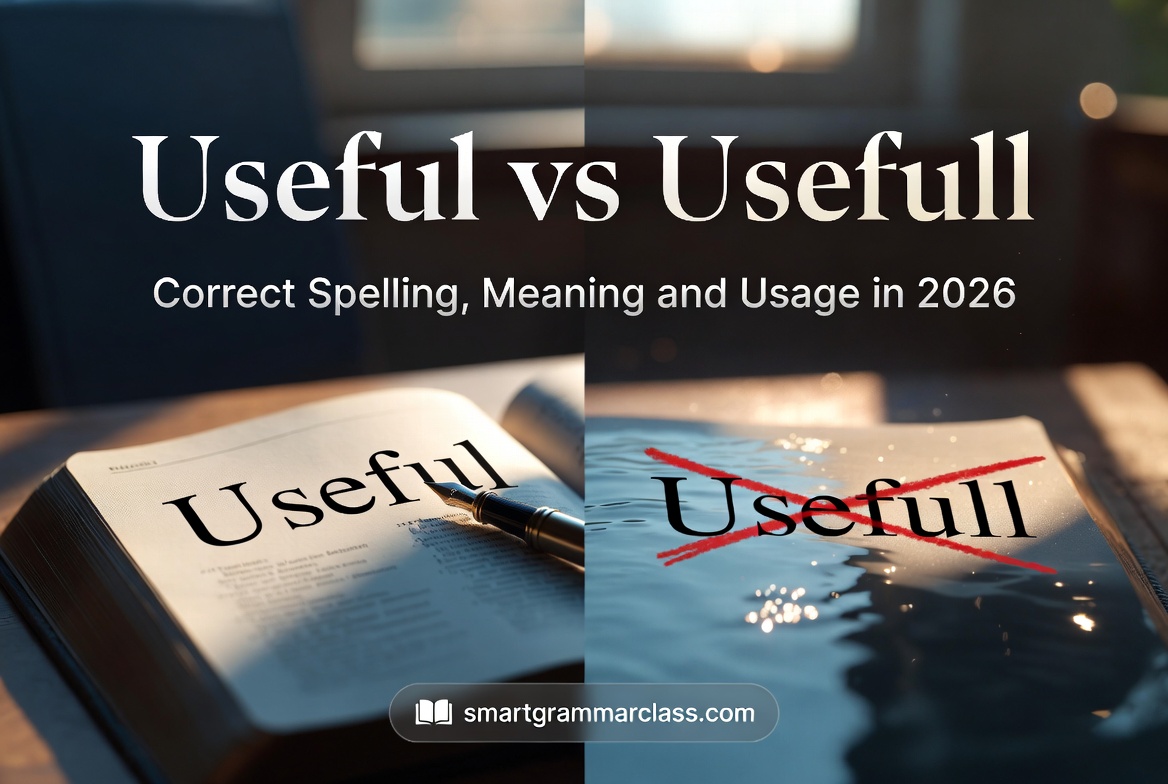
Many learners confuse useful and usefull in modern English writing. This common spelling mistake affects clarity in everyday English writing. The correct spelling in standard English is always useful only. Understanding this adjective improves writing clarity and grammatical accuracy greatly.
Such confusion among learners often appears in fast typing mistakes. Proper usage of useful ensures better readability in modern writing. The difference between useful and usefull lies in spelling accuracy rules. English grammar rules explain the suffix rule of dropping second L.
Words like careful, beautiful, and successful follow one L pattern. This explanation improves clarity and readability in everyday usage examples. Incorrect instinct typing in search bars often causes spelling confusion. Careful keyboard typing ensures beneficial and practical word usage accuracy.
Also read this: Bright vs Brite: Correct Spelling, Meaning, and Usage in 2026
Useful vs Usefull: Define Useful in Simple Terms
The word useful works as an adjective. It describes something that provides benefit, value, or practical help.
In simple terms:
- Something useful helps you do a task better
- It saves time or effort
- It adds value in real life situations
Think about your phone charger. Without it your phone becomes useless quickly. That charger is useful because it solves a real problem.
Here are simple meanings in context:
- A useful tool helps you work faster
- A useful idea improves results
- A useful skill increases your ability to succeed
The word always connects to practicality. It never describes emotions alone. It focuses on function.
Useful vs Usefull: Is Usefull a Real Word
Here is the truth in plain language.
“Usefull” is not a real word in modern English.
It does not appear in standard dictionaries. It does not have an accepted meaning. It is always treated as an error.
Why does it still appear so often?
- Typing mistakes happen quickly on keyboards
- People assume double letters feel correct
- Autocorrect sometimes fails to fix it
- Learners copy what they see in informal writing
Even though it looks familiar it has no grammatical foundation.
So if you write “usefull” in an essay or email most grammar tools will flag it immediately.
Useful vs Usefull: Word Structure Explained
To truly understand the correct spelling, break the word into parts.
- Use means to apply something
- Ful means “full of”
So “useful” literally means:
full of use
That is why the correct spelling uses only one “l” at the end.
English shortens many compound ideas for simplicity. That is what happened here. Instead of “usefull” the language standardized it into a cleaner form.
A simple way to remember it:
- Use + ful = useful
- Not use + full = usefull
That mental trick prevents most spelling mistakes.
Useful vs Usefull: How to Use Useful in a Sentence
Using useful correctly is easy once you see patterns.
It usually comes before a noun or after linking verbs like “is” or “was.”
Common structures:
- useful + noun
- be + useful
- very useful + noun
Examples of correct placement:
- This book is useful for beginners
- She gave a useful explanation
- The tool proved useful during repairs
Notice how the word always describes value.
It never stands alone. It always supports another idea.
Useful vs Usefull: Sentence Examples That Feel Natural
Real writing becomes easier when you see the word in action.
Here are natural examples:
- A useful habit saves time every morning
- That guide turned out useful during travel
- This app is useful for tracking expenses
- His advice was useful during the interview
- A useful shortcut improves productivity instantly
Each sentence keeps things simple and direct. The word fits smoothly without forcing complexity.
Useful vs Usefull: Why People Keep Writing It Wrong
This mistake is more psychological than grammatical.
Here are the main reasons:
Fast typing behavior
People often type without looking at the keyboard. Extra letters slip in easily.
Pattern confusion
Words like “successful” and “beautiful” end with double letters. The brain copies that structure incorrectly.
Pronunciation influence
When spoken quickly the ending sounds longer. That leads people to assume a double “l.”
Memory shortcuts
People remember sound more than spelling. English does not always match sound perfectly.
This combination creates a persistent error that spreads across writing platforms.
Common Mistakes in Useful vs Usefull Usage
Even strong writers make small errors when they rush.
Spelling error confusion
The most common issue is adding an extra “l.”
Wrong:
- usefull information
Correct:
- useful information
Adjective misuse
Some writers overuse “useful” when stronger words fit better.
Instead of:
- This is useful
Try:
- This is effective
- This is practical
- This is efficient
Context errors
Sometimes writers use “useful” in vague ways where clarity suffers.
Example:
- This tool is useful
Better version:
- This tool reduces editing time by half
Specific language always wins.
Useful vs Usefull: Tips to Avoid Mistakes
A few simple habits can fix this spelling forever.
- Break the word into “use + ful”
- Say “full of use” in your mind
- Avoid doubling consonants unless you are sure
- Use spellcheck as a training tool not a crutch
- Practice writing sentences slowly first
One mental trick works especially well.
Imagine cutting off one “l” like trimming excess weight. English prefers clean and minimal structure here.
Useful vs Usefull: Why Context Always Matters
Words never exist alone. Context decides how powerful they feel.
The word useful changes impact depending on situation:
- In education it describes clarity and understanding
- In business it describes efficiency and results
- In technology it describes features and performance
- In daily life it describes convenience and help
A single word can shift meaning depending on where it appears.
That is why careful usage matters more than memorization alone.
Useful vs Usefull: Examples in Different Contexts
Let’s explore how the word adapts in real life.
Education context
- A useful summary helps students revise faster
- Teachers use useful examples to explain ideas
Business context
- A useful report improves decision making
- Teams rely on useful insights for planning
Technology context
- A useful feature simplifies user experience
- Software updates add useful improvements
Personal life context
- A useful routine builds discipline
- A useful reminder prevents missed tasks
Each context shows practical benefit in action.
Useful vs Usefull: Why Usefull Never Became Standard
Language history plays a role here.
English evolved through usage patterns, not strict rules. Over time:
- Dictionaries standardized “useful”
- Writers consistently dropped the second “l”
- Printing presses reinforced correct spelling
- Education systems adopted one official form
Once a spelling becomes widely accepted it locks into grammar rules. “Usefull” never reached that stage.
That is why it remains outside formal English today.
Useful vs Usefull: Exceptions and Special Cases
Even though “usefull” is incorrect there are rare situations where it still appears.
Typographical errors
Fast typing often produces accidental extra letters.
Creative writing
Some brands or designs may alter spelling intentionally for style.
OCR mistakes
Scanned documents sometimes misread letters and produce errors.
Informal communication
Chats or social media posts often ignore strict spelling rules.
However none of these cases make it correct in formal writing.
Useful vs Usefull: Practical Comparison Table
| Word | Status | Meaning | Example |
| Useful | Correct | Provides value or practical help | A useful tool improves workflow |
| Usefull | Incorrect | No accepted meaning | Treated as a spelling error |
This table makes the difference crystal clear at a glance.
Useful vs Usefull: Practice Exercises for Mastery
Learning sticks better when you practice.
Exercise 1: Fill in the blank
- This guide is very ______ for beginners
Answer:
- useful
Exercise 2: Identify the correct spelling
Choose the correct form:
- useful
- usefull
Answer:
- useful
Exercise 3: Rewrite the sentence
Incorrect:
- This is a usefull tip for students
Correct:
- This is a useful tip for students
These exercises strengthen memory through repetition.
Useful vs Usefull: Case Study of a Real Writing Mistake
A small mistake can create big confusion in professional writing.
A marketing team once prepared a product guide. The draft included the phrase:
- “usefull features improve user experience”
The error went unnoticed during early review. It appeared in internal documents and a presentation deck.
Later, the content went through editing. The mistake was flagged immediately by proofreading software and removed.
What this shows:
- Small spelling errors reduce credibility
- Automated tools catch mistakes but humans must still review
- Consistency matters in professional communication
One letter changed perception of quality. That is how sensitive written language can be.
Useful vs Usefull: Final Clarity Check
Before finishing any piece of writing, run a quick mental checklist:
- Does the word appear as “useful” only
- Is there any unnecessary double letter
- Does the sentence sound natural when read aloud
- Does the word clearly add value to the idea
A quick review saves you from repeated mistakes.
FAQs
What is the correct spelling between useful and usefull?
The correct spelling in standard English is useful, while usefull is incorrect. This spelling mistake often creates confusion among learners in English writing. Using the right form improves clarity and correct usage in sentences.
What does the word useful mean in English?
The word useful is an adjective meaning beneficial, practical, and helpful. It is commonly used in everyday English writing to describe something valuable or effective. It improves clarity and strengthens communication meaning.
What is the difference between useful and usefull?
The difference between useful and usefull is spelling accuracy only. Useful is correct, while usefull is a spelling mistake that breaks standard English rules. Correct usage ensures better readability and writing quality.
Why is usefull considered a spelling mistake?
Usefull is incorrect because English grammar rules follow the suffix rule of dropping the second L. Only one L is used in useful, making double L wrong. This error reduces clarity in writing.
How does the suffix rule apply to useful?
The suffix rule explains dropping the second L when forming useful. This rule also applies to words like careful, beautiful, and successful. It ensures proper structure in English words and correct spelling patterns.
Can you give examples of useful in sentences?
The word useful is commonly used in writing to show something beneficial or practical use. It appears in many daily sentences across English writing tasks. Proper usage improves understanding and sentence flow.
Why do learners confuse useful and usefull in writing?
Many learners confuse useful and usefull due to fast keyboard typing and instinct typing errors. Mistakes often appear in search bars and notes. This confusion affects accuracy in modern English writing.
How can spelling mistakes like usefull be avoided?
Avoiding spelling mistakes requires understanding grammar rules and practicing correct forms like useful. Careful typing improves accuracy in everyday English writing. Regular reading helps reduce confusion and improves clarity.
Is useful a commonly used adjective in English?
Yes, useful is a common adjective meaning helpful, beneficial, and practical. It is widely used in standard English communication. It improves expression in both writing and speaking contexts.
How is useful related to other English words like careful and beautiful?
Words like careful, beautiful, and successful follow the same suffix rule as useful. They all use one L instead of double L. This pattern ensures consistency in English writing and correct spelling structure.
Conclusion
Useful vs Usefull: Correct Spelling, Meaning, and Usage in 2026 is essential for clear and accurate communication in writing. The correct spelling of useful is widely accepted in standard English, while usefull is simply a common spelling mistake among learners. The word useful works as an adjective meaning beneficial, practical, and helpful, improving overall clarity and readability in expression. Understanding the difference between useful and usefull along with basic grammar rules helps strengthen accuracy in everyday English writing, ensuring correct usage and better language confidence.

Mia Rose is a dedicated grammar expert and language educator committed to helping learners master English with clarity and confidence. With extensive experience in teaching grammar, writing, and communication skills, she specializes in turning complex language rules into simple, easy-to-understand lessons.
At Smart Grammar Class, Mia creates accurate, well-researched, and practical content tailored for students, professionals, and everyday learners. Her teaching style focuses on real-world examples and clear explanations, enabling readers to confidently apply grammar rules in both writing and speaking.
Mia is committed to maintaining high editorial standards, ensuring every piece of content is reliable, up-to-date, and aligned with modern English usage. Her mission is to make grammar accessible, engaging, and useful for learners at all levels.