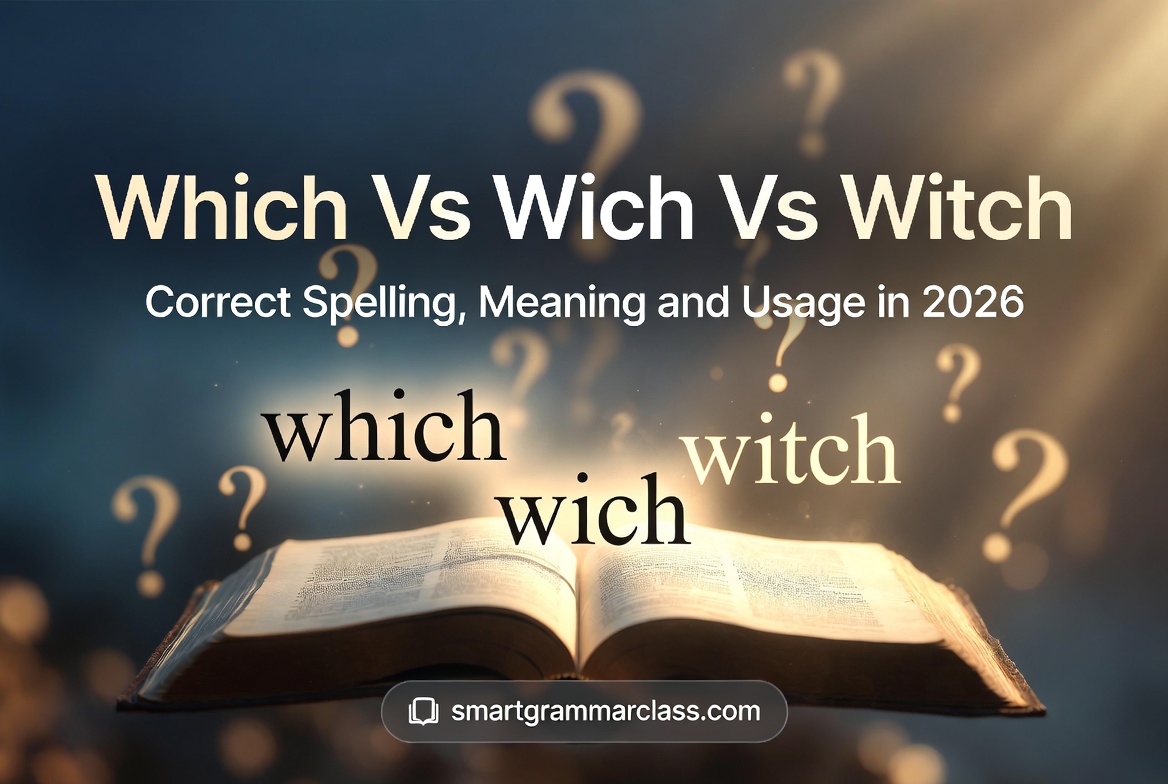
Understanding which, wich, and witch prevents common spelling mistakes and strengthens everyday writing confidence. This which vs wich vs witch spelling comparison explains every spelling difference using simple examples and practical sentence context.
You will learn each word’s meaning, definition, usage, and correct spelling without unnecessary confusion. Mastering these commonly confused words improves clear communication, grammar accuracy, and overall writing quality for every reader.
This guide explores English grammar, pronoun usage, noun functions, word choice, and sentence structure through clear explanations. You will discover homophone confusion, pronunciation similarity, different spellings, different meanings, and useful context clues for accurate understanding.
Practical example sentences, memorable memory trick, and foolproof memory tricks make every correct word easier to remember. Whether improving professional writing, language skills, or English vocabulary, this usage guide builds lasting writing confidence and communication accuracy.
Also Read This: Ceil Vs Seal Vs Seel: Correct Spelling, Meaning, and Usage in 2026
Quick Answer
Which is the only correct spelling for the interrogative or relative pronoun. It asks questions or introduces clauses. Wich is not a valid standalone word in standard English but appears as a suffix in place names like Sandwich and Norwich. Witch refers to a supernatural practitioner or a derogatory term for an unpleasant woman. Use the replacement test: if you can substitute what or that, choose which. If you mean a person with magical powers, choose witch. Never use wich unless it appears in a proper noun.
The Grammatical Role of Which
Which serves two primary functions in English grammar. First it acts as an interrogative pronoun that introduces questions. Second it works as a relative pronoun that connects clauses. Understanding both roles helps you use the word correctly every time.
As an interrogative pronoun, which asks for a choice between options. You might ask “Which color do you prefer?” or “Which restaurant serves the best pizza?” The word signals that the speaker expects a selection from a defined set.
As a relative pronoun, which introduces clauses that provide additional information. For example “My laptop which I bought last year just crashed” adds extra detail about the laptop. In restrictive clauses, which sometimes competes with that. Style guides often recommend that for essential information and which for nonessential details.
The Historical Origins of Which
Which traces back to Old English hwilc, which meant “of what form” or “what kind.” This ancient root connects to other question words like what, where, and why. All these words share the wh spelling pattern that signals interrogative function. The modern spelling has remained remarkably stable over centuries. You will find which in texts from the 12th century onward. Its consistency makes it one of the most reliable words in the English language.
Understanding the Wich Variant
Wich does not appear in standard English dictionaries as a standalone word. However it exists as a suffix in numerous English place names. This suffix comes from Old English wic, which meant a dwelling place, trading center, or village. Over time the spelling shifted but the pronunciation remained.
Consider the town of Sandwich. The name means “sandy trading place.” Norwich means “northern trading center.” Ipswich means “Ipa’s trading center.” These historical names preserve the wich spelling even though the modern word which never appears in that form.
Some brands intentionally use wich as a stylized spelling for memorability. Wichcraft, a sandwich chain, leverages the unconventional spelling to stand out. However these are marketing exceptions not legitimate English variants. You should never use wich in formal writing.
The Cultural Weight of Witch
Witch carries centuries of cultural significance. It refers to a person who practices witchcraft or magic. The word evokes images of broomsticks, cauldrons, and spellcasting. Yet its meaning has evolved dramatically over time.
In the 16th and 17th centuries, witches faced persecution during the infamous witch trials. Thousands of people, mostly women, were executed on charges of maleficium—harmful magic. Today the term has been partially reclaimed. Modern Wicca practitioners embrace the word positively. Popular media like Harry Potter and The Charming Adventures of Sabrina present witches as heroes rather than villains.
The word also functions as a derogatory slang term for a difficult or unpleasant woman. This usage appears in informal contexts but can be offensive. Always consider your audience before using witch in any negative sense.
The Pronunciation Puzzle
All three words share the exact same pronunciation: /wɪtʃ/. The wh in which sounds identical to the *w* in witch for most American English speakers. Some dialects preserve a distinction between the wh sound and the *w* sound but the merger has become nearly universal.
This phonetic overlap means you cannot rely on your ears. Your brain hears the same sound regardless of spelling. You must remember the meaning based entirely on context and grammar. That is why this particular homophone trio causes so much trouble.
Comparing the Three Words
| Feature | Which | Wich | Witch |
| Part of Speech | Pronoun/determiner | Proper noun suffix/neologism | Noun/verb (rare) |
| Dictionary Status | Valid standard English | Invalid variant | Valid standard English |
| Primary Domain | Grammar, questions, clauses | Place names, brand names | Supernatural, folklore |
| Pronunciation | /wɪtʃ/ | /wɪtʃ/ | /wɪtʃ/ |
| Common Error | None if used correctly | Misspelled for “which” | Misspelled for “which” |
| 2026 Usage Trend | Stable, high frequency | Niche, brand-related | Stable, cultural relevance |
The Famous Tongue Twister
The phrase “Which witch is which?” perfectly illustrates the confusion. It uses all three forms in a single sentence. The first which is the interrogative pronoun. The second which is the relative pronoun. Witch is the supernatural noun. Without grammatical context, the sentence would be unintelligible.
This tongue twister has entertained English learners for generations. It also provides a useful memory anchor. When you are unsure which word to use, recall the tongue twister. The context of the sentence will usually reveal the correct choice.
Search Behavior and User Intent
Search data reveals widespread confusion about these words. Monthly searches for which exceed 2 million. Searches for which vs witch total around 50,000. Searches for wich vs which total around 12,000. This consistent query volume indicates that people genuinely struggle with these distinctions.
Related searches show specific patterns:
- “Which vs witch” – 50,000 monthly searches
- “Which or witch” – 35,000 monthly searches
- “Wich or which” – 12,000 monthly searches
- “Which witch is which meaning” – 4,000 monthly searches
- “Define witch” – 90,000 monthly searches
Users want clear guidance. They know the words but question their spelling. This article provides exactly that information.
The Wich Suffix in Place Names
| Place Name | Meaning | Region |
| Sandwich | Sandy trading place | Kent, England |
| Norwich | Northern trading center | Norfolk, England |
| Ipswich | Ipa’s trading center | Suffolk, England |
| Greenwich | Green trading place | London, England |
| Harwich | Army trading place | Essex, England |
These place names preserve the ancient wic suffix. Understanding this etymology helps you recognize wich when you encounter it. However it does not justify using wich as a substitute for which.
Grammar Checkers and Their Limitations
Spell-checkers handle these words inconsistently. Most tools will flag wich as a misspelling and suggest which. However context-specific errors often slip through. If you type “witch” instead of “which,” the checker sees a valid word and moves on. It cannot infer your intended meaning.
This limitation places the burden on human proofreading. You must manually verify every instance. Relying entirely on software guarantees errors will persist.
Social Media and Rapid Typing
Social platforms encourage speed over accuracy. Users type quickly and skip proofreading. Autocorrect sometimes changes witch to which incorrectly. Other times it leaves wich unchanged because it recognizes the string. These errors spread through repetition. People see the mistakes and internalize them as acceptable.
Maintaining accuracy on social media requires conscious effort. Proofread posts before publishing. Use grammar tools for longer content. Avoid typing on mobile without checking later. Your professional reputation depends on these small details.
Cultural Representations of Witches
The cultural meaning of witch has transformed dramatically. In the 17th century it meant a dangerous heretic subject to execution. Today it represents empowerment for many modern practitioners. The Wicca movement reclaimed the term as positive. Popular media normalized sympathetic witch characters.
This evolution affects how the word is perceived. Understanding cultural context helps you use witch appropriately. Avoid using it as a derogatory term without understanding the potential offensiveness.
The Professional Stakes
Confusing which and witch damages your professional credibility. A business email that says “The vendor witch we selected” looks careless. A report that asks “Wich department handles billing?” appears unprofessional. These errors undermine trust and competence.
Clients question your attention to detail. Colleagues doubt your abilities. The fix is simple: learn the distinctions and proofread carefully. Investing time in accurate spelling pays dividends in professional reputation.
Memory Anchors That Work
Five distinct mnemonic systems help you remember the rule:
Letter count anchor: Which and witch both have five letters but their first letters differ. Which starts with wh like what and where. Witch starts with wi like wicked.
Association anchor: Which is a question word just like what, where, and why. Witch is a person just like man and woman.
Visual anchor: Picture a witch with a broomstick. The *i* in witch is like the broomstick handle. Which has an *h* which stands for “help” because questions ask for help.
Replacement anchor: Substitute what or that in your sentence. If what fits, use which. If person fits, use witch.
Pattern anchor: Which belongs with question words. Witch belongs with Halloween words.
Idiomatic Expressions and Folklore
Witch appears in many idiomatic expressions. The “Witch of November” refers to powerful storms on the Great Lakes. A “witch hunt” describes an unjustified persecution campaign. A “witch’s brew” means a magical concoction.
These expressions preserve the word’s mystical connotations. Using them correctly demonstrates cultural literacy. Misusing them creates confusion and undermines your writing.
ESL Learners and Homophones
Non-native speakers face unique challenges with these homophones. Many languages lack the wh sound. Learners pronounce which and witch identically. They rely entirely on context for meaning.
Specific guidance for ESL students includes practicing the wh sound separately from *w*. Using visual dictionaries helps see spelling differences. Writing example sentences reinforces correct usage. Reading aloud and listening for contextual clues builds intuition. Asking native speakers to correct usage accelerates learning.
The That vs. Which Distinction
Academic writing requires understanding the that versus which distinction. The Chicago Manual of Style recommends using which for nonrestrictive clauses and that for restrictive clauses. Which introduces clauses that add extra information. That introduces clauses that define essential information.
Examples clarify the rule. “The car, which is red, belongs to John” adds extra detail about color. The sentence remains complete without the clause. “The car that is red belongs to John” identifies which car among many. The clause is essential for meaning.
Digital Challenges and Voice-to-Text
Modern technology amplifies the confusion. Voice assistants often transcribe which as witch because they prioritize pronunciation over context. Autocorrect changes wich to which but sometimes overcorrects valid usage.
These technical issues require vigilant proofreading. Digital pitfalls include voice-to-text mishearing the wh sound, autocorrect changing valid words incorrectly, predictive text suggesting the wrong option, and spell-check ignoring context entirely.
The Three-Step Proofreading Protocol
Catch every error with this simple process:
Step 1: Search your document for “wich” and change it to “which”
Step 2: Search for “witch” and verify each instance means the supernatural person
Step 3: Search for “which” and verify it functions as a question or relative pronoun
This three-step method catches every instance and ensures correct usage.
FAQs
What is the correct spelling among which, wich, and witch?
The correct spelling depends on the intended meaning. Which is a pronoun used for questions, choices, and identifying people or things, while witch is a noun describing a person who practices witchcraft. Wich is an incorrect spelling and a common misspelling in the English language.
What is the spelling difference between which and witch?
The main spelling difference is one letter, but their different meanings and grammatical function are completely different. Which supports clause introduction, phrase usage, and sentence structure, whereas witch refers to magic, supernatural powers, and magical stories. Understanding this word difference improves grammar accuracy and communication accuracy.
Why are which, wich, and witch considered commonly confused words?
These words create homophone confusion because of their pronunciation similarity and phonetic similarity, even though their definitions differ. Many learners make spelling mistakes due to sound alike words, but using context clues and sentence context helps identify the correct word every time.
How can I remember the difference between which and witch easily?
A useful memory trick is Which has two Hs, reminding you it helps with questions and selection. Another popular tip is The witch had an itch, linking witch with witchcraft. These foolproof memory tricks improve word recognition, vocabulary development, and long term writing confidence.
Why is choosing the proper word important in professional writing?
Using the proper word strengthens clear communication, prevents mixed messages, and improves your credibility. Correct word choice, usage, and English grammar also enhance writing quality, language proficiency, and overall English vocabulary, helping both writers and readers communicate with confidence.
Conclusion
By understanding which, wich, and witch, you can avoid spelling mistakes, choose the correct spelling, and apply the right usage in every situation. Knowing each word’s meaning, word difference, and English grammar role improves word choice, sentence structure, and clear communication. With practical examples, reliable memory trick techniques, and a simple spelling guide, you can build stronger writing confidence, improve writing quality, and use the correct word naturally in both personal and professional writing.

Emma Brooke is a dedicated grammar expert and language educator with a strong passion for helping learners master the English language with clarity and confidence. With years of hands-on experience in teaching grammar, writing, and communication skills, she specializes in breaking down complex language rules into simple, practical explanations.
At Smart Grammar Class, Emma focuses on creating accurate, easy-to-understand, and well-researched content that supports students, professionals, and everyday learners in improving their writing and speaking skills. Her approach combines real-world usage, clear examples, and structured guidance to ensure learners not only understand grammar rules but can apply them effectively.
Emma is committed to maintaining high editorial standards, ensuring every piece of content is reliable, up-to-date, and aligned with modern English usage. Her work reflects a deep understanding of language learning challenges and a mission to make grammar accessible to everyone.