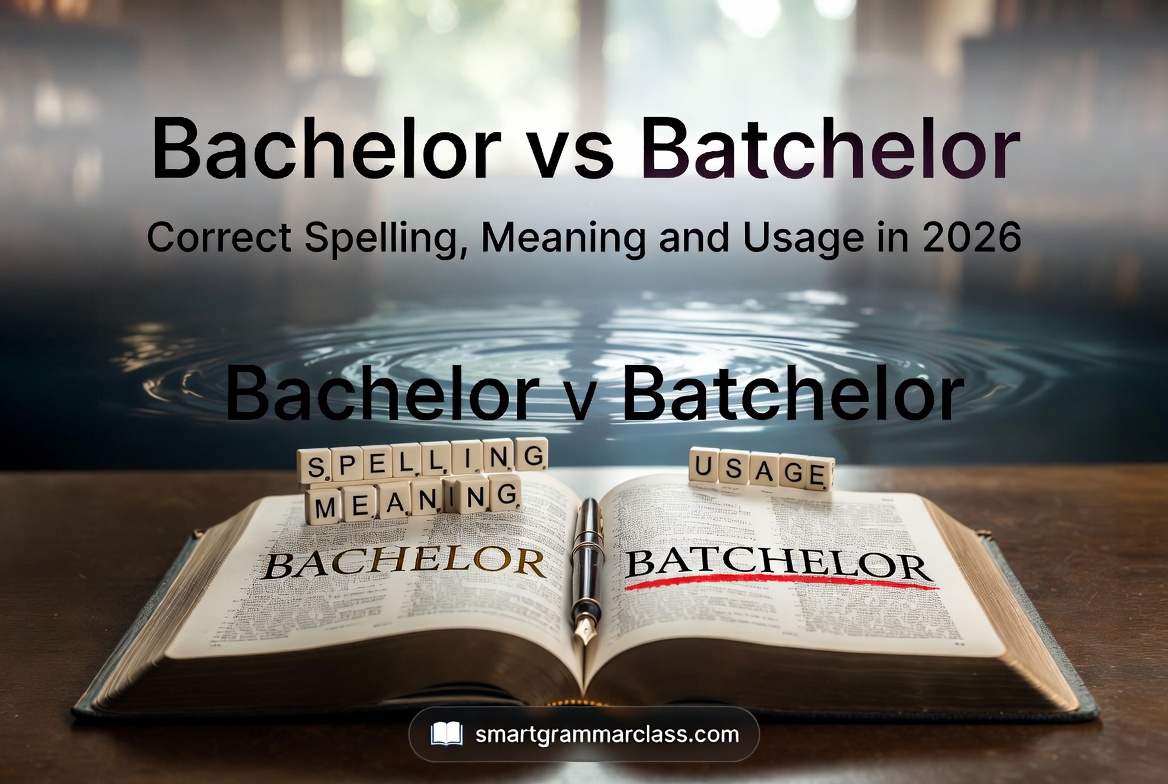
Confusion between bachelor vs batchelor often causes issues in modern English writing. The correct spelling is bachelor, while batchelor is an incorrect spelling variant. This spelling difference creates spelling confusion among students and language learners worldwide.
Many writers make this common misspelling due to sound similarity in pronunciation. Standard English rejects this nonstandard spelling in formal writing and documents. Understanding spelling accuracy improves clarity and prevents unnecessary writing errors.
The word bachelor refers to an unmarried man or academic degree holder. In universities, bachelor’s degree includes bachelor of arts degree programs worldwide. Proper usage is important in academic writing and professional documents like resumes.
Incorrect spelling like batchelor appears in informal pages and outdated online sources. Learners improve language skills by practicing correct English spelling rules daily. Clear communication builds professional credibility and supports strong writing confidence overall.
Also read this: Title vs Tittle: Correct Spelling, Meaning, and Usage in 2026
Bachelor vs Batchelor: The Fast Answer
Here is the clearest way to remember it:
- Bachelor is the standard modern spelling.
- Batchelor is usually a surname or an old spelling.
- In ordinary writing, Bachelor is the right choice.
- In names, archives, and historical references, Batchelor can appear as a proper noun.
That is the core rule. Everything else flows from it.
A lot of confusion comes from the fact that English kept old spellings in family names. So you may see “Batchelor” in a person’s surname and assume it is acceptable as a common noun. It is not. In modern usage, the standard form is Bachelor.
Why Bachelor vs Batchelor Still Confuses People
The spelling difference looks small. The consequences are not small.
The confusion exists because English spelling did not always follow fixed rules. For centuries, writers spelled words in more than one way. Printing gradually standardized spelling, but names often stayed unchanged. That left us with words that look related yet behave differently.
Historical spelling variation
Before spelling settled down, words shifted based on region, pronunciation, and scribal habits. “Batchelor” appeared in older English texts. Over time, “Bachelor” became the preferred form in standard English.
Surname preservation
Family names often keep old spellings for generations. A person may legally use “Batchelor” because that is their inherited surname. That does not mean the spelling works for the common noun.
Search and autocomplete errors
People search both spellings online. Search engines then return mixed results. That reinforces the idea that both are valid in general writing. They are not.
Learner confusion
Students often see both forms and never get a direct rule. That creates uncertainty in essays, application forms, and professional writing.
Define Bachelor in Modern English
The word Bachelor has more than one meaning. The context tells you which one applies.
Bachelor as an unmarried man
Traditionally, a bachelor is an unmarried adult man. This usage still appears in everyday speech and literature.
Example:
- He stayed a bachelor for most of his twenties.
This meaning is still alive. It may sound slightly old-fashioned in some settings, but it is completely correct.
Bachelor as an academic degree
This is the most common modern use in formal writing. A bachelor refers to an undergraduate degree. You see it in degree names, transcripts, resumes, and university documents.
Common forms include:
- Bachelor of Arts
- Bachelor of Science
- Bachelor of Commerce
- Bachelor of Business Administration
Example:
- She earned a bachelor of science in biology.
In many style guides, the degree name is capitalized when written in full as a formal title. In general prose, lowercase use may appear depending on the style guide and sentence structure.
Bachelor as a broader lifestyle term
Sometimes the word carries a cultural meaning. It can suggest independence, single living, or a carefree stage of adult life.
Example:
- He enjoyed bachelor life in a small apartment downtown.
This usage is more informal. It often appears in lifestyle writing or storytelling.
Bachelor in a historical sense
The word once had broader social meanings. In medieval usage, it could refer to a junior knight or a man of lower rank. That older sense still matters in etymology, even if modern readers rarely use it that way.
Define Batchelor and Why It Still Exists
Unlike “Bachelor,” Batchelor does not serve as the standard common noun in modern English.
Batchelor as an older spelling
“Batchelor” is an archaic spelling variant. It reflects an earlier stage of English before spelling rules became more consistent. In modern writing, it looks dated and incorrect unless you are quoting a historical source.
Batchelor as a surname
This is the main place you still see the spelling today. It survives as a family name. That is why people, businesses, and historical records can legally use it.
Examples:
- Mr Batchelor
- The Batchelor family
- Batchelor Construction
- Batchelor Road
In these cases, the word is a proper noun. That changes everything. Proper nouns keep their original spelling.
Batchelor in archival records
Old parish records, newspapers, and legal documents may contain “Batchelor.” That reflects the spelling habits of the time. It does not mean the form belongs in modern grammar.
Bachelor vs Batchelor: Side-by-Side Comparison
A direct comparison makes the rule easier to remember.
| Feature | Bachelor | Batchelor |
| Modern standard spelling | Yes | No |
| Used as a common noun | Yes | No |
| Used for degrees | Yes | No |
| Used for unmarried men | Yes | No |
| Used as a surname | Rarely | Yes |
| Used in historical texts | Sometimes | Yes |
| Appropriate in formal writing | Yes | Only as a proper noun |
The table tells the story clearly. Bachelor belongs in current English. Batchelor belongs to names and history.
Bachelor Meaning in Real Life Contexts
Words feel clearer when you see them in real settings. That is where most spelling mistakes show up too.
In education
When someone says bachelor in an academic context, they usually mean an undergraduate qualification.
Examples:
- He finished his bachelor in computer science.
- She is pursuing a bachelor of arts.
- The university offers a bachelor of engineering.
In natural English, people often say bachelor’s degree rather than just bachelor. That sounds smoother and more complete.
Example:
- He earned a bachelor’s degree in mathematics.
In relationship status
In social conversation, bachelor means unmarried man.
Examples:
- He was a bachelor when he moved to the city.
- The character lived the life of a bachelor for years.
This meaning is especially common in storytelling, articles, and older literature.
In cultural language
The word also appears in phrases like:
- bachelor pad
- bachelor party
- bachelor lifestyle
These expressions are common and still active. They often imply independence, celebration, or a transition before marriage.
Batchelor Meaning in Real Life Contexts
The key point is simple. “Batchelor” does not usually carry a standard dictionary meaning in modern common usage.
As a name
This is the main modern use.
Examples:
- Mrs Batchelor arrived early.
- Batchelor was listed as the guest speaker.
- The Batchelor estate dates back several generations.
As an old form
You may encounter the spelling in old books or records.
Examples:
- The manuscript used the older spelling “Batchelor.”
- Historical documents sometimes preserve “Batchelor” as written.
This kind of usage belongs to historical writing, not everyday grammar.
How to Use Bachelor Correctly
If you are writing today, start with this rule: choose Bachelor unless you are dealing with a proper name or an exact historical quote.
For academic degrees
Use bachelor in degree names.
Examples:
- Bachelor of Arts
- Bachelor of Science
- Bachelor of Commerce
In regular prose you may also see:
- bachelor’s degree
- bachelor degree
The first is more natural and widely used. The second appears in some regions and contexts, but “bachelor’s degree” is safer in most formal writing.
For unmarried men
Use bachelor when describing marital status.
Examples:
- He is still a bachelor.
- The bachelor lived alone in a quiet neighborhood.
For lifestyle descriptions
Use bachelor in phrases like:
- bachelor apartment
- bachelor pad
- bachelor party
These are standard expressions. They work in everyday English.
How to Use Batchelor Correctly
This is much simpler than people think.
Use Batchelor only when the spelling is part of a real name or historical record.
Examples:
- Mr Batchelor
- Batchelor School
- The Batchelor family
If you are writing a sentence that is not about a name, do not use it.
Incorrect:
- He earned a Batchelor degree.
Correct:
- He earned a bachelor’s degree.
That single distinction prevents most errors.
Common Mistakes in Bachelor vs Batchelor
Some mistakes appear so often that they deserve special attention.
Using Batchelor instead of Bachelor
This is the biggest error. People see the surname and assume it is acceptable in normal writing.
Incorrect:
- She completed her Batchelor of Science.
Correct:
- She completed her Bachelor of Science.
Using Bachelor only for degrees
That is too narrow. The word also describes an unmarried man.
Incorrect idea:
- Bachelor only means school degree.
Correct understanding:
- Bachelor can mean a degree or an unmarried man.
Confusing bachelor with bachelorette
This mistake happens because the two words sound linked. They are related, but they are not identical.
- Bachelor = unmarried man
- Bachelorette = unmarried woman
The modern world often uses “bachelor” more broadly in branding and media. Still, the traditional distinction remains useful in writing.
Forgetting article and apostrophe use
Many writers also trip over grammar around the word.
Examples:
- a bachelor’s degree
- his bachelor’s degree
- the bachelor’s party
That apostrophe matters. It shows possession or association.
Context Matters More Than Guessing
The same word can behave differently depending on the setting. That is why context matters so much.
Academic context
In university writing, bachelor almost always refers to a degree. Precision matters here. Use the full degree name when possible.
Examples:
- Bachelor of Science in Nursing
- Bachelor of Arts in English
- bachelor’s degree in economics
Social context
In conversation, bachelor often refers to a man who is not married.
Example:
- He enjoyed his bachelor days before settling down.
Historical context
In older literature or records, “Batchelor” may appear. When quoting it, keep the original spelling if accuracy matters.
Example:
- The 18th-century record spelled the name “Batchelor.”
Name context
If “Batchelor” is someone’s legal surname, do not alter it. That would be incorrect and disrespectful.
Etymology of Bachelor
The history of the word gives useful insight. It also explains why the spelling and meaning changed.
The word bachelor comes through Old French and medieval English usage. Earlier forms referred to a young man or a junior knight. Over time, the word narrowed and then shifted into social and educational meanings.
That evolution is common in English. Many words change meaning as society changes.
From social rank to personal status
The original word had a more formal or feudal sense. Later, it came to describe unmarried men.
From personal status to education
The academic meaning grew later. Universities adopted the term in degree titles. That is why we say Bachelor of Arts and Bachelor of Science today.
Why spelling changed
As English spelling standardized, “bachelor” became the dominant form. The older “batchelor” did not survive in standard grammar.
Why Bachelor Is the Safer Choice in 2026
English writers today need clarity. They need consistency. They need forms that readers instantly recognize.
That is why Bachelor is the safer choice in nearly every case.
It works in:
- academic writing
- resumes
- formal letters
- essays
- articles
- everyday conversation
“Batchelor” only works when it is part of a name or a historical quotation.
If you are unsure, choose bachelor. That rule will almost always protect you.
Practical Examples of Correct Usage
Here are cleaner examples that show natural modern English.
Bachelor in degree-related writing
- She earned a bachelor’s degree in psychology.
- He completed a Bachelor of Science in chemistry.
- Many jobs now list a bachelor’s degree as a minimum requirement.
Bachelor in relationship status
- He remained a bachelor until age forty.
- The bachelor led a quiet life by the coast.
- She jokingly called him “the last bachelor in the family.”
Bachelor in idiomatic phrases
- They moved into a bachelor apartment.
- His friends threw him a bachelor party.
- He lived a bachelor lifestyle for years.
Batchelor as a proper noun
- The letter was addressed to Mr Batchelor.
- Batchelor Road runs through the old district.
- The Batchelor family donated the land.
Notice the pattern. Bachelor functions as a common word. Batchelor functions as a name.
Case Study: Academic Writing and Spelling Accuracy
A university admissions office once reviewed hundreds of applications with similar qualifications. Many applicants wrote “batchelor’s degree” on their forms. The office noticed a pattern.
The issue was not the degree itself. The issue was the spelling.
Applicants who wrote bachelor’s degree looked more polished and careful. Those who used “batchelor” created a small but visible error. In competitive settings, small errors can affect trust.
That does not mean one typo ruins everything. It means careful spelling helps your writing feel credible and professional.
This matters even more in:
- resumes
- scholarship applications
- formal reports
- cover letters
- job bios
Spelling signals attention to detail. Readers notice that.
How to Remember the Difference Easily
A memory trick helps.
Think of it this way:
- Bachelor begins with the standard modern spelling pattern.
- Batchelor has an extra “tch” that often appears in older or surname spellings.
Another simple trick:
- If it is not a name, use Bachelor.
- If it is a family name, keep Batchelor.
That rule is fast, practical, and reliable.
Common Questions Writers Ask Themselves
Before sending a sentence out into the world, ask these questions:
- Am I writing about a degree?
- Am I writing about an unmarried man?
- Am I quoting a historical source?
- Am I dealing with a surname?
If the answer is yes to the first two, use Bachelor.
If the answer is yes to the last two, Batchelor may be correct.
That simple decision tree saves time and prevents confusion.
Why This Matters in Professional Writing
Spelling accuracy is not just about grammar. It shapes perception.
A recruiter, teacher, editor, or client sees spelling as part of overall care. When a writer uses the wrong version of a word that should be familiar, it raises a small flag.
That flag may be mild. Still, it matters.
Good writing often comes down to small choices:
- the right word
- the right tense
- the right spelling
- the right context
Bachelor vs Batchelor is one of those small choices with outsized impact.
Quick Reference Guide
Use this mini guide whenever you are unsure:
- Bachelor = correct modern spelling
- Bachelor’s degree = standard academic phrase
- Bachelor = unmarried man
- Batchelor = surname or historical spelling
- Do not use Batchelor in ordinary modern grammar
That is the whole rule in one glance.
FAQs
What is the difference between bachelor vs batchelor?
The main difference is that bachelor is the correct spelling, while batchelor is an incorrect spelling and nonstandard spelling. This creates spelling confusion, especially for English learners and students. Understanding this spelling difference helps improve spelling accuracy and writing clarity.
What does the word bachelor mean in English?
The word bachelor is a noun that means an unmarried man or a university degree holder. In modern education, it is used in terms like bachelor’s degree and bachelor of arts degree. This clear definition improves understanding in academic and everyday communication.
How is bachelor’s degree used in education?
A bachelor’s degree is an undergraduate qualification offered by college and university programs. It includes courses like BA degree and other academic fields. Correct usage in academic writing and professional documents improves credibility and clarity.
Why is batchelor considered a mistake?
The spelling batchelor is a common misspelling caused by pronunciation confusion and typing errors. It is seen as an incorrect spelling and typographical error in modern English. Using correct spelling ensures strong language correctness and professional communication.
How can I improve spelling accuracy for words like bachelor?
Improving spelling accuracy requires understanding English spelling rules and practicing correct word usage. Avoiding spelling mistakes and checking dictionary definitions helps reduce spelling confusion. Regular practice in academic writing and resumes builds stronger writing confidence.
Conclusion
The confusion between bachelor vs batchelor highlights a clear spelling difference where bachelor is the correct spelling and batchelor is an incorrect spelling. This spelling mistake and nonstandard spelling often appear in writing but are not accepted in modern English. Maintaining spelling accuracy is essential for strong academic writing, professional documents, and clear communication, especially in a resume where precision builds trust. Correct usage of bachelor also supports proper reference to bachelor’s degree, improving overall clarity and writing confidence.

Mia Rose is a dedicated grammar expert and language educator committed to helping learners master English with clarity and confidence. With extensive experience in teaching grammar, writing, and communication skills, she specializes in turning complex language rules into simple, easy-to-understand lessons.
At Smart Grammar Class, Mia creates accurate, well-researched, and practical content tailored for students, professionals, and everyday learners. Her teaching style focuses on real-world examples and clear explanations, enabling readers to confidently apply grammar rules in both writing and speaking.
Mia is committed to maintaining high editorial standards, ensuring every piece of content is reliable, up-to-date, and aligned with modern English usage. Her mission is to make grammar accessible, engaging, and useful for learners at all levels.