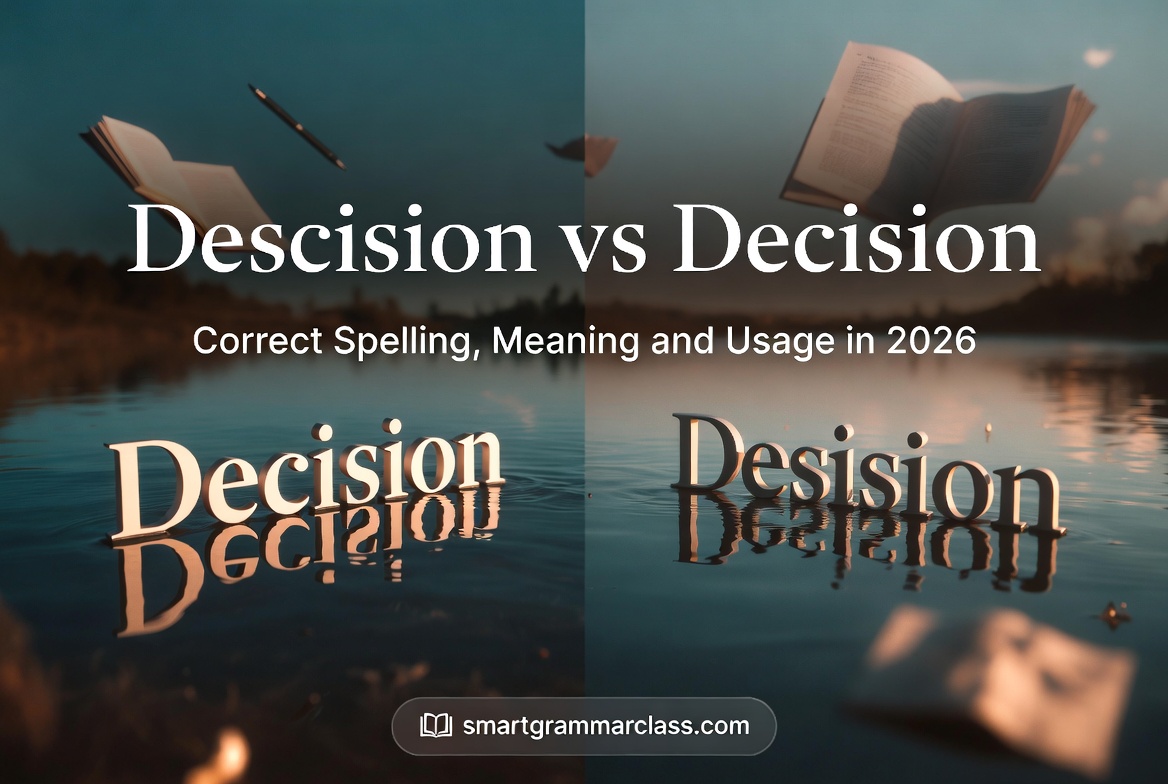
Many writers confuse decision and descision, causing a common spelling mistake during everyday communication. This decision vs descision guide explains the correct spelling, meaning, correct usage, and decision definition using clear grammar examples.
You will understand why descision is an invalid word, while decision remains the recognized spelling in modern English. This practical grammar guide supports English learners seeking better writing accuracy and stronger communication skills.
Whether creating academic writing, business writing, professional writing, email writing, or social media posts, choosing the correct word matters. We compare British English and American English, explain pronunciation, dictionary usage, word comparison, and usage comparison with useful examples.
You will also discover spelling tips, a simple spelling memory trick, writing tips, and proofreading advice to avoid common mistakes. By the end, you will confidently make a decision about the right word choice for clear English language communication.
Also read this: Exigence vs Context: Correct Spelling, Meaning, and Usage in 2026
Quick Answer: Decision vs. Descision
If you only need the short answer, here it is.
| Word | Correct? | Meaning |
| Decision | ✅ Yes | A choice or conclusion reached after consideration |
| Descision | ❌ No | Incorrect spelling of decision |
Whenever you write an email, report, school assignment, resume, article, or business proposal, always use decision.
There are no exceptions in standard American English.
Why People Confuse “Decision” and “Descision”
Spelling mistakes often happen because English does not always match pronunciation. That is exactly what happens with decision.
When spoken quickly, the word may sound as though it contains an extra “s.” As a result, many people mistakenly write descision instead.
Several factors make this mistake common.
- The pronunciation can be misleading.
- Many English words contain double consonants.
- Fast typing increases spelling errors.
- People memorize the sound instead of the spelling.
- The mistake spreads when copied from incorrect online content.
For example, someone may write:
We finally reached a descision yesterday.
Although the sentence makes sense, the spelling is incorrect.
The correct version is:
We finally reached a decision yesterday.
One misplaced letter changes a correctly spelled word into one that does not exist.
Is “Descision” a Real Word?
No.
Descision is not an English word.
It does not appear in respected dictionaries and has never been accepted as a standard spelling. If you see descision, treat it as a spelling error rather than an alternative version.
Here is how the two compare.
| Feature | Decision | Descision |
| Recognized by dictionaries | ✅ Yes | ❌ No |
| Accepted in academic writing | ✅ Yes | ❌ No |
| Used in professional writing | ✅ Yes | ❌ No |
| Correct English spelling | ✅ Yes | ❌ No |
Spellcheck software may catch this mistake, yet proofreading remains important because not every writing tool detects every error.
What Does “Decision” Mean?
A decision is a choice made after thinking about different possibilities.
People make decisions every day. Some are small while others shape careers, relationships, finances, and businesses.
Simple Definition
A decision is the final choice between two or more options.
Formal Definition
A decision is a conclusion reached after careful thought, discussion, or evaluation.
Everyday Meaning
In daily life, a decision simply means choosing one option over another.
Examples include:
- Choosing a college
- Accepting a job offer
- Buying a house
- Ordering dinner
- Selecting travel dates
Every one of these actions requires making a decision.
Pronunciation Guide
Many spelling mistakes begin with pronunciation confusion.
Fortunately, decision follows a predictable pronunciation once you understand its syllables.
Pronunciation
di-SIZH-uhn
Syllable Breakdown
de • ci • sion
The second syllable receives the strongest emphasis.
Notice that there is only one “s” before the ending.
That single letter often causes confusion because the pronunciation sounds slightly different from the spelling.
Origin and Etymology
Understanding where a word comes from often makes it easier to remember its spelling.
The word decision traces its roots back to the Latin verb decidere, which means to cut off or to settle.
Over time, the meaning shifted from physically cutting something to mentally settling an issue or resolving a question.
That history explains why a decision represents the point where uncertainty ends.
The modern English spelling has remained remarkably consistent for centuries.
How to Spell “Decision” Correctly Every Time
Instead of memorizing random letters, learn a simple pattern.
The word is built like this:
De + ci + sion
Notice there is only one “s.”
Easy Memory Trick
Think of this sentence:
A decision needs one solution, so it needs only one “s.”
Another helpful trick is to connect it with the verb decide.
- Decide
- Decision
Both words begin with the same root.
If you remember decide, spelling decision becomes much easier.
Decision vs. Descision Comparison
| Feature | Decision | Descision |
| Correct English spelling | ✅ Yes | ❌ No |
| Dictionary word | ✅ Yes | ❌ No |
| Accepted in schools | ✅ Yes | ❌ No |
| Used in business writing | ✅ Yes | ❌ No |
| Appropriate in legal documents | ✅ Yes | ❌ No |
| Recommended for professional communication | ✅ Yes | ❌ No |
Whenever you hesitate, choose decision.
How to Use “Decision” in a Sentence
Learning through examples makes correct spelling stick.
Everyday Examples
- I made the right decision.
- Her decision surprised everyone.
- The final decision belongs to you.
- We reached a decision after dinner.
- His decision changed his future.
Business Examples
- The board announced its final decision yesterday.
- Management delayed the decision until next week.
- Every hiring decision should follow company policy.
Academic Examples
- The professor praised her research decision.
- Students must explain every decision in the experiment.
- Your decision should be supported with evidence.
Legal Examples
- The judge delivered a written decision.
- The court’s decision established a new precedent.
These examples show how naturally the word fits into different contexts.
Common Phrases That Use “Decision”
English speakers use decision in many fixed expressions.
Some of the most common include:
- Make a decision
- Final decision
- Business decision
- Executive decision
- Important decision
- Difficult decision
- Personal decision
- Informed decision
- Decision-making process
- Decision criteria
These phrases appear frequently in books, news articles, workplaces, and classrooms.
Grammar Rules for “Decision”
Understanding grammar prevents more than spelling mistakes.
Decision functions as a countable noun.
Singular Form
- The decision was correct.
Plural Form
- Several decisions were discussed.
With Articles
- A decision
- The decision
With Adjectives
- Difficult decision
- Smart decision
- Quick decision
- Final decision
- Important decision
With Verbs
Common verb combinations include:
- Make a decision
- Reach a decision
- Reverse a decision
- Announce a decision
- Delay a decision
- Support a decision
- Question a decision
These combinations sound natural because native English speakers use them regularly.
Decision vs. Decide
Many learners confuse these words because they share the same root.
The difference is straightforward.
| Word | Part of Speech | Example |
| Decision | Noun | The decision was difficult. |
| Decide | Verb | Please decide before Friday. |
Think of it this way.
You decide first.
Then you have a decision.
That simple relationship makes both words easier to remember.
Decision vs. Choice
Many people use decision and choice interchangeably. While they are closely related, they are not always identical.
A choice refers to selecting one option from several possibilities. A decision emphasizes the conclusion you reach after evaluating those options. In other words, every decision involves a choice, but not every choice requires careful decision-making.
For example, choosing between vanilla and chocolate ice cream is a simple choice. Choosing whether to accept a new job offer after comparing salary, benefits, and career growth is a decision.
Comparison Table
| Feature | Decision | Choice |
| Meaning | Final conclusion after consideration | Selection among options |
| Usually involves analysis | Yes | Sometimes |
| Common in business | Yes | Less frequently |
| Common in everyday conversation | Yes | Yes |
| Can involve significant consequences | Often | Not always |
Examples
- She made the right decision after reviewing all the facts.
- You have a choice between the blue and black jacket.
- Their decision improved the company’s performance.
- Every customer has the choice to cancel the subscription.
Understanding the difference helps you sound more precise in both spoken and written English.
Decision vs. Conclusion
Another pair that often causes confusion is decision and conclusion.
A decision is something you choose to do. A conclusion is something you believe after examining information.
For instance:
- A jury reaches a decision.
- A scientist reaches a conclusion.
Although both involve thinking, the outcomes are different.
Side-by-Side Comparison
| Decision | Conclusion |
| Choosing an action | Forming a judgment |
| Focuses on what to do | Focuses on what is true |
| Often leads to action | Often summarizes findings |
| Common in business and daily life | Common in research and analysis |
Examples
- The manager made the final decision to expand the team.
- After reviewing the evidence, the researchers reached their conclusion.
Words Commonly Confused With “Decision”
Several words share the same root as decision. Learning them together builds a stronger vocabulary.
| Word | Meaning |
| Decide | To make a choice |
| Decision | The final choice |
| Decisive | Able to make decisions quickly and confidently |
| Decisively | In a firm and definite manner |
| Decision-making | The process of choosing between alternatives |
| Indecision | Difficulty making a choice |
Examples
- You need to decide today.
- Her decision surprised everyone.
- He gave a decisive answer.
- The team acted decisively during the crisis.
- Strong decision-making improves leadership.
- His indecision delayed the project.
Common Mistakes to Avoid
Even experienced writers occasionally make spelling mistakes. Knowing the most common errors helps you avoid them.
Using “Descision”
❌ Incorrect:
- The descision was difficult.
✅ Correct:
- The decision was difficult.
Confusing “Decision” With “Decide”
❌ I need a decision tomorrow what to buy.
✅ I need to decide tomorrow what to buy.
Using the Wrong Verb
Native English speakers rarely say:
- Do a decision
Instead, they say:
- Make a decision
- Reach a decision
- Announce a decision
Learning these natural word combinations improves your writing immediately.
Misspelling the Plural
The correct plural is:
- Decisions
Not:
- Decissions
- Desicions
- Descisions
Forgetting to Proofread
Many spelling mistakes happen because writers type quickly.
Before sending an important email or submitting an assignment:
- Read your work once.
- Check difficult words.
- Look for repeated spelling errors.
- Use spellcheck as a helper, not a replacement.
Professional Writing Tips
Whether you write emails, reports, blog posts, or research papers, correct spelling reflects attention to detail.
In Business
Professional communication depends on credibility.
Writing descision instead of decision may seem like a small mistake, yet it can create a poor impression in proposals, presentations, and executive reports.
Instead, proofread carefully before sharing important documents.
In Academic Writing
Teachers and professors expect accurate spelling.
Repeated spelling mistakes can distract from strong ideas and reduce the overall quality of your work.
When editing an assignment:
- Read each paragraph slowly.
- Watch for commonly confused words.
- Double-check headings.
- Review titles separately.
In Emails
Business emails often influence first impressions.
Compare these examples.
❌ We have made our final descision.
✅ We have made our final decision.
The corrected version immediately appears more professional
In Digital Content
Whether you publish blog posts, newsletters, or social media updates, spelling matters.
Readers often associate accurate writing with expertise and trustworthiness.
Even one noticeable typo can reduce confidence in your content.
Examples From Real-Life Contexts
Seeing decision in different situations helps reinforce its correct usage.
Workplace
After reviewing several candidates, the hiring committee made a final decision based on experience and leadership skills.
Education
The student’s decision to study every evening resulted in higher exam scores.
Healthcare
Doctors discussed multiple treatment options before making a decision that prioritized the patient’s long-term recovery.
Finance
Investors based their decision on market trends, company performance, and future growth potential.
Sports
The coach’s late-game decision changed the outcome of the championship.
Everyday Life
Choosing where to live, which car to buy, or when to start a new career all require thoughtful decisions.
Although these situations differ, the spelling never changes.
Mini Case Study: One Letter Can Change Your Professional Image
Imagine two job applicants submitting identical resumes.
The first writes:
My descision helped increase company revenue.
The second writes:
My decision helped increase company revenue.
Their qualifications may be identical, yet recruiters often notice spelling errors immediately.
While one typo alone may not cost someone a job, repeated mistakes can suggest a lack of attention to detail.
This simple example highlights why learning the correct spelling is worthwhile.
Key Takeaways
- Decision is the only correct spelling in English.
- Descision is always a misspelling.
- Decision is a noun, while decide is a verb.
- The word comes from the Latin decidere, meaning to settle or cut off.
- Common expressions include make a decision, final decision, and decision-making.
- Careful proofreading helps eliminate spelling mistakes before publication.
- Using the correct spelling strengthens your credibility in academic, business, and everyday writing.
FAQs
Is decision or descision the correct spelling in English language?
The correct spelling is decision. Descision is an invalid word caused by a misspelling, spelling mistake, or common typo. Modern dictionaries and the English dictionary recognize only decision as the recognized spelling in modern English.
What is the meaning and decision definition of decision?
The decision definition refers to a choice, judgment, or determination reached after careful thinking. It describes the outcome of decision making, where people make a decision or take a decision before reaching a conclusion.
How should I use decision correctly in formal writing and everyday communication?
Use decision in academic writing, business writing, professional writing, email writing, assignments, business documents, and social media posts whenever referring to a final choice or resolution. Following the correct usage improves writing accuracy, communication skills, and overall correct English.
Is there any difference between British English and American English for decision?
Both British English and American English use the same correct word, decision, with identical pronunciation, meaning, and dictionary usage. The only variation is that some writers prefer take a decision, while others commonly make a decision depending on regional language usage.
How can I avoid the spelling error of writing descision instead of decision?
Practice proofreading, editing, and follow reliable writing tips with simple spelling tips and a spelling memory trick to remember spelling correctly. Comparing decision vs descision, reviewing grammar examples, and improving vocabulary help prevent language mistakes and strengthen English usage.
Conclusion
Choosing decision instead of descision ensures correct spelling, stronger writing accuracy, and more effective communication skills in the English language. Understanding its meaning, correct usage, pronunciation, and decision definition helps you avoid every spelling mistake, spelling error, and common typo with confidence. Whether you are writing for academic writing, business writing, professional writing, or everyday communication, following this grammar guide, applying writing tips, and practicing proofreading will improve your correct English and make every decision clear, accurate, and professional.

Emma Brooke is a dedicated grammar expert and language educator with a strong passion for helping learners master the English language with clarity and confidence. With years of hands-on experience in teaching grammar, writing, and communication skills, she specializes in breaking down complex language rules into simple, practical explanations.
At Smart Grammar Class, Emma focuses on creating accurate, easy-to-understand, and well-researched content that supports students, professionals, and everyday learners in improving their writing and speaking skills. Her approach combines real-world usage, clear examples, and structured guidance to ensure learners not only understand grammar rules but can apply them effectively.
Emma is committed to maintaining high editorial standards, ensuring every piece of content is reliable, up-to-date, and aligned with modern English usage. Her work reflects a deep understanding of language learning challenges and a mission to make grammar accessible to everyone.