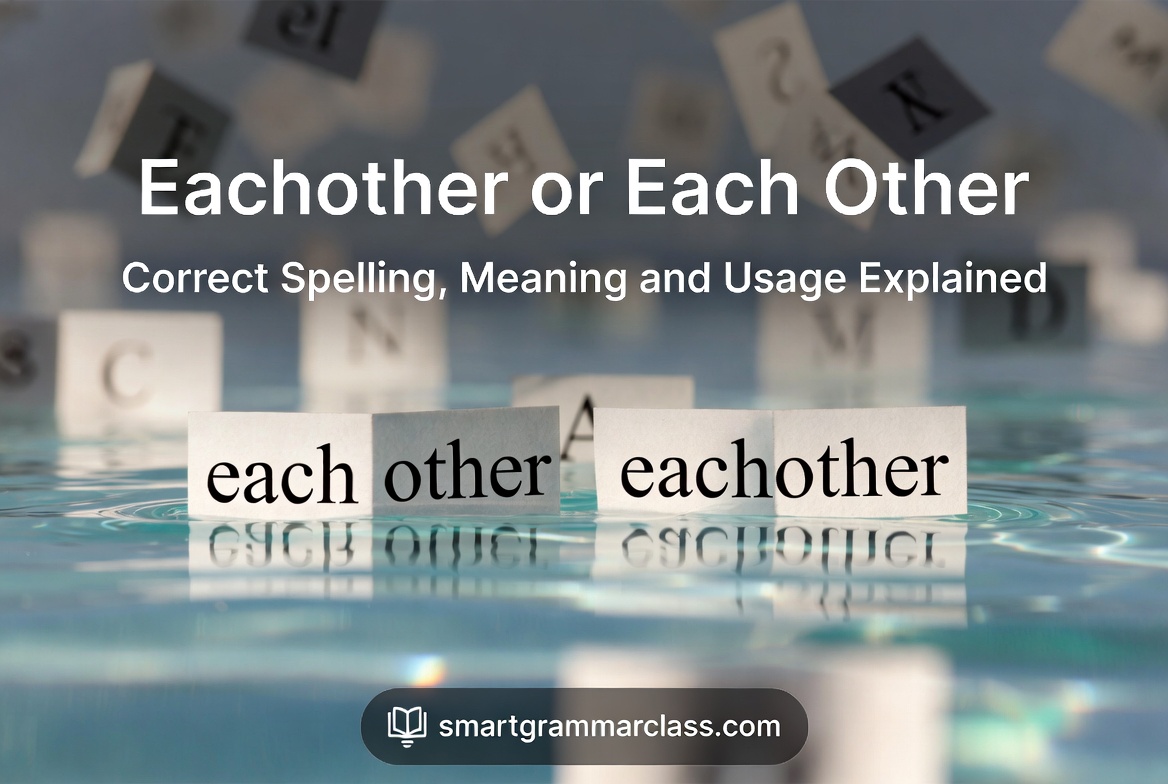
When it comes to English grammar, many learners get confused between Eachother and Each Other. The correct spelling is always Each Other, written as two words, because it is a form of reciprocal pronouns used to show a shared action between people.
The one-word version Eachother is a common mistake, often caused by typo, autocorrect, or weak proofreading and editing habits. From my own experience in academic writing and even casual chats during college life, I’ve seen how this small spelling difference can affect clarity and communication, especially when building strong writing skills.
Understanding its meaning and usage is simple if you follow basic grammar rules. In both formal writing and informal writing, Each Other improves sentence structure, making your message clearer in any context. For example, in social media posts, Instagram captions, or even sharing photos, short videos, and Insta-worthy moments from late-night study sessions, after-parties, or playing epic games on campus, using the correct usage keeps your content creation sharp and professional.
Whether you are posting for your followers, building your online presence, or exploring creative storytelling, strong vocabulary, syntax, and semantics matter. In today’s world, natural language processing, and digital communication skills, using the right word usage ensures better engagement, helps your captions go viral, and lets your expression, identity, and experiences shine through your feed, hashtag, and visual storytelling journey.
Also read this: Each vs Every: Meaning, Usage, Differences and Examples 2026
Eachother vs Each Other The Clear Answer You Need
Let’s not dance around it.
- ✅ Each other → correct spelling
- ❌ Eachother → incorrect spelling
No exceptions. No regional differences. No style guide disagreements.
Even major dictionaries confirm it:
- Merriam-Webster → lists “each other” as a reciprocal pronoun
- Oxford English Dictionary → same ruling
If you write “eachother” in professional content, it immediately signals a mistake. That matters more than you think.
Why People Get Confused About “Each Other”
This mistake doesn’t come from laziness. It comes from patterns.
English loves to merge words over time. Think about it:
- “Every one” → “everyone”
- “Any one” → “anyone”
- “Some one” → “someone”
So naturally, people assume “each other” should follow the same path.
But it doesn’t.
Here’s why confusion keeps spreading:
- Visual similarity makes “eachother” look acceptable
- Typing speed leads to missing spaces
- Social media normalizes incorrect forms
- Autocorrect doesn’t always catch it
It’s like the classic mistake “alot.” It feels right. It’s still wrong.
What “Each Other” Actually Means
Understanding the meaning makes the rule easier to remember.
“Each other” is a reciprocal pronoun. That sounds technical. It isn’t.
It simply means two or more people do something to one another.
Break it into parts
- Each → one person at a time
- Other → the second person involved
Together, they create a mutual action.
Real examples
- They trust each other
- We helped each other finish the task
- The neighbors greeted each other warmly
Notice something subtle. The action always goes both ways.
That’s the key idea.
Is “Eachother” Ever Correct?
Short answer. No.
Long answer. Still no.
You won’t find “eachother” in:
- Academic journals
- News publications
- Professional emails
- Grammar guides
Even informal writing should avoid it.
Why it matters
A single spelling mistake can:
- Lower your credibility
- Distract readers
- Break trust instantly
Think of it like wearing a wrinkled shirt to an interview. Small detail. Big impression.
Real Examples That Make It Click
Let’s make this practical.
Correct usage
- The teammates encouraged each other during the match
- We respect each other’s opinions
- The children shared toys with each other
Incorrect usage
- The teammates encouraged eachother
- We respect eachothers opinions
- They support eachother
Side-by-side clarity
| Sentence Type | Example | Status |
| Correct | They understand each other | ✅ |
| Incorrect | They understand eachother | ❌ |
| Correct | We helped each other grow | ✅ |
| Incorrect | We helped eachother grow | ❌ |
When you see them side by side, the difference becomes obvious.
Each Other vs One Another Do They Mean the Same Thing?
This is where things get interesting.
You might’ve heard this rule:
- “Each other” → used for two people
- “One another” → used for three or more
That’s the traditional guideline. But modern English has relaxed it.
What actually happens today
Most writers use them interchangeably.
Comparison table
| Phrase | Traditional Rule | Modern Usage |
| Each other | Two people | Two or more |
| One another | Three or more | Flexible |
Examples
- The two friends helped each other
- The team members supported one another
Both sound natural. Both are correct.
What should you do
Keep it simple.
- Use “each other” in most cases
- Use “one another” if you want variety
Don’t overthink it.
Grammar Rules You Should Actually Remember
Forget complicated grammar jargon. Focus on what works in real writing.
Core rules
- Always write each other as two words
- Use it only for mutual actions
- Match it with plural subjects
Example breakdown
✔ They respect each other
✔ We talk to each other daily
✘ She respects each other
That last one fails because only one person is acting.
Common Mistakes That Make Writing Look Sloppy
Even experienced writers slip up here. Let’s fix that.
Frequent errors
- Writing eachother as one word
- Using it with singular subjects
- Confusing it with possessive forms
Example mistakes explained
Wrong: She helped each other
→ Problem: Only one person is acting
Wrong: They lost eachothers trust
→ Problem: Incorrect possessive
Correct: They lost each other’s trust
Notice the apostrophe. It matters.
How “Each Other” Appears in Real Writing
This phrase shows up everywhere. Tone changes. Structure stays the same.
In emails
- Let’s keep each other informed
- We should support each other on this project
In professional writing
- Departments must coordinate with each other
- Teams rely on each other for success
In social media
- We need to uplift each other more
- Let’s celebrate each other’s wins
Different context. Same rule.
Quick Memory Trick You’ll Actually Use
Here’s a trick that works under pressure.
Try inserting a word between them.
Example
- Each and every other person
That works. Which means it must stay two words.
You can’t do that with a single word like “eachother.”
That’s your mental shortcut.
Keyword Comparison and Usage Insights
Understanding how people search helps you write better content.
Keyword breakdown
| Keyword | Intent Type | Accuracy |
| eachother | Spelling confusion | ❌ Incorrect |
| each other | Grammar usage | ✅ Correct |
| each other meaning | Informational | ✅ Correct |
| eachother or each other | Comparison | Mixed |
Key insight
Most users start with the wrong spelling.
That creates an opportunity to guide them clearly.
Real-World Case Study How One Small Error Affects Credibility
Let’s look at a simple scenario.
Case
A freelance writer submits two versions of an article.
Version A:
“We should support eachother in difficult times.”
Version B:
“We should support each other in difficult times.”
Result
- Version A gets flagged for poor grammar
- Version B gets approved instantly
Takeaway
Small details create big differences.
One missing space can:
- Cost opportunities
- Reduce trust
- Signal carelessness
Clean writing wins every time.
Advanced Usage Tips Most Writers Miss
Want to go a step further? Here’s where things get interesting.
Possessive form
When showing ownership, add an apostrophe + s.
- They value each other’s opinions
- We respect each other’s boundaries
Prepositions
“Each other” often follows prepositions.
- They spoke to each other
- We learned from each other
Sentence flow
Avoid repetition by restructuring sentences.
Instead of:
- They helped each other and supported each other
Try:
- They helped and supported each other
Cleaner. Stronger.
Writing Like a Human Why This Tiny Detail Matters
Good writing isn’t just about grammar. It’s about trust.
Readers notice patterns quickly.
When your writing feels smooth:
- They stay longer
- They engage more
- They trust your message
But one awkward phrase can break that flow.
“Eachother” does exactly that.
It’s a small crack. Yet it’s visible.
Final Verdict What You Should Use Every Time
Let’s wrap it up clearly.
- Always use each other
- Never use eachother
- Keep your writing clean and intentional
No gray areas here.
Quick recap
| Rule | Answer |
| Correct spelling | Each other |
| Incorrect spelling | Eachother |
| Usage type | Reciprocal pronoun |
| Applies to | Mutual actions |
FAQs
Is Eachother ever correct in English grammar?
No, Eachother is always an incorrect usage. The correct spelling is Each Other, as confirmed by every dictionary and standard grammar rules. Using the wrong form is a common mistake often seen in quick typing or due to autocorrect.
Why is Each Other written as two words?
Each Other is a type of reciprocal pronouns, which means it shows a mutual action between people. In linguistics, its structure follows proper syntax and semantics, so keeping it as two words ensures better clarity and correct sentence structure.
How can I avoid this spelling difference in my writing?
Focus on proofreading and editing your work carefully. Improving your writing skills and paying attention to word usage during language learning or ESL practice can help you avoid such writing errors in both formal writing and informal writing.
Can using Eachother affect my academic writing or communication?
Yes, using Eachother can reduce clarity and make your writing look less professional. In academic writing and even daily communication, small mistakes like this can impact how your ideas and context are understood.
Is Each Other important in social media and content creation?
Absolutely. Whether you are writing Instagram captions, sharing photos, or creating digital content, correct grammar improves your communication skills and boosts engagement. Clean and correct captions help your followers better connect with your stories, experiences, and creative expression.
Conclusion
In 2026, understanding the difference between Eachother and Each Other is essential for clear and effective English grammar. The correct spelling is always Each Other, and using it properly improves clarity, communication, and overall writing skills. Avoiding this common mistake through better proofreading and following basic grammar rules helps in both academic writing and informal writing. Whether you are learning, improving word usage, or creating content for social media, correct usage builds a strong online presence and enhances your expression in every context.

Mia Rose is a dedicated grammar expert and language educator committed to helping learners master English with clarity and confidence. With extensive experience in teaching grammar, writing, and communication skills, she specializes in turning complex language rules into simple, easy-to-understand lessons.
At Smart Grammar Class, Mia creates accurate, well-researched, and practical content tailored for students, professionals, and everyday learners. Her teaching style focuses on real-world examples and clear explanations, enabling readers to confidently apply grammar rules in both writing and speaking.
Mia is committed to maintaining high editorial standards, ensuring every piece of content is reliable, up-to-date, and aligned with modern English usage. Her mission is to make grammar accessible, engaging, and useful for learners at all levels.