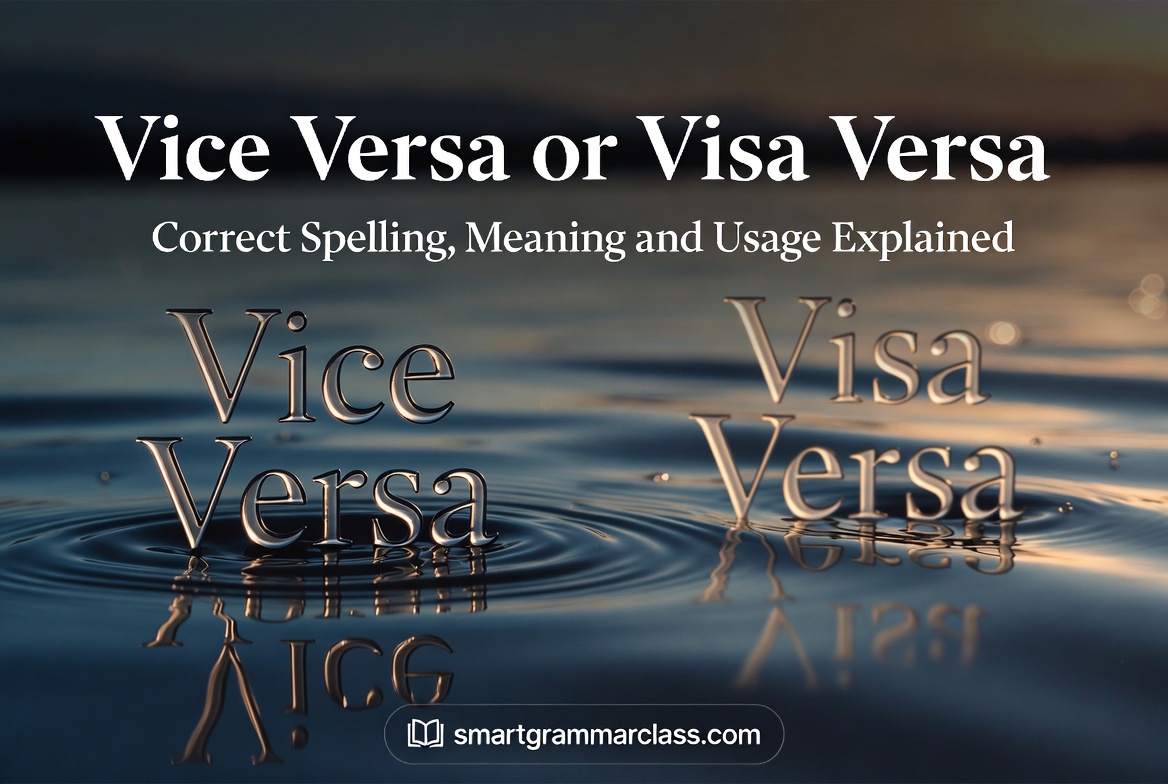
Many English speakers face a common confusion between vice versa and visa versa because they sound alike in fast speech. The correct spelling is always vice versa, while visa versa is an incorrect spelling often caused by a simple typo or habit in everyday writing like emails, essays, blog posts, or even a catchy headline.
The meaning of this familiar phrase is “the other way around” or conversely, where the subject and object switch places in a reversed statement. This Latin phrase is used in both American English and British English, helping improve writing confidence, speaking confidence, and overall communication clarity.
From my own writing guide experience, I’ve seen how using vice-versa, vice-a versa, or even trying to match the pronunciation like vice–vur-suh or vice-uh-vur-suh can lead to spelling confusion and hurt credible writing. The definition stays simple: it works as an adverb or adverbial phrase to avoid repetition and improve sentence structure.
For example, “John respects Amy, and vice versa,” or “Germany and Britain influenced each other during the Second World War, and vice versa,” showing reversed order clearly. Whether talking about neighbors, Germans, or even damage in history, using this correct phrase ensures reader understanding, information clarity, and strong writing accuracy based on solid English grammar rules, vocabulary, and contextual meaning aligned with keywords and semantic relevance in 2026.
Also read this: Eachother or Each Other: Correct Spelling, Meaning and Usage 2026
Quick Answer: Vice Versa vs Visa Versa
Let’s not overcomplicate it.
- ✅ Vice versa = correct spelling
- ❌ Visa versa = incorrect spelling
- ✔ Meaning = “the other way around” or “in reverse order”
Here’s a simple test you can use right away:
If swapping the subjects still makes sense, you can use vice versa.
Example:
- “She trusts him, and vice versa.”
→ “He trusts her.” Still works.
That’s the entire idea.
What Does “Vice Versa” Mean in Real Use?
At its core, vice versa expresses a reversible relationship.
Not just repetition. Not just similarity. It’s about mutual exchange.
Think of it like a two-way street:
- Action goes one way
- Then it comes right back
Common meanings include:
- The reverse is also true
- The situation applies equally in both directions
- Roles or positions can be swapped without changing meaning
Everyday Meaning in Plain English
Instead of saying:
- “A affects B and B affects A”
You say:
- “A affects B and vice versa”
Cleaner. Faster. Smarter.
Why “Visa Versa” Is So Common
Here’s where things get interesting.
People don’t misspell it randomly. There’s a pattern.
Reasons this mistake happens:
- Sound confusion
“Vice” and “visa” sound close enough in casual speech - Familiarity bias
The word “visa” shows up in:- Travel documents
- Payment cards
- Immigration forms
- Autopilot typing
Your brain fills in what it recognizes faster
A Quick Reality Check
Search data shows something surprising:
| Phrase | Monthly Searches | Correct? |
| Vice versa | High | Yes |
| Visa versa | Thousands | No |
Even though people search for “visa versa”, it never becomes correct.
Accuracy always wins in professional writing.
The Origin of “Vice Versa”
This phrase didn’t just appear out of nowhere.
It comes from Latin — and that’s why it stays fixed.
Breaking it down:
- Vice = “in place of”
- Versa = “turned”
Together:
“Turned the other way”
That meaning still holds today.
Why the Spelling Matters
When a phrase comes from Latin, its structure tends to stay stable.
Change one letter, and you lose the original meaning.
That’s exactly what happens with “visa versa.”
Deep Insight
Unlike modern English words that evolve quickly, borrowed phrases like this behave differently.
They act like linguistic fossils — preserved, consistent, and resistant to change.
British vs American English: Any Difference?
Some words shift depending on where you are.
This one doesn’t.
| Region | Correct Spelling |
| United States | Vice versa |
| United Kingdom | Vice versa |
| Canada | Vice versa |
| Australia | Vice versa |
No variations. No exceptions.
So if you’re writing in US English — you’re already using the global standard.
When Should You Use “Vice Versa”?
This is where most people either shine or stumble.
Use vice versa when:
- Two ideas mirror each other
- A relationship goes both ways
- You want to avoid repeating a sentence
Strong Use Cases
- Relationships
- Cause and effect
- Mutual actions
- Balanced comparisons
Example Transformations
Before:
- “Teachers influence students, and students influence teachers.”
After:
- “Teachers influence students and vice versa.”
Why It Works
- Reduces redundancy
- Keeps sentences tight
- Sounds natural in conversation
Real-Life Examples That Feel Natural
Let’s bring this into real situations.
Everyday Conversations
- “I respect you and vice versa.”
- “They support us and vice versa.”
Business Communication
- “Customer trust builds brand loyalty and vice versa.”
- “Strong leadership improves teams and vice versa.”
Academic Writing
- “Language shapes thought and vice versa.”
- “Environment influences behavior and vice versa.”
Social Media Use
- “Good vibes attract good people and vice versa ✨”
Short. Clean. Engaging.
Common Mistakes You Should Avoid
Even experienced writers slip here.
Spelling Errors
- ❌ Visa versa
- ❌ Vice verca
- ❌ Vice verza
Only one is correct:
- ✅ Vice versa
Logical Misuse
Bad example:
- “I went to the store and vice versa.”
Why it fails:
- There’s no second idea to reverse
Overuse
Using it too often makes writing feel lazy.
Instead of:
- “He likes coffee and vice versa. She likes tea and vice versa.”
Mix it up. Keep it fresh.
Grammar and Placement Tips That Actually Help
Here’s where clarity matters.
Where to place it:
- End of a sentence
- Middle of a sentence
- After a comma or conjunction
Examples
- “She admires him and vice versa.”
- “The relationship works both ways, vice versa.”
Key Rule
Make sure both parts of the sentence are balanced.
Think symmetry. Think reflection.
Quick Comparison Table: Vice Versa vs Visa Versa
| Feature | Vice Versa | Visa Versa |
| Correct spelling | Yes | No |
| Meaning | Reverse relationship | None |
| Usage | Formal and informal | Incorrect |
| Origin | Latin | Not applicable |
| Accepted globally | Yes | No |
Case Study: How One Small Mistake Hurts Credibility
Imagine this.
You’re applying for a job. Your resume says:
“I support team collaboration and visa versa.”
It’s a tiny mistake. But it signals something bigger.
What recruiters might think:
- Lack of attention to detail
- Weak language skills
- Careless proofreading
Now compare:
“I support team collaboration and vice versa.”
Same sentence. Completely different impression.
Lesson
Small details shape big perceptions.
Advanced Usage Tips for Better Writing
If you want your writing to stand out, go beyond basics.
Use It Strategically
Don’t drop it randomly. Use it where it adds clarity.
Combine with Strong Verbs
- “Trust builds loyalty and vice versa.”
- “Innovation drives growth and vice versa.”
Avoid Repetition
Instead of repeating phrases, let vice versa do the work.
Synonyms and Alternatives
Sometimes you want a different tone.
Here are solid alternatives:
- The other way around
- In reverse
- Conversely
- Reciprocally
- The opposite applies
Example Swap
Instead of:
- “He helps her and vice versa.”
You can say:
- “He helps her and the opposite applies.”
Key Observations
- “Vice versa” dominates written content
- “Visa versa” spikes due to confusion
- Educational sites consistently reinforce the correct form
What This Means for You
Using the correct spelling:
- Improves credibility
- Boosts clarity
- Aligns with standard English
Practical Writing Checklist
Before using vice versa, ask yourself:
- Can I reverse the sentence logically?
- Does it reduce repetition?
- Does it improve flow?
If yes, use it.
If not, rewrite the sentence.
Mini Practice Section
Try these:
Rewrite Using “Vice Versa”
- “Parents teach children, and children teach parents.”
→ Parents teach children and vice versa - “Supply influences demand, and demand influences supply.”
→ Supply influences demand and vice versa
You’ll start noticing it everywhere once you get used to it.
FAQs
What is the correct spelling: vice versa or visa versa?
The correct spelling is always vice versa. Visa versa is an incorrect spelling that comes from spelling confusion because both forms sound alike in speech, but only vice versa is accepted in English grammar rules.
What does vice versa actually mean in a sentence?
The meaning of vice versa is “the other way around” or conversely. It shows a reversed statement, where the subject and object switch places to keep the sentence structure clear and natural.
Is vice versa used differently in American English and British English?
No, vice versa is used the same way in both American English and British English. Its usage, definition, and phrase meaning stay consistent, making it a reliable familiar phrase across different styles of writing.
How can I use vice versa correctly in everyday writing?
You can use vice versa in emails, essays, blog posts, or captions to avoid repetition and improve information clarity. It works as an adverbial phrase to replace repeated ideas and improve writing accuracy and communication clarity.
Why is visa versa considered a common confusion among English speakers?
Visa versa happens due to pronunciation habits like vice–vur-suh or vice-uh-vur-suh, leading to a typo in writing. This incorrect spelling can reduce credible writing and affect reader understanding, so learning the correct phrase builds better writing confidence and speaking confidence.
Conclusion
In 2026, understanding the difference between vice versa and visa versa is key to strong and credible writing. The correct spelling vice versa, a classic Latin phrase, improves writing accuracy, communication clarity, and overall reader understanding by clearly showing a reversed statement or the other way around. Avoiding this common confusion helps English speakers build better writing confidence and speaking confidence, especially in everyday writing like emails, essays, and blog posts. Mastering its meaning, usage, and contextual meaning ensures polished sentence structure and aligns with modern English grammar rules and semantic relevance.

Mia Rose is a dedicated grammar expert and language educator committed to helping learners master English with clarity and confidence. With extensive experience in teaching grammar, writing, and communication skills, she specializes in turning complex language rules into simple, easy-to-understand lessons.
At Smart Grammar Class, Mia creates accurate, well-researched, and practical content tailored for students, professionals, and everyday learners. Her teaching style focuses on real-world examples and clear explanations, enabling readers to confidently apply grammar rules in both writing and speaking.
Mia is committed to maintaining high editorial standards, ensuring every piece of content is reliable, up-to-date, and aligned with modern English usage. Her mission is to make grammar accessible, engaging, and useful for learners at all levels.