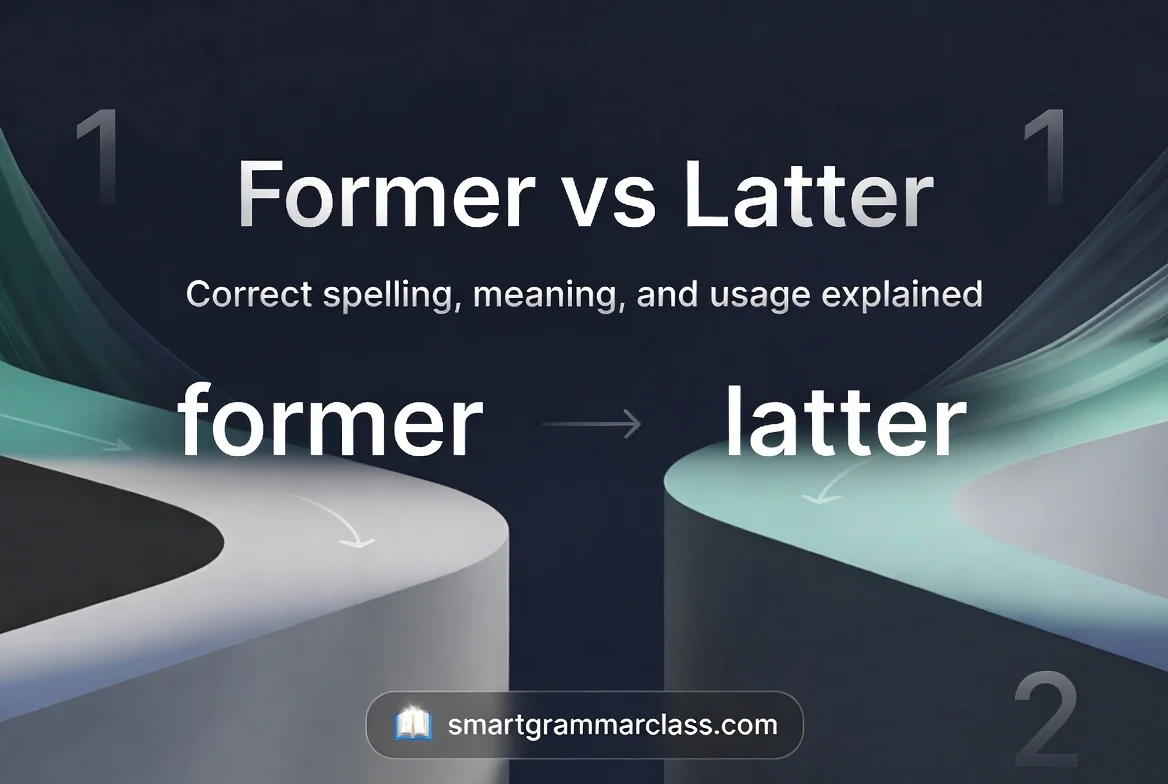
When learning former and latter, many writers and readers get confuse because these words often appear everywhere from books, emails, and news headlines to casual instagram captions about epic games, late-night study sessions, and after-parties. In simple terms, former refers to the first of two items, while latter refers to the second one mentioned, making your writing more clear, sharp, and confident.
I remember being paused mid-sentence while writing essays and articles, trying to decide what fits, but once you understand the logic, it becomes easier to avoid confusion and overcomplicate things. These are referential adjectives that describe a noun, helping distinguish between a person, place, or thing without repetition, which helps save space and improve clarity.
In real usage, the difference becomes obvious with examples: if I say “I had to choose between exercising and taking my dog for a long walk adventure, I chose the latter,” it clearly refers back to the second option in the sequence. In another example, “Between my coworker Steve and another team member, the former handled the weekly team meeting,” the reference points to the preceding name. These terms work best when dealing with a group of two, not several, and they generally apply within the same sentence or paragraph.
Many usage guides and definitions highlight that actual usages depend on position, order, and comparison, but in practice, a quick guide is to remember “first = former, last = latter.” Over time, with memory tricks and practical insights, you will learn to use them correctly, making your sentences flow better and your message feel more true, simple, and impactful whether you’re writing a post, sharing photos, or creating a huge list of caption ideas to capture the spirit of your campus life and keep your followers scrolling for inspiration.
Also read this : Wracking or Racking: Correct Spelling, Meaning and Usage in 2026
Former vs Latter Quick Answer That Actually Helps
If you need a fast answer here it is:
- Former refers to the first of two things
- Latter refers to the second of two things
That’s it. No fluff.
Quick example
I had coffee and tea this morning. I preferred the former.
You preferred coffee because it came first.
I had coffee and tea this morning. I preferred the latter.
Now you preferred tea because it came second.
Simple memory trick
- Former = First
- Latter = Later
Short. Clean. Easy to remember.
What “Former” and “Latter” Really Mean in Plain English
Let’s slow it down for a moment.
When you mention two things in a sentence you sometimes don’t want to repeat them. That’s where former and latter step in.
They act like shortcuts. Instead of repeating the same words you point back to them.
Why people get confused
Most confusion comes from one issue:
- Writers forget the order matters
The words don’t describe importance or preference. They describe position.
Think of it like this
Imagine lining up two objects:
- First item → Former
- Second item → Latter
Nothing else changes that rule. Not tone. Not context. Not style.
The Core Rule Explained with a Visual Diagram
Two items mentioned → A then B
Former = A (first item)
Latter = B (second item)
Why this matters
If you lose track of order your sentence becomes confusing. Readers won’t stop to decode it. They’ll move on.
Example breakdown
Sarah and Emma joined the meeting. The former presented first.
- Sarah = first name
- Emma = second name
- Former = Sarah
Clear and direct.
Simple Memory Hacks You Won’t Forget
Sometimes rules fade. But clever shortcuts stick.
Use these mental triggers
- Former = First
Both start with “F” - Latter = Later
Both relate to time progression
Real-life analogy
Think about a race:
- The runner at the front = former
- The runner behind = latter
You don’t need grammar rules anymore. You just need the picture.
Side-by-Side Comparison Table
| Feature | Former | Latter |
| Position | First item | Second item |
| Meaning | Earlier mentioned | Later mentioned |
| Memory Trick | Former = First | Latter = Later |
| Usage Context | Two-item comparison | Two-item comparison |
| Risk of Confusion | Moderate if unclear | Moderate if unclear |
Real Examples That Sound Like Everyday Speech
Let’s move beyond textbook sentences. Real usage matters more.
Casual conversation
I watched a comedy and a thriller last night. I liked the former more.
I tried pizza and pasta. The latter was better.
Workplace examples
The team proposed two strategies. The former focused on growth. The latter emphasized stability.
We reviewed email marketing and social ads. The latter delivered stronger results.
Academic writing
The study compared two methods. The former relied on manual input. The latter used automation.
Why these work
Each example keeps things simple:
- Only two items
- Clear order
- No ambiguity
When NOT to Use Former or Latter
Here’s where most writers go wrong. They try to use these words everywhere.
Don’t.
Avoid using them in these situations
- When you mention more than two items
- When the sentence becomes too long
- When the reference isn’t obvious
Bad example
We discussed marketing sales and finance. The former needs improvement.
This fails because there are three items. Readers won’t know what “former” refers to.
Better rewrite
We discussed marketing sales and finance. Marketing needs improvement.
Simple always wins.
Former vs Latter vs Respectively What’s the Difference
Now things get interesting.
These words often appear together but they serve different roles.
What “respectively” does
It links multiple items in order.
Example
John and Mike scored 10 and 15 points respectively.
- John → 10
- Mike → 15
When to use “former and latter” instead
Use them when referring back to two items already mentioned.
Comparison
| Situation | Best Choice |
| Referring to two items | Former / Latter |
| Matching lists in order | Respectively |
| Complex sentence | Rewrite instead |
Pro tip
If your sentence feels heavy just rewrite it. Clarity beats clever grammar.
Common Mistakes That Make Writing Look Weak
Even strong writers slip up here.
Mistake 1: Losing track of order
I met Alex and Ryan. The latter was taller.
If you forget who came second your sentence falls apart.
Mistake 2: Using them too often
Repeating these words makes writing feel robotic.
Mistake 3: Overcomplicating simple ideas
Sometimes repeating the noun is clearer.
Weak sentence
The former option offers more benefits.
Strong rewrite
The first option offers more benefits.
Clarity improves instantly.
British vs American English Does It Change Anything
Good news. There’s no difference.
- Same spelling
- Same meaning
- Same usage
Whether you write in US or UK English the rules stay identical.
So if you were hoping for a regional twist there isn’t one.
How Native Writers Actually Use These Terms
Here’s something most guides won’t tell you.
Native writers don’t rely heavily on former and latter.
Why
- They can feel formal
- They slow down readability
- They add unnecessary complexity
What skilled writers do instead
- Repeat key words
- Use names directly
- Keep sentences short
Example
Instead of:
The former strategy worked better.
They write:
The growth strategy worked better.
It’s clearer. Faster. More natural.
Better Alternatives That Sound More Natural
You don’t always need these words.
Try these options
- Repeat the noun
- Use “first” or “second”
- Use names or labels
Example transformations
Original:
The former was expensive.
Better:
The first option was expensive.
Even better:
The premium plan was expensive.
Why this matters
Readers shouldn’t have to think twice. Smooth writing feels effortless.
Quick Practice Section (Test Yourself)
Let’s lock this in.
Fill in the blanks
- I chose between tea and coffee. I preferred the ______.
- We reviewed two proposals. The ______ focused on cost savings.
Answers
- Latter
- Former
Identify the issue
We discussed design development and testing. The latter needs improvement.
Problem?
- Three items create confusion
Fix
We discussed design development and testing. Testing needs improvement.
Real-World Case Study: Clear Writing vs Confusing Writing
Scenario
A company sends this email:
We reviewed two marketing strategies social media and email. The latter performed better.
What’s wrong
- Missing punctuation clarity
- Slight ambiguity
Improved version
We reviewed two marketing strategies: social media and email. Email performed better.
Result
- Faster understanding
- Cleaner tone
- More professional delivery
FAQs
What is the meaning of former and latter in simple words?
The meaning of former and latter is very simple. Former refers to the first item mentioned, while latter refers to the second one. These words help make your writing more clear and avoid repeating names or details again.
How are former and latter used in sentences?
In usage, both terms are used after mentioning two items. For example, if you talk about two people, objects, or choices, you can use former and latter to refer back to them. This makes sentences shorter, sharp, and easier to understand.
Why do writers and readers often confuse former and latter?
Many writers and readers confuse these terms because they depend on order and position in a sentence or paragraph. When someone rush or overthinks, it becomes easy to mix them up, especially in essays, articles, or emails.
Can former and latter be used for more than two items?
No, these terms are best used only when talking about two items, not a group of several things. Using them with more than two options can cause confusion and reduce clarity in your writing.
What are some easy tips to remember former vs latter?
A quick guide is to remember that former = first and latter = last. Using memory tricks and practical insights helps you learn faster and use them correctly in real examples, whether in books, news, or even casual posts.
Conclusion
In conclusion, understanding former and latter becomes much easier when you focus on their simple meaning, clear usage, and practical examples. These words help you refer to the first and second mentioned items without repeating them, making your writing more clear, sharp, and confident. Many writers may confuse them at first, but with a quick guide, strong memory tricks, and regular practice, you can use them correctly and avoid confusion. Over time, this small skill improves your sentences, adds clarity, and helps you communicate ideas in a more simple, effective, and professional way.

Mia Rose is a dedicated grammar expert and language educator committed to helping learners master English with clarity and confidence. With extensive experience in teaching grammar, writing, and communication skills, she specializes in turning complex language rules into simple, easy-to-understand lessons.
At Smart Grammar Class, Mia creates accurate, well-researched, and practical content tailored for students, professionals, and everyday learners. Her teaching style focuses on real-world examples and clear explanations, enabling readers to confidently apply grammar rules in both writing and speaking.
Mia is committed to maintaining high editorial standards, ensuring every piece of content is reliable, up-to-date, and aligned with modern English usage. Her mission is to make grammar accessible, engaging, and useful for learners at all levels.