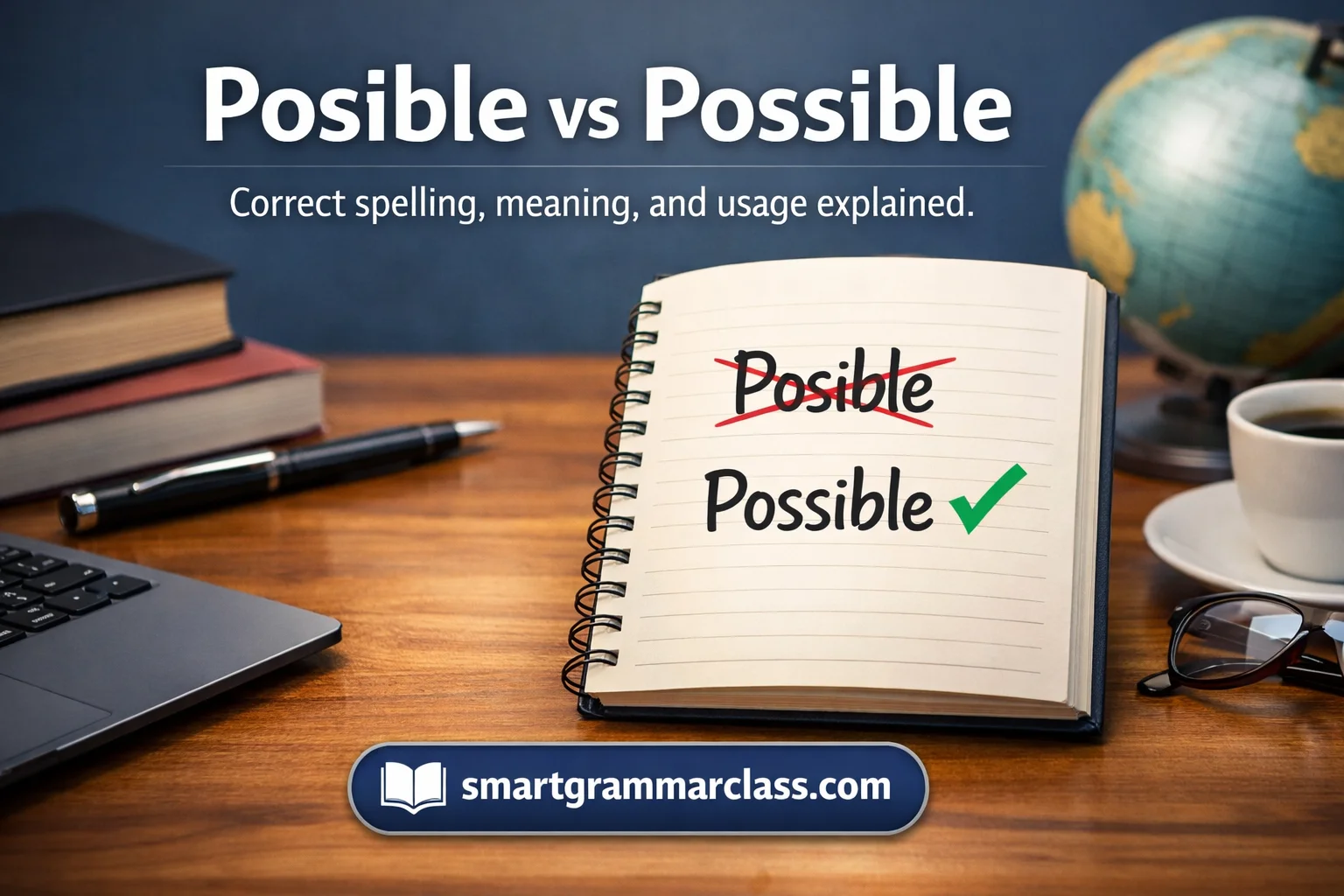
In English, the correct spelling is always Possible, while Posible comes from Spanish, which is why these words may sound alike and confuse writers, students, and even professionals. This common error often happens due to a missing s, especially when something is typed in a rush or influenced by language overlap and typing habits.
I’ve personally noticed this mistake in emails, essays, and social media posts, where quick digital shortcuts lead to spelling mistakes. The simple answer is to always choose the English version “Possible” when writing for clarity and to appear sharp and credible in any online or formal context.
The meaning of Possible as an adjective is something that can be done, achieved, or is existing within a certain measure or amount, like “as soon as possible” or “as much as possible,” which are common expressions used in business communication and formal writing. Its related adverb, possibly, is used when you are unsure or being careful, such as when scheduling a meeting, sending a calendar invite, or coordinating projects.
Using the wrong form like Posible may seem small, but it can undermine credibility, create confusion, and affect professionalism in documents, platforms, or even broadcasting and announcements. A good method I follow is to check a dictionary, follow style guides like US English or UK English, and practice with attention to detail to maintain consistency, precise language, and flawless usage across all written communication.
Also read this : Do to or Due to: Correct Meaning, Usage and Examples 2026
Posible vs Possible: Quick Answer That Clears the Confusion
If you remember one thing, make it this:
- Correct spelling: possible
- Incorrect spelling: posible
- Usage: Always use “possible” in English writing
There’s no exception. No alternate version. No regional variation.
You might wonder why such a simple word causes so much confusion. The answer lies in how we write today. Fast typing, autocorrect quirks, and multilingual habits blur the lines.
Still, when it comes to professional or even casual English writing, “possible” is the only acceptable choice.
Why “Posible vs Possible” Confusion Happens So Often
At first glance, the mistake seems careless. Look closer and you’ll see patterns.
Language crossover plays a major role
In Spanish, the correct spelling is “posible.” That spelling is valid and widely used. Someone switching between languages can easily carry it over into English without noticing.
Speed kills accuracy
Modern writing happens quickly. You type on your phone while walking. You respond to emails in seconds. That extra “s” often disappears under pressure.
Autocorrect isn’t perfect
Spellcheck tools help, but they don’t always catch everything. Especially when the word looks close enough to a valid pattern.
Visual similarity tricks the brain
Your brain reads shapes, not individual letters. “Posible” looks almost identical to “possible” at a glance. That’s why errors slip through.
What “Possible” Really Means in Everyday Language
You’ve used the word countless times. But understanding its depth helps you use it better.
Core meaning
Possible describes something that can happen, exist, or be done.
It doesn’t guarantee success. It simply means the door is open.
Practical interpretation
Think of “possible” as a green light. Not a promise. Not a certainty. Just permission for something to occur.
Examples that clarify the idea
- “It’s possible to learn a new skill in 30 days.”
- “We explored every possible option before deciding.”
- “That outcome isn’t possible with current resources.”
Each sentence carries a different tone. Yet the meaning stays consistent.
How “Possible” Functions in Different Contexts
The word adapts to many situations. That flexibility makes it powerful.
In decision-making
You use it to evaluate options.
- “Is it possible to reduce costs without losing quality?”
In problem-solving
It opens the door to solutions.
- “Let’s consider all possible fixes.”
In everyday conversation
It keeps things realistic yet hopeful.
- “It’s possible, but it’ll take time.”
In professional writing
It signals careful thinking.
- “We assessed all possible outcomes before implementation.”
Common Mistakes With “Posible vs Possible”
Mistakes follow patterns. Once you see them, you stop making them.
Dropping the double “s”
This is the most frequent issue.
- Incorrect: posible
- Correct: possible
Mixing languages unintentionally
Especially common among bilingual speakers.
Ignoring proofreading
A quick reread often catches this mistake. Skipping that step lets it slip through.
Side-by-Side Comparison That Ends the Debate
| Feature | Posible | Possible |
| Spelling | Incorrect in English | Correct |
| Language origin | Spanish | English |
| Professional use | Not acceptable | Fully acceptable |
| Frequency online | Common typo | Standard usage |
| Credibility impact | Reduces trust | Builds trust |
This table makes one thing clear. Only one version belongs in English writing.
Why “Possible” Stays the Same Across English Variants
English loves variation. Words like “color” and “colour” prove that.
Yet “possible” doesn’t change.
Here’s why
- It comes from Latin roots that stayed consistent
- Both US and UK English adopted the same spelling
- No alternative version evolved over time
That consistency simplifies things. You never have to second-guess it.
Easy Memory Tricks That Actually Work
Rules help. Patterns stick better.
Use the “double strength” idea
Think of the double “s” as reinforcement.
- Possible → strong spelling
- Posible → missing support
Link it to similar words
- Possess
- Possession
- Possibility
They all use double “s”.
Break it into syllables
Say it slowly:
pos-si-ble
That middle sound reminds you to double the “s”.
“Possible” in Real-Life Writing Situations
You don’t write in theory. You write in context.
In emails
- “Please confirm if it’s possible to move the meeting.”
On social media
- “Anything is possible with the right mindset.”
In business reports
- “We evaluated all possible risks before launching.”
In academic writing
- “This method offers several possible interpretations.”
Same spelling. Every time.
Case Study: How One Small Spelling Error Affects Credibility
Imagine this scenario.
A freelancer sends a proposal to a client. The content is strong. The pricing is competitive.
But one line reads:
“It is posible to complete this project within two weeks.”
That single mistake raises doubts.
What happens next
- The client questions attention to detail
- Trust drops slightly
- Another candidate with cleaner writing gets chosen
Lesson learned
Small errors create big impressions.
Correct spelling doesn’t just look good. It builds trust.
Why People Still Search “Posible vs Possible” in 2026
Search behavior tells a story.
Key reasons behind the trend
- Increased bilingual communication
- Mobile typing errors
- Fear of making mistakes in public writing
- Professional pressure to appear polished
People don’t want to guess. They want certainty.
Advanced Usage: “Possible” vs Similar Words
Sometimes confusion goes beyond spelling. Words with similar meanings add another layer.
Possible vs Probable
| Word | Meaning | Example |
| Possible | Can happen | “It’s possible to win.” |
| Probable | Likely to happen | “It’s probable we’ll win.” |
Possible vs Feasible
| Word | Meaning | Example |
| Possible | Theoretically achievable | “It’s possible to build it.” |
| Feasible | Practical and realistic | “It’s feasible within budget.” |
These distinctions sharpen your writing.
Deep Dive: The Origin of “Possible”
Words carry history. Understanding it adds depth.
Latin roots
“Possible” comes from the Latin word possibilis.
- “Posse” means “to be able”
- Combined meaning: capable of being done
Evolution into English
The word entered English through Old French. Over time, the spelling stabilized.
That stability explains why it hasn’t changed across regions.
How to Instantly Spot the Correct Spelling
You don’t need a dictionary every time.
Use this quick mental checklist
- Does it have double “s”?
- Does it feel complete?
- Does it match words like “possess”?
If yes, you’re good.
If not, fix it.
Writing Tips to Avoid This Mistake Forever
Good writing comes from habits.
Build a simple routine
- Pause after typing key words
- Scan for common errors
- Use spellcheck as backup, not primary defense
Read your sentences aloud
If something feels off, it probably is.
Keep a personal “mistake list”
Track words you often misspell. Review them occasionally.
Practical Exercises to Lock It In
Practice builds confidence.
Exercise one
Rewrite these sentences correctly:
- “It is posible to improve quickly.”
- “We explored every posible solution.”
Correct versions
- “It is possible to improve quickly.”
- “We explored every possible solution.”
Exercise two
Create your own sentences using “possible” in different contexts.
This active approach helps the correct spelling stick.
Visual Breakdown of the Word Structure
Here’s a simple way to see it:
pos + si + ble
↑
double s
That middle section matters most.
Remove one “s” and the structure collapses.
Why Correct Spelling Matters More Than Ever
In a fast digital world, details stand out.
Key impacts
- Builds credibility
- Enhances readability
- Strengthens communication
People notice errors instantly. Even if they don’t say it.
FAQs
What is the difference between Posible and Possible?
Posible is a misspelling in English, while Possible is the correct spelling. The confusion happens because Posible is the correct form in Spanish, leading to a common error in writing.
Why do people often make this spelling mistake?
Many writers, students, and professionals make this mistake due to typing habits, language overlap, or when they write in a rush. The missing s is easy to overlook, especially in casual texts or social media posts.
How can I remember the correct spelling easily?
A simple trick is to remember that Possible has two “s” letters, just like many English words with similar sounds. Regular practice, using a dictionary, and paying attention to detail can help you avoid this misspelling.
Is using Posible a serious issue in professional writing?
Yes, using the wrong form can undermine credibility and affect your professionalism, especially in emails, official documents, or business communication. It may create confusion and make your work look less polished.
Where is Possible commonly used in daily usage?
Possible is widely used in expressions like “as soon as possible” or “as much as possible,” especially in scheduling, meetings, and managing projects. It helps maintain clear English usage and ensures consistency in both formal writing and everyday communication.
Conclusion
In 2026, understanding the difference between Posible vs Possible is essential for clear and professional writing. The correct spelling in English is always Possible, and using the wrong form can lead to spelling mistakes that affect your credibility and create confusion. Whether you are drafting emails, working on essays, or posting on social media, choosing the right word improves clarity, consistency, and overall communication. By building strong typing habits, checking a dictionary, and paying close attention to detail, you can confidently avoid this common error and ensure proper usage in every context.

Emma Brooke is a dedicated grammar expert and language educator with a strong passion for helping learners master the English language with clarity and confidence. With years of hands-on experience in teaching grammar, writing, and communication skills, she specializes in breaking down complex language rules into simple, practical explanations.
At Smart Grammar Class, Emma focuses on creating accurate, easy-to-understand, and well-researched content that supports students, professionals, and everyday learners in improving their writing and speaking skills. Her approach combines real-world usage, clear examples, and structured guidance to ensure learners not only understand grammar rules but can apply them effectively.
Emma is committed to maintaining high editorial standards, ensuring every piece of content is reliable, up-to-date, and aligned with modern English usage. Her work reflects a deep understanding of language learning challenges and a mission to make grammar accessible to everyone.