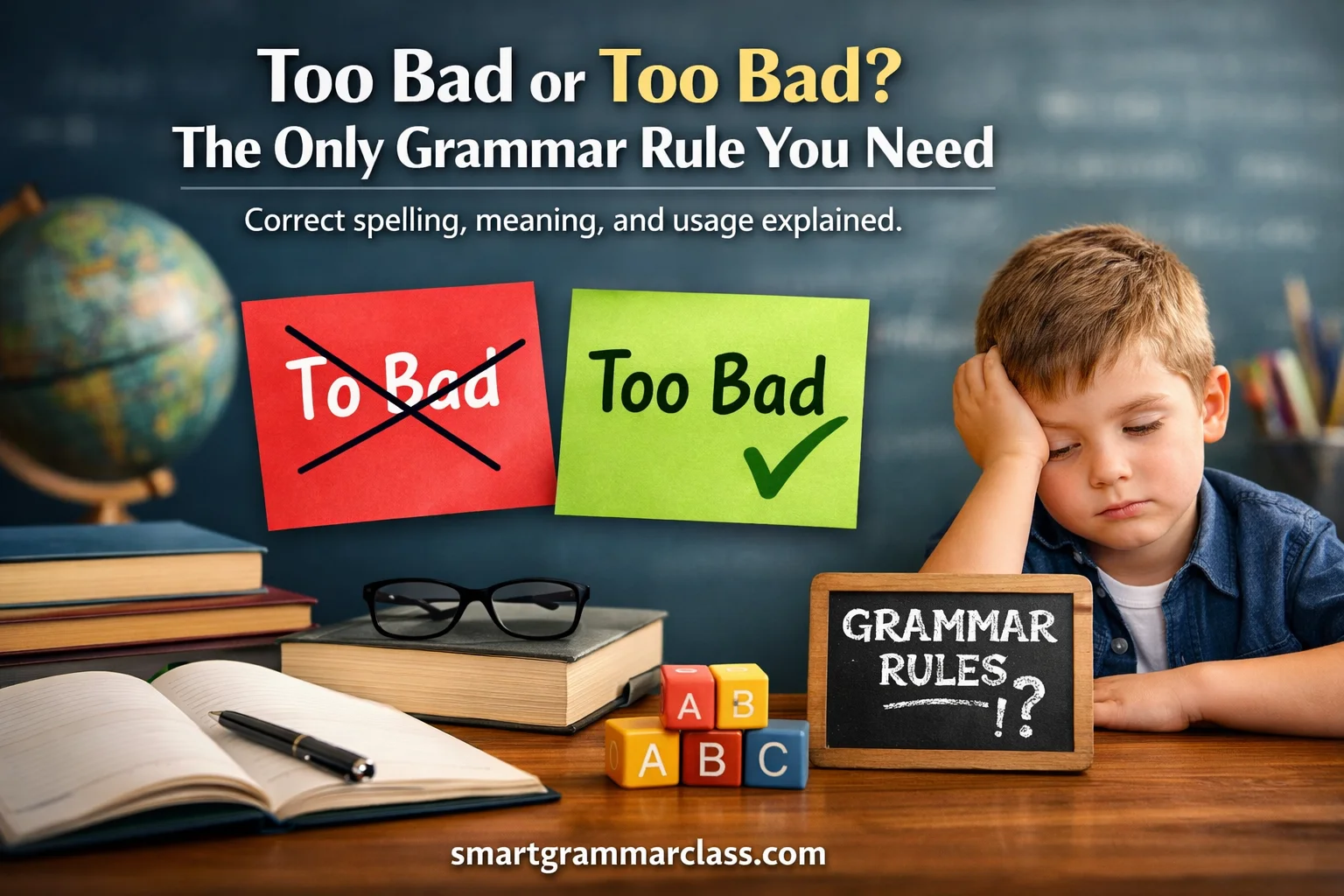
When I first started helping English learners and even native speakers with writing, I noticed how often people mix up to bad and too bad in emails, posts, and quick messages. This confusion usually comes from sound similarity and phonetic similarity, which create classic grammar traps. In simple terms, to bad is almost always a wrong usage, while too bad is the correct phrase in standard English.
The grammar rule is easy: use too bad when you want to show sympathy, regret, or react to an unfortunate situation. For example, in a sentence like “That’s too bad,” the meaning expresses a feeling, not direction. This small spelling difference matters a lot for communication clarity, because even a tiny error can lead to misunderstanding and affect how others see your intelligence or writing skills.
From my experience, most writers face hesitation, often paused mid-sentence, and start to second-guess before hitting send—I’ve done this countless times myself. The confusion stems from weak rule understanding and habit, but once you focus on intended meaning, everything becomes clearer. Think of it as part of your learning process in mastering language rules, sentence construction, and overall grammar clarity.
Many common mistakes come from ignoring context, semantics, and context usage, which are key in NLP and real-world communication. A good grammar guide or spelling guide will always stress correct usage, phrase correction, and expression clarity through usage examples and even real-life examples. Over time, this builds language understanding, improves writing accuracy, and strengthens communication skills, helping you avoid misuse, fix linguistic confusion, and achieve better expression meaning and effective communication in any language setting.
Also read this : Putting vs Puting: The Only Spelling Guide You’ll Ever Need
To Bad or Too Bad: The Quick Answer You Actually Need
Short answer?
- ✅ “Too bad” is correct
- ❌ “To bad” is always wrong
There are no exceptions. None.
That might sound blunt, yet clarity beats confusion every time. The phrase “too bad” works because “too” functions as an adverb. It modifies “bad” to intensify the feeling.
On the other hand, “to” doesn’t work here at all. It can’t modify adjectives like “bad.” So when someone writes “to bad,” they’re either typing too fast or mixing up similar-looking words.
A Simple Memory Trick That Actually Sticks
- Too = extra
- To = direction or purpose
Think of it this way. The word “too” has an extra “o,” which literally reminds you of “extra.” That tiny visual cue solves the problem instantly.
Side-by-Side Example
| Incorrect | Correct |
| That’s to bad | That’s too bad |
| It’s to bad you missed it | It’s too bad you missed it |
Once you see it, you can’t unsee it.
What Does “Too Bad” Really Mean? (It’s More Nuanced Than You Think)
At first glance, “too bad” looks simple. It expresses something unfortunate. But tone changes everything.
In real conversations, this phrase carries two distinct meanings.
Genuine Sympathy
Sometimes, “too bad” signals empathy.
“It’s too bad your trip got canceled.”
In this context, you’re acknowledging disappointment. You’re on the other person’s side.
Dismissive or Indifferent Tone
Other times, it can feel cold or even sarcastic.
“You missed the deadline? Too bad.”
Same words. Completely different impact.
Why Tone Matters So Much
Language isn’t just about words. It’s about delivery. A slight shift in tone can turn kindness into indifference.
That’s why context matters more than grammar here.
Real-Life Scenarios
- Friendly tone:
“Too bad you couldn’t make it. We had fun.” - Neutral tone:
“That’s too bad. Maybe next time.” - Dismissive tone:
“Too bad. Rules are rules.”
Same phrase. Three different emotional effects.
Why “To Bad” Is Always Incorrect (No Exceptions, Ever)
Let’s break this down logically.
The word “to” serves specific roles in English:
- It shows direction → “go to the store”
- It introduces verbs → “to eat,” “to run”
What it does NOT do is modify adjectives like “bad.”
So when someone writes “to bad,” the sentence literally loses structure. It doesn’t make grammatical sense.
Why People Still Make This Mistake
Even though the rule is simple, the mistake is common. Here’s why:
- Typing quickly on phones
- Autocorrect errors
- Phonetic confusion (they sound identical)
- Habit-based writing
Visual Breakdown
| Word | Function | Can It Modify “Bad”? |
| To | Preposition / infinitive marker | ❌ No |
| Too | Adverb | ✅ Yes |
That’s the entire rule in one glance.
The Real Grammar Rule Behind “Too” (And Why It Works)
Now let’s zoom out.
The word “too” is an adverb. It plays two main roles:
Meaning 1: Excess or Degree
- “too hot”
- “too expensive”
- “too loud”
Here, “too” means more than necessary or desirable.
Meaning 2: Also
- “I want to go too”
- “She’s coming too”
In the phrase “too bad,” we’re using the first meaning. It intensifies “bad,” suggesting something is unfortunately bad or disappointing.
Why “Too Bad” Works Perfectly
Because it follows a clear structure:
Adverb + Adjective
- too (adverb)
- bad (adjective)
That pairing is grammatically sound and widely used.
“Too Bad” in Real Sentences (Natural Examples You’ll Actually Use)
Let’s move away from theory.
Here’s how people actually use “too bad” in everyday language.
Casual Conversations
- “It’s too bad we didn’t meet earlier.”
- “That’s too bad. I was looking forward to it.”
- “Too bad the weather didn’t cooperate.”
Workplace Situations
- “It’s too bad the project got delayed.”
- “That’s too bad. Let’s reschedule.”
Blunt or Firm Responses
- “Too bad. The policy won’t change.”
- “You missed it? Too bad.”
Tone Comparison Table
| Sentence | Tone |
| “That’s too bad, I’m sorry” | Empathetic |
| “That’s too bad” | Neutral |
| “Too bad” | Dismissive |
Small differences. Big impact.
Common Mistakes with “Too Bad” (And How to Fix Them Fast)
Even simple phrases can trip people up.
Here are the most common mistakes and how to avoid them.
Mixing Up “To,” “Too,” and “Two”
These three words sound identical, which makes them easy to confuse.
| Word | Meaning | Example |
| To | Direction / purpose | Go to school |
| Too | Excess / also | Too hot |
| Two | Number | Two apples |
Writing “To Bad” by Habit
This is the most frequent error. It usually happens during fast typing.
Fix: Pause for half a second and ask, “Do I mean ‘extra bad’?” If yes, use “too.”
Overusing “Too Bad” in Serious Situations
Sometimes, “too bad” sounds insensitive.
Instead of:
- “Too bad your business failed”
Try:
- “That’s really unfortunate”
Quick Correction Table
| Wrong Phrase | Correct Phrase |
| to bad | too bad |
| I feel to bad | I feel too bad |
| thats to bad | that’s too bad |
“Too Bad” vs Similar Phrases (Choose the Right Tone)
“Too bad” isn’t always the best choice.
Sometimes, you need something softer. Other times, something stronger.
Better Alternatives
- That’s a shame → softer, polite
- That’s unfortunate → formal, neutral
- Oh no → emotional, immediate
- Tough luck → slightly harsh
- That sucks → informal, casual
Tone Ladder (From Gentle to Harsh)
| Phrase | Tone Level |
| That’s unfortunate | Very polite |
| That’s a shame | Gentle |
| That’s too bad | Neutral |
| Too bad | Cold |
| Tough luck | Harsh |
Choosing the right phrase can change how people perceive you.
British vs American English: Any Difference in “Too Bad”?
Here’s something surprising.
There’s no spelling difference between British and American English for this phrase.
Both use:
- Too bad ✅
Subtle Differences in Usage
- Americans tend to say “that’s too bad” more often
- British speakers often prefer “that’s a shame”
Example Comparison
| Region | Common Phrase |
| United States | That’s too bad |
| United Kingdom | That’s a shame |
Same meaning. Slight cultural flavor.
“Too Bad” in Modern Usage (2026 Trends and Real Language)
Language evolves. Fast.
In 2026, “too bad” remains widely used, especially in informal settings.
Where You’ll See It Most
- Text messages
- Social media comments
- Casual conversations
- TV shows and movies
Modern Usage Patterns
- Shortened replies → “too bad”
- Sarcastic tone increasing online
- Used in memes and reactions
Example from Social Media
“Missed the sale? Too bad 😬”
Here, the phrase leans slightly sarcastic. Emojis often soften the tone.
Quick Recap (Lock This In Your Memory)
Let’s simplify everything.
- “Too bad” is always correct
- “To bad” is always wrong
- “Too” means extra or excessive
- Tone determines meaning:
- Kind → sympathy
- Flat → neutral
- Sharp → dismissive
One-Line Rule
If you mean “unfortunate,” use “too bad.”
That’s it.
FAQs
What is the difference between to bad and too bad in grammar?
The difference is simple: to bad is not a correct phrase in standard English, while too bad is correct and commonly used. This grammar rule helps avoid confusion and ensures proper writing accuracy in everyday communication.
Why do English learners and native speakers confuse these commonly confused expressions?
The confusion stems from sound similarity and phonetic similarity, which make both phrases feel alike. This creates linguistic confusion and leads to wrong usage, especially during fast typing or casual writing like emails and posts.
When should I use too bad in a sentence?
Use too bad when expressing sympathy, regret, or reacting to an unfortunate situation. It reflects the intended meaning clearly and improves communication clarity, making your expression meaning easy to understand.
How can I avoid this grammar trap in my writing?
Focus on rule understanding, practice with usage examples, and pay attention to context and semantics. Following a good grammar guide or spelling guide can improve writing skills, reduce misuse, and strengthen overall language understanding.
Does using the wrong phrase affect communication skills?
Yes, even small errors like this can cause misunderstanding and impact your communication skills. Consistent learning, proper sentence construction, and attention to language rules help build confident writers and improve effective communication.
Conclusion
In the end, mastering the difference between to bad and too bad comes down to simple grammar rule awareness and clear meaning. This small but important distinction improves writing accuracy, avoids misunderstanding, and strengthens overall communication clarity. By focusing on correct usage, understanding context, and practicing through real sentence examples, both English learners and native speakers can overcome this common confusion. With time, this becomes part of your natural language understanding, helping you write with confidence and achieve more effective communication skills in everyday writing.

Mia Rose is a dedicated grammar expert and language educator committed to helping learners master English with clarity and confidence. With extensive experience in teaching grammar, writing, and communication skills, she specializes in turning complex language rules into simple, easy-to-understand lessons.
At Smart Grammar Class, Mia creates accurate, well-researched, and practical content tailored for students, professionals, and everyday learners. Her teaching style focuses on real-world examples and clear explanations, enabling readers to confidently apply grammar rules in both writing and speaking.
Mia is committed to maintaining high editorial standards, ensuring every piece of content is reliable, up-to-date, and aligned with modern English usage. Her mission is to make grammar accessible, engaging, and useful for learners at all levels.