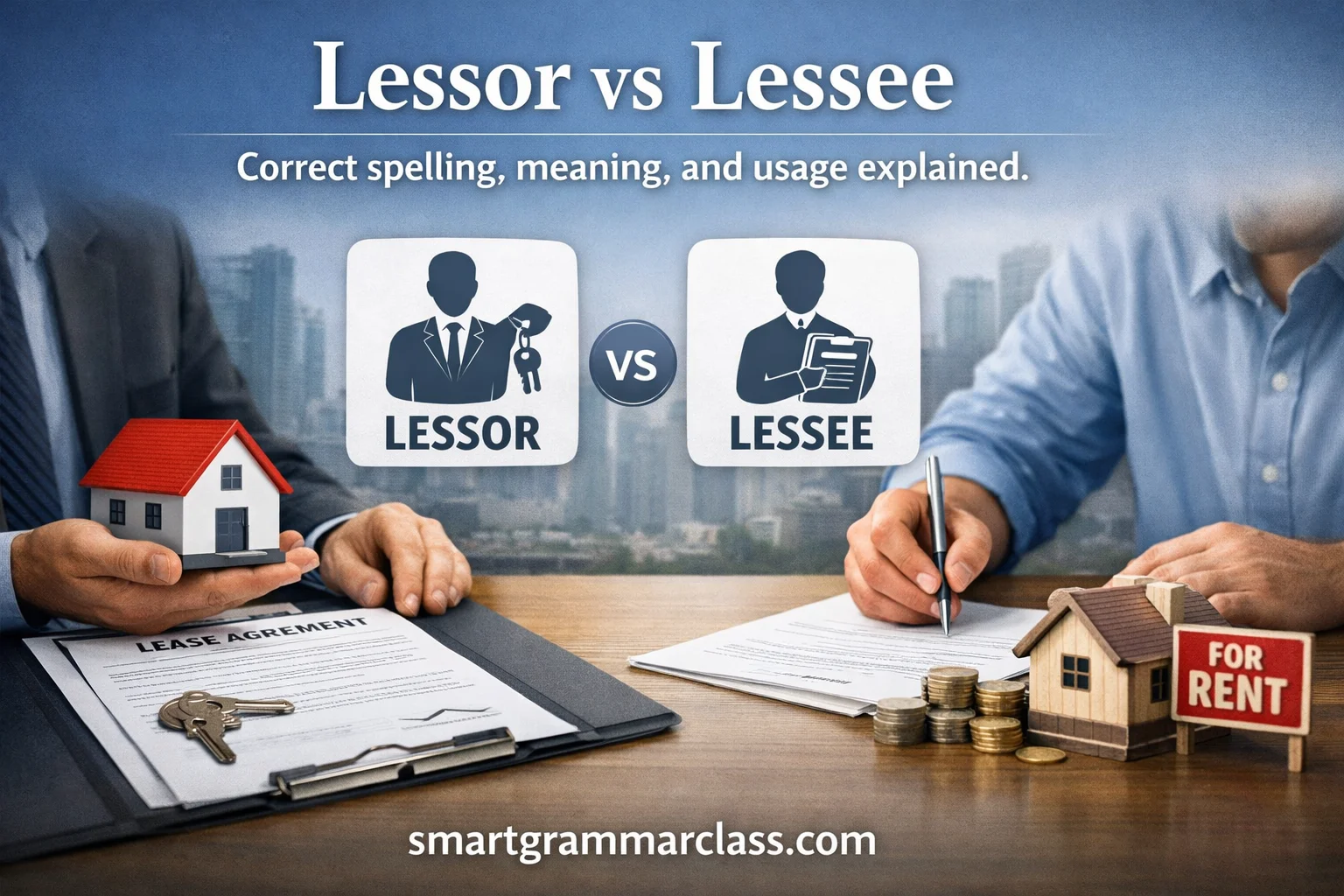
In simple terms, a lessor is the owner, landlord, or property owner who provides asset or provides property, while the lessee is the tenant or user who gets temporary possession through a lease or lease agreement. This rental relationship is a contractual arrangement between two parties, where one retains ownership and the other gains usage rights by paying rent or making periodic payments over an agreed period.
The correct spelling, meaning, and usage matter because even a small terminology confusion or using a wrong term like lesser instead of lessor can lead to legal mistakes, financial mistakes, or serious contract mistakes. From my experience reviewing contracts and rental agreements, many people simply skim contracts without verifying terms, which causes confusion and costly issues later.
To build clarity and avoid lease confusion, always focus on the difference, distinction, and roles in a lease contract. The lessor accounting records income flow like rental income, while lessee accounting tracks lease payments as part of financial statements. Whether it’s an apartment, house, car, or equipment leasing like a bouncy castle, the agreement structure, legal structure, and financial structure stay similar.
A finance professional or manager will tell you that understanding legal language, terms, and definitions helps in navigating leases, especially with rising property values and the growing renting trend. Always read the rental contract, check agreement verification, and follow simple contract tips, lease tips, and writing tips to write clearly and understand contracts better. This terminology mastery builds strong professional knowledge, helping both working adults and families avoid financial consequences and protect their money.
Also read this : Crowler or Growler: Correct Spelling, Meaning, Differences and When to Use Each 2026
Quick Answer: Lessor vs Lessee Explained Clearly
Here’s the simplest breakdown you’ll ever need.
- Lessor → The owner who rents out an asset
- Lessee → The user who pays to use that asset
Think of a basic exchange. One party provides access. The other pays for that access.
| Term | Role | Money Flow |
| Lessor | Owner or provider | Receives money |
| Lessee | User or renter | Pays money |
Short and sharp. Yet that clarity prevents confusion later.
Why Lessor vs Lessee Confuses So Many People
These terms trip people up for a simple reason. They look almost identical.
You see two nearly identical words. You assume they function the same way. That assumption leads you straight into confusion.
Here’s why it happens:
- Both words come from the same root “lease”
- Only the endings differ slightly
- Legal documents use them repeatedly
- Everyday language rarely uses either
Now add pressure. You’re signing a contract. You’re scanning quickly. Suddenly you mix them up.
That’s how small errors turn into big problems.
The Origin of Lessor and Lessee
Language always tells a story. These words come from Old French legal terminology used in medieval Europe.
- “Lessor” comes from lesser meaning “to allow” or “to let”
- “Lessee” evolved as the receiving party
Over centuries these terms became standard in English law. Courts adopted them because they clearly defined roles. Precision matters in contracts. Ambiguity invites disputes.
Even today these terms dominate:
- Real estate contracts
- Equipment leases
- Corporate agreements
- Financial leasing documents
Despite modern language evolving rapidly these two words refuse to disappear. They remain deeply embedded in legal systems.
Legal Meaning vs Everyday Usage
This is where things shift slightly.
Legal Context
In legal documents every word carries weight. There’s no room for interpretation.
- Lessor always means owner
- Lessee always means user
- Definitions appear at the beginning of contracts
- Courts enforce those definitions strictly
One wrong interpretation can lead to disputes or financial loss.
Everyday Usage
Outside legal documents people prefer simpler words.
- Landlord instead of lessor
- Tenant instead of lessee
However here’s the catch. These everyday words don’t always match perfectly. For example:
- A “lessor” could lease equipment not just property
- A “lessee” could be a corporation not an individual
So while casual language simplifies things legal language stays exact.
Lessor vs Lessee: Detailed Comparison
Let’s go deeper. This table breaks down the differences in practical terms.
| Aspect | Lessor | Lessee |
| Ownership | Owns the asset | Does not own the asset |
| Rights | Retains ownership rights | Gains usage rights |
| Financial Role | Earns income from leasing | Pays for temporary use |
| Responsibilities | Maintains asset condition | Uses asset responsibly |
| Risk Exposure | Depreciation or damage risk | Liability for misuse |
| Legal Position | Contract issuer | Contract acceptor |
Notice how each role complements the other. One cannot exist without the other.
When to Use Lessor vs Lessee Correctly
Knowing the difference is one thing. Using it correctly is another.
Use “Lessor” When
- You own the asset
- You allow someone else to use it
- You receive payment
Examples:
- Property owner renting apartments
- Company leasing machinery
- Bank offering leasing services
Use “Lessee” When
- You rent or lease something
- You agree to pay for access
- You use the asset temporarily
Examples:
- Tenant renting an apartment
- Business leasing office equipment
- Individual leasing a car
A simple rule helps.
If you pay → you’re the lessee
If you get paid → you’re the lessor
Common Mistakes in Lessor vs Lessee Usage
Even experienced professionals mix these up occasionally. Let’s fix that.
Mixing Up Roles
This happens when people rush through contracts.
Example mistake:
Calling a tenant the lessor
Fix:
Always check who owns the asset.
Assuming They Mean the Same Thing
They don’t. Not even close.
Fix:
Treat them like opposite sides of a transaction.
Ignoring Contract Definitions
Most contracts define both terms at the start.
Fix:
Read the definitions section before anything else.
Relying on Memory Instead of Logic
Memory tricks help but logic wins.
Fix:
Ask one question: Who pays whom?
Real-World Examples That Make It Click
Let’s bring this into real life. Theory is useful but examples make it stick.
Rental Agreements
A landlord rents an apartment to a tenant.
- Landlord = Lessor
- Tenant = Lessee
The landlord owns the property. The tenant pays for access.
Vehicle Leasing
A dealership leases a car to a customer.
- Dealership = Lessor
- Customer = Lessee
The dealership keeps ownership. The customer pays monthly.
Equipment Leasing
A company leases machinery to another business.
- Equipment owner = Lessor
- Business user = Lessee
This model dominates industries like construction and manufacturing.
Office Space Leasing
A corporation rents office space.
- Property owner = Lessor
- Corporation = Lessee
Large companies often lease instead of buying to preserve cash flow.
Case Study: How a Small Mistake Cost Thousands
Consider a real scenario.
A startup signed a lease for office space. The contract clearly defined roles. However the founder misunderstood the terminology.
He believed “lessee” referred to the property owner. That misunderstanding led to:
- Misinterpretation of maintenance responsibilities
- Delayed repairs
- Legal dispute with the landlord
The result?
Over $15,000 in unexpected costs.
One small misunderstanding. One expensive lesson.
Financial Implications of Lessor vs Lessee
This distinction goes beyond vocabulary. It affects money directly.
For Lessors
- Generate steady income
- Retain asset ownership
- Face depreciation risks
For Lessees
- Avoid large upfront costs
- Gain flexibility
- Accept ongoing payment obligations
Example Breakdown
| Scenario | Lessor Benefit | Lessee Benefit |
| Property Lease | Rental income | Housing without buying |
| Car Lease | Asset utilization | Lower upfront cost |
| Equipment Lease | Revenue stream | Operational access |
Each side gains something valuable. That balance drives leasing markets worldwide.
Quick Memory Tricks That Work
Let’s make this stick permanently.
- Lessor = Lets the asset go
- Lessee = Leases and uses
Or try this:
- Lessor → Less effort collecting money
- Lessee → More expense paying money
It sounds simple. That’s the point. Simple sticks.
Advanced Insight: Lease Structures Explained
Not all leases work the same way. Understanding structures adds clarity.
Operating Lease
- Short-term
- Lessor maintains ownership
- Lessee uses asset temporarily
Finance Lease
- Long-term
- Lessee assumes more responsibility
- Often leads to ownership transfer
Sale-Leaseback
- Owner sells asset
- Immediately leases it back
This strategy frees up cash while maintaining usage.
How Businesses Use Lessor vs Lessee Strategies
Companies use leasing strategically. It’s not just about renting.
Why Companies Choose to Be Lessors
- Generate passive income
- Maximize asset value
- Build long-term revenue streams
Why Companies Choose to Be Lessees
- Preserve capital
- Scale operations quickly
- Avoid maintenance headaches
Smart businesses switch roles depending on their goals.
SEO Insight: Why “Lessor vs Lessee” Matters in 2026
Search trends show growing interest in financial literacy.
Popular queries include:
- “lessor vs lessee meaning”
- “difference between lessor and lessee”
- “lease agreement terms explained”
This surge reflects a shift. More people now review contracts carefully. That’s a good thing.
Practical Checklist Before Signing Any Lease
Before signing anything pause and review this checklist.
- Identify the lessor clearly
- Confirm your role as lessee
- Understand payment terms
- Review maintenance responsibilities
- Check termination clauses
This simple process prevents costly surprises later.
Key Takeaways You Should Remember
Let’s lock this in.
- Lessor owns and rents out
- Lessee pays and uses
- These roles define every lease agreement
- Misunderstanding can cost serious money
Once you understand this everything else becomes easier.
FAQs
What is the main difference between a lessor and a lessee?
The lessor is the owner or landlord who gives a property or asset, while the lessee is the tenant who gets temporary possession and pays rent under a lease agreement. This basic difference understanding helps avoid confusion in any rental relationship.
Why is the correct spelling of lessor and lessee important?
Using the correct spelling ensures proper legal clarity in contracts and legal documents. A small mistake like writing lesser instead of lessor can create terminology confusion and lead to legal consequences or contract mistakes.
What are the roles and responsibilities of each party in a lease?
The lessor retains ownership and collects income, while the lessee has usage rights and is responsible for paying rent or lease payments. These defined roles in a contractual arrangement help both parties follow clear terms.
How does leasing affect finance and accounting?
In finance and accounting, the lessor accounting records rental income, while lessee accounting tracks payments as expenses. These leasing transactions appear in financial statements, making agreement understanding very important for accuracy.
What are some tips to avoid lease confusion and contract mistakes?
Always read the lease contract carefully, focus on terms, and do proper contract verification before signing. Simple understanding tips like checking definitions, reviewing agreement language, and learning basic lease terminology can prevent financial mistakes and improve clarity.
Conclusion
In conclusion, understanding the lessor and lessee is essential for clear lease dealings and avoiding contract mistakes. The difference lies in their roles, where the lessor as the owner provides the property or asset, and the lessee as the tenant gains temporary possession by paying rent under a lease agreement. Using the correct spelling, proper terminology, and clear usage ensures strong legal clarity and prevents financial mistakes. Whether dealing with rental agreements, contracts, or leasing transactions, having solid understanding, following terms, and applying simple tips can protect your money and improve overall agreement clarity.

Mia Rose is a dedicated grammar expert and language educator committed to helping learners master English with clarity and confidence. With extensive experience in teaching grammar, writing, and communication skills, she specializes in turning complex language rules into simple, easy-to-understand lessons.
At Smart Grammar Class, Mia creates accurate, well-researched, and practical content tailored for students, professionals, and everyday learners. Her teaching style focuses on real-world examples and clear explanations, enabling readers to confidently apply grammar rules in both writing and speaking.
Mia is committed to maintaining high editorial standards, ensuring every piece of content is reliable, up-to-date, and aligned with modern English usage. Her mission is to make grammar accessible, engaging, and useful for learners at all levels.