I once paused while writing an email and even a short report, wondering which phrase was correct. This is a common problem in English where tricky words that have a similar sound can confuse even seasoned writers. The keyword here is clarity, because using the right form really matters, especially in professional or academic work. Many people search for a quick answer to avoid embarrassing mistakes, and this article will break it down in a simple way. The difference may look like a tiny letter, but it often trips students and professionals alike, especially mid-sentence.
Here’s the truth: affect is usually a verb that means to change or influence, like when the weather affected your mood, while effect is a noun meaning a result, outcome, or impact. Think of it as a small puzzle piece that must fit the purpose and meaning of your sentence.
In real-life examples, you might say “The policy had a big effect,” but “The policy will affect many people.” From Google Trends and data, this confusion appears worldwide, across British and American usage. A helpful memory trick is to remember that effect relates to aftermath or repercussion, while affect shows action. If still unsure, a grammar checker in Gmail or a blue underline can help fix grammatical flubs before you hit send.
Also read this : Freshman vs Freshmen: Meaning, Grammar, Usage and Real Examples 2026
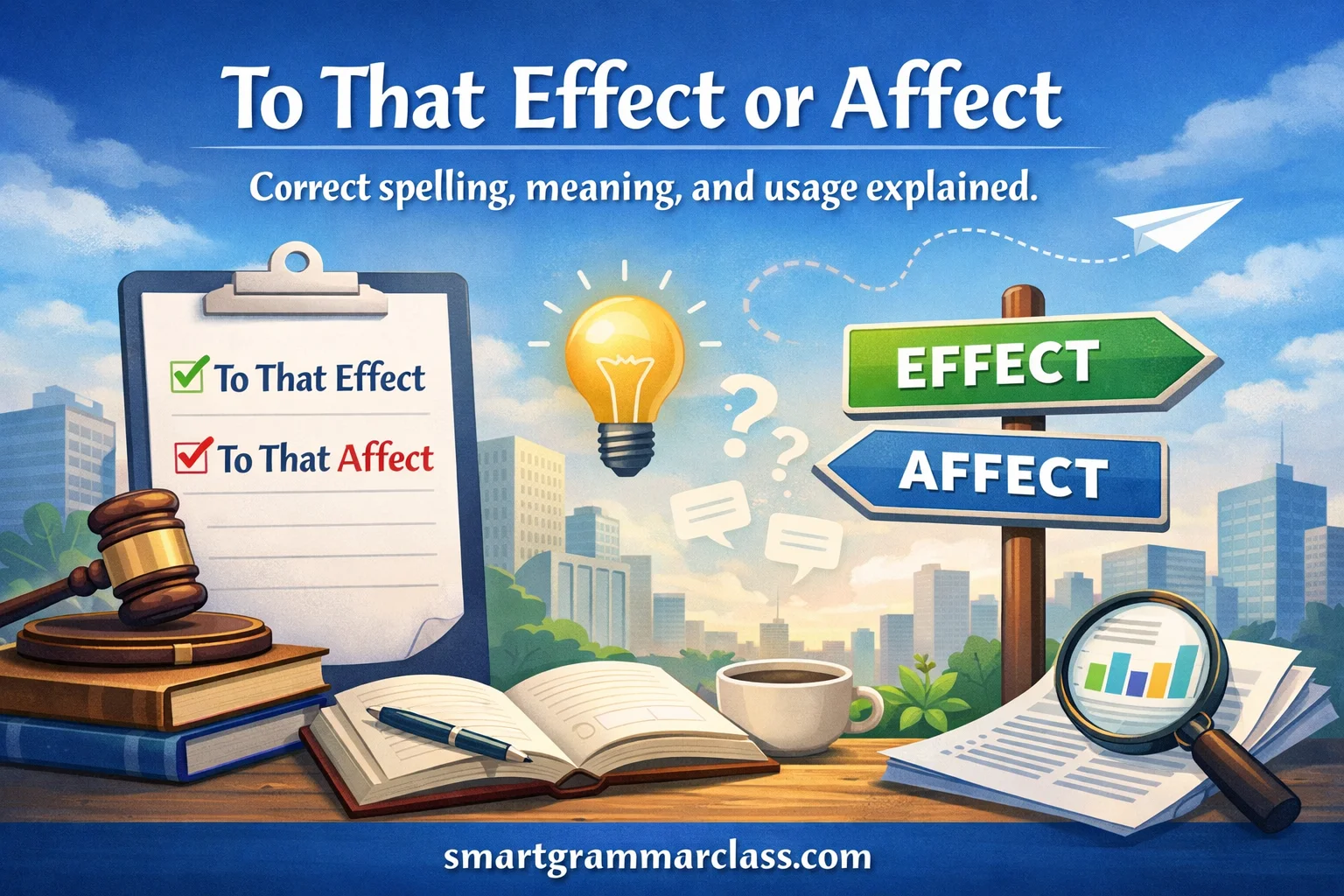
Quick Answer: To That Effect vs To That Affect
If you remember only one thing from this guide, make it this.
- ✅ To that effect = correct
- ❌ To that affect = incorrect
Why?
Because “effect” is the noun that fits the meaning of the phrase. It refers to a result or intended meaning. On the other hand, “affect” is usually a verb. It doesn’t belong here.
Example:
He said something to that effect during the meeting.
Simple. Clean. Correct.
What “To That Effect” Really Means
This phrase does something subtle yet powerful. It allows you to summarize what someone said without quoting them exactly.
Think of it as a shortcut. Instead of repeating every word, you capture the essence.
Core Meaning
- Refers to a similar idea or intention
- Indicates approximate wording
- Signals paraphrasing instead of quoting
Example in context
Imagine a manager says a long sentence about improving performance.
You don’t need to repeat it word for word. You can say:
She mentioned improving productivity or something to that effect.
That phrase acts like a bridge. It connects your summary to the original idea.
Why “To That Affect” Is Incorrect
Here’s where many people slip.
They assume both words are interchangeable. They’re not.
The real issue
- Affect = usually a verb (an action)
- Effect = usually a noun (a result)
When you say “to that effect” you’re referring to a result or meaning. Not an action.
Example breakdown
| Phrase | Correct? | Reason |
| To that effect | ✅ Yes | Uses noun correctly |
| To that affect | ❌ No | Uses verb incorrectly |
Quick mental check
Ask yourself this:
Am I talking about a result or meaning?
If yes, you need effect.
Real-Life Examples That Make It Click
Rules help. Examples stick.
Here are practical, everyday uses of “to that effect”.
In conversations
- He said he might resign or something to that effect
- She warned us about delays or words to that effect
In emails
- The client responded to that effect but didn’t confirm details
- They agreed to that effect during the call
In meetings
- The CEO hinted at expansion plans or something to that effect
- The report concluded to that effect without specifics
Notice a pattern?
You’re always summarizing. Never quoting exactly.
Common Mistakes People Keep Making
Even experienced writers fall into these traps. Let’s clear them out.
Confusing affect and effect
This is the biggest one.
- Writing “to that affect” by mistake
- Assuming both words mean the same thing
Overthinking grammar
Some people know the rule but still hesitate. They second guess themselves.
That hesitation leads to errors.
Misusing in formal writing
In professional documents, even a small mistake stands out.
A single wrong word can reduce credibility.
A Memory Trick That Actually Works
Forget complicated grammar rules. Use this instead.
The E-A Shortcut
- Effect = End result
- Affect = Action
Both start with the same letter. That makes it easy to remember.
Apply it here
“To that effect” refers to a result or meaning. So “effect” fits perfectly.
How “To That Effect” Works in Professional Writing
This phrase shows up everywhere. Especially in formal communication.
Business communication
Used to summarize conversations without quoting directly.
Example:
The agreement included clauses to that effect.
Legal writing
Lawyers often paraphrase statements.
Example:
The witness testified to that effect during the hearing.
Academic writing
Helps avoid repetition while maintaining clarity.
Example:
The study concluded to that effect based on collected data.
Case Study: One Small Mistake, Big Impact
Let’s look at a real-world style scenario.
Situation
A job applicant submits a cover letter.
They write:
“I mentioned my leadership experience to that affect.”
Outcome
The hiring manager notices the mistake immediately.
What happens next?
- The applicant appears careless
- Attention to detail becomes questionable
- Chances of selection drop
Lesson
Small grammar errors create big impressions.
Fixing them gives you an edge.
Comparison Table: Affect vs Effect Explained Clearly
Here’s a quick reference you can revisit anytime.
| Feature | Affect | Effect |
| Part of speech | Verb | Noun |
| Meaning | To influence | Result or outcome |
| Usage example | Stress affects sleep | The effect was noticeable |
| Used in phrase | ❌ No | ✅ Yes |
Everyday Situations Where You’ll Use This Phrase
You might think this is rare. It’s not.
Common use cases
- Recalling conversations
- Summarizing speeches
- Writing emails
- Reporting discussions
Example scenarios
At work:
The manager suggested changes or something to that effect
With friends:
He said he’s moving away or words to that effect
In writing:
The article argued to that effect without strong evidence
Related Grammar Mistakes You Should Fix Next
If you struggle with “affect vs effect” chances are you’ve seen these too.
Common confusion pairs
- Then vs Than
- Your vs You’re
- Its vs It’s
Each one looks minor. Each one changes meaning completely.
Fixing these improves your writing instantly.
Why This Mistake Still Happens in 2026
You’d expect people to get this right by now. Yet searches keep rising.
Key reasons
Similarity in spelling
They look almost identical. Easy to mix up.
Sound confusion
In fast speech, they sound very similar.
Lack of grammar clarity
Many people never learned the difference properly.
Search Trends and Real Usage Insights
Online data shows a consistent pattern.
- Thousands search “to that effect or affect” every month
- Error rates remain high in user-generated content
- Even blogs and articles sometimes get it wrong
This creates an opportunity.
If you use it correctly, your writing stands out.
Advanced Usage Tips Most People Miss
Want to go beyond basic understanding? Here’s where it gets interesting.
Use it to soften statements
Instead of sounding too direct, this phrase adds flexibility.
Example:
He criticized the plan or something to that effect
Use it to imply uncertainty
When you’re not quoting exactly.
Example:
She mentioned budget issues to that effect
Avoid overuse
Like any phrase, using it too often feels repetitive.
Mix it with alternatives:
- “In similar terms”
- “Along those lines”
- “In that sense”
Practical Writing Tips to Avoid This Mistake Forever
Let’s make this stick.
Quick checklist
- Ask yourself: result or action
- If result → use effect
- Double check before submitting
Editing trick
Search your document for “affect” and review each instance.
Read out loud
Does it sound natural?
If not, fix it.
Mini Drill: Test Yourself
Try these quickly.
Choose the correct option
He responded to that ___
- Affect
- Effect
Correct answer: Effect
She described the plan or something to that ___
- Affect
- Effect
Correct answer: Effect
If you got those right, you’re already ahead of most writers.
FAQs
What is the main difference between affect and effect?
The main difference is in their grammar roles. Affect is usually a verb that means to change or influence something, while effect is a noun that refers to a result or outcome.
When should I use “to that effect” in a sentence?
You can use “to that effect” when you want to express a general idea or do a bit of paraphrasing instead of quoting exactly. It helps summarize a statement without repeating the exact words.
Why do people often confuse affect and effect?
This confusion happens because both words are homophones with a similar sound but different meanings and usage. Even experienced writers sometimes mix them up, especially while writing quickly.
Are there any simple memory tricks to remember them?
Yes, a popular memory trick is that affect is an action (both start with “A”), and effect is the end result. Thinking of aftermath or repercussion can also help you remember effect.
Can grammar tools help fix these mistakes?
Yes, many grammar checker tools like those in Gmail highlight errors with a blue underline. They can catch grammatical mistakes and help you choose the correct spelling based on your sentence context.
Conclusion
In 2026, understanding to that effect or affect comes down to knowing the correct spelling, meaning, and usage in everyday English. While the difference may seem small, choosing the right word improves clarity and helps avoid common mistakes in both professional and academic writing. By remembering that affect is usually a verb and effect is a noun, you can use each phrase correctly with more confidence. With regular practice, simple memory tricks, and a quick grammar check, this once tricky problem becomes easy to handle in any sentence.

Emma Brooke is a dedicated grammar expert and language educator with a strong passion for helping learners master the English language with clarity and confidence. With years of hands-on experience in teaching grammar, writing, and communication skills, she specializes in breaking down complex language rules into simple, practical explanations.
At Smart Grammar Class, Emma focuses on creating accurate, easy-to-understand, and well-researched content that supports students, professionals, and everyday learners in improving their writing and speaking skills. Her approach combines real-world usage, clear examples, and structured guidance to ensure learners not only understand grammar rules but can apply them effectively.
Emma is committed to maintaining high editorial standards, ensuring every piece of content is reliable, up-to-date, and aligned with modern English usage. Her work reflects a deep understanding of language learning challenges and a mission to make grammar accessible to everyone.