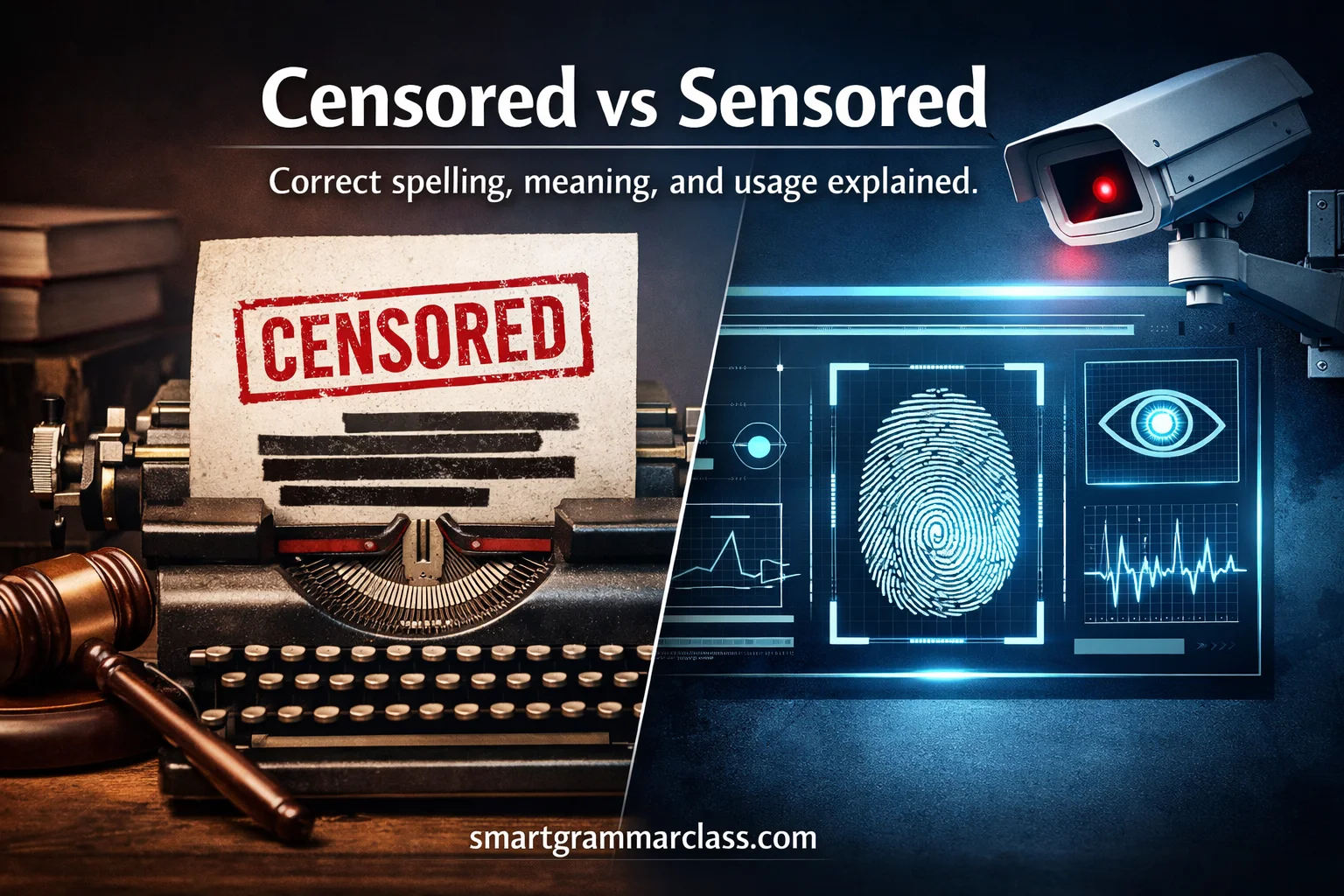
Many writers, whether a student, creator, or professional, often pause when choosing between censored and sensored because the words sound similar. This mix-up is natural, and many people search this exact phrase online for quick clarity. In this simple, easy guide, I’ll share how I personally learned to stop second-guessing and confidently pick the correct spelling, meaning, and usage. At a glance, these versions may look alike, but they live in completely different worlds, and mixing them can quietly chip away at your credibility in writing, reading, and business communication.
The word censored refers to the suppression or removal of objectionable content in movies, books, or broadcasting, often involving human intervention to control anything politically or socially unacceptable. A censor is a person authorized to read publications, correspondence, or watch theatrical performances and suppress a whole or part of it. In contrast, sensored comes from sensor, a device for detecting physical stimuli like light, motion, heat, or pressure, providing objective data in technology, such as a smoke detector, motor rotor position tracker, or speed detector.
These similar-sounding terms are homophones, but their definitions, pronunciation, and example sentences clearly show the differences. Whether you’re drafting emails, preparing reports, or managing projects, understanding this distinction ensures grammatical consistency, avoids mistakes, and helps you confidently distinguish the right word in both formal and casual settings.
Also read this : Lessor vs Lessee: Correct Spelling, Meaning and Usage Explained 2026
Instant Answer: Censored vs Sensored Explained in Seconds
Here’s the quick version you came for.
- “Censored” = content is restricted, edited, or suppressed
- “Sensored” = something is detected or measured using a device
Quick examples
- The article was censored before publication ✔
- The system sensored a gas leak ✔
- The article was sensored before publication ✘
If a human or authority removes content, use censored.
If a machine detects something, use sensored.
Simple. But there’s more beneath the surface.
What Does “Censored” Mean? Full Breakdown with Real Context
The word censored carries weight. It often shows up in serious discussions about freedom, control, and information flow.
Core definition
Censored means:
To examine and suppress parts of content considered inappropriate, sensitive, or dangerous.
Where you’ll see it most
- Government-controlled media
- Social media moderation
- Journalism and publishing
- Film and television editing
Real-world example
A documentary exposes corruption. Before release, officials demand edits. Certain scenes disappear. The final version feels incomplete.
That’s censorship in action.
Types of censorship
Different forms appear depending on context:
- Political censorship – Governments limit criticism
- Cultural censorship – Content conflicts with norms
- Corporate censorship – Platforms enforce guidelines
- Self-censorship – Writers hold back ideas voluntarily
Case study: Social media moderation
Platforms like Facebook, YouTube, and TikTok remove millions of posts daily. Reasons include:
- Hate speech
- Misinformation
- Graphic content
Some users call it necessary. Others call it censorship.
Either way, the correct word remains censored.
What Does “Sensored” Mean? The Technical Truth
Now let’s shift gears.
The word sensored belongs to science and technology. It rarely appears in everyday conversation.
Core definition
Sensored means:
Detected, measured, or monitored using a sensor device.
What is a sensor?
A sensor collects data from its environment.
Examples include:
- Temperature sensors
- Motion detectors
- Light sensors
- Pressure sensors
Real-life example
A smart home system detects movement at night. Lights turn on automatically.
The system sensored motion.
Where “sensored” is used correctly
- Engineering reports
- Robotics documentation
- Industrial systems
- IoT (Internet of Things) devices
Important note
Even in technical writing, many professionals prefer phrases like:
- “Detected by a sensor”
- “Measured using sensors”
So while sensored is correct, it’s less common.
Why People Confuse Censored vs Sensored
This mistake isn’t random. It follows patterns.
Main reasons for confusion
- Similar pronunciation
- Autocorrect errors
- Lack of exposure to technical terms
- Fast typing habits
Cognitive shortcut
Your brain often prioritizes sound over spelling. Words that sound alike get mixed up.
Analogy that makes it click
Think of it this way:
- Brake vs Break
- Their vs There
- Censored vs Sensored
Same sound. Different meaning. Big consequences.
Side-by-Side Comparison Table: Censored vs Sensored
Clarity matters. This table makes the difference obvious.
| Feature | Censored | Sensored |
| Meaning | Content restricted or edited | Data detected by sensors |
| Context | Media, speech, communication | Technology, engineering |
| Common usage | Very common | Rare |
| Correct for social media | Yes | No |
| Involves human decision | Yes | No |
| Involves machines | No | Yes |
Real Examples You’ll Actually Encounter
Let’s move beyond theory. These examples mirror real life.
News and journalism
- The interview was censored before airing
- Sensitive details were removed from the report
Social media
- My post got censored after I mentioned politics
- The platform flagged and removed the video
Workplace communication
- The email wasn’t censored, just edited for clarity
- Some sections were removed due to confidentiality
Technology and engineering
- The device sensored a sudden pressure drop
- The system sensored movement in restricted areas
British vs American English: Any Difference?
Short answer: none.
Key facts
- “Censored” is spelled the same in US and UK English
- “Sensored” also remains unchanged globally
- No regional variations exist
So no matter where you are, the rule stays consistent.
When You Should Use “Censored” (Practical Guide)
Here’s where most people need clarity.
Use “censored” when talking about:
- Edited videos or films
- Blocked posts or comments
- Restricted news coverage
- Removed images or text
Simple rule
If content is being controlled, hidden, or limited, use censored.
Quick checklist
Ask yourself:
- Is a human or organization involved?
- Is information being restricted?
- Is something removed or edited?
If yes, the answer is censored.
When “Sensored” Is Actually Correct
Now let’s prevent overcorrection.
Use “sensored” only when:
- A device detects something
- Data is collected automatically
- No human decision is involved
Examples
- The alarm system sensored smoke
- The wearable device sensored heart rate changes
Better alternatives
In many cases, these sound more natural:
- “Detected by sensors”
- “Measured using sensors”
Common Mistakes and How to Avoid Them
Mistakes happen. Fixing them is easy once you know what to watch for.
Most common errors
- Writing “sensored” in essays
- Using it in social media captions
- Mixing it up in emails
Real mistake example
❌ “My post was sensored by the platform”
✔ “My post was censored by the platform”
How to avoid confusion
- Think about who or what is acting
- Humans censor. Machines sense
- Say the sentence out loud
If it sounds off, it probably is.
Google Trends and Usage Insights (2026 Data)
Search data tells a clear story.
Key insights
- “Censored” gets millions of searches monthly
- “Sensored” appears mostly in typo-related queries
- Confusion spikes during trending news events
Why this matters
Search engines prioritize correct usage. Using the wrong word can hurt:
- SEO performance
- Content credibility
- Reader trust
Memory Trick You’ll Never Forget
You don’t need to memorize definitions. Use this shortcut.
Easy mental connection
- Censored → Censor controls content
- Sensored → Sensor detects signals
Two words. Two roles. Zero confusion.
Deep Dive: Why Correct Usage Impacts Credibility
Words shape perception.
First impressions matter
Readers notice small mistakes. Even subconsciously.
Using the wrong word can:
- Make content look rushed
- Reduce trust
- Lower perceived expertise
Example scenario
Two articles explain the same topic.
- One uses censored correctly
- The other says sensored content
Which one feels more reliable?
The difference is subtle. The impact is not.
Case Study: Content Accuracy in Digital Publishing
Let’s look at a real-world pattern.
Scenario
A blog post about social media policies goes viral. It repeatedly uses “sensored” instead of “censored.”
Results
- Readers point out the mistake in comments
- Credibility drops
- Bounce rate increases
Lesson learned
Accuracy isn’t optional. It’s foundational.
Practical Writing Tips to Stay Sharp
Strong writing comes from small habits.
Tips that actually work
- Proofread slowly
- Use grammar tools wisely
- Read sentences out loud
- Keep a list of commonly confused words
Bonus tip
When in doubt, rewrite the sentence.
Instead of:
- “The content was sensored”
Write:
- “The content was restricted”
Clarity wins every time.
Extended Examples for Better Understanding
Let’s push deeper with more context.
Academic writing
- The study was censored due to political pressure
- Data was not sensored, only collected automatically
Legal context
- Evidence was censored before public release
- Surveillance systems sensored activity in the area
Entertainment industry
- Scenes were censored to meet rating guidelines
- Cameras sensored audience reactions
FAQs
What is the correct spelling: censored or sensored?
The correct spelling depends on the meaning. Use censored when talking about content being controlled or removed, and sensored when referring to a sensor or device that detects physical stimuli like light or motion.
Why do people confuse censored and sensored?
These words sound similar and are homophones, which makes the mixing very common. At a glance, they look alike, so many people assume they are interchangeable, even though they belong to different worlds.
What does censored mean in simple terms?
Censored refers to the suppression or removal of objectionable material from movies, books, or media. It usually involves a person authorized to review and control what is shared publicly.
What does sensored mean in technology?
Sensored relates to a sensor, which is a mechanism that detects changes in the environment like heat, pressure, or motion. These devices provide objective data and are widely used in technology and everyday systems.
How can I remember the difference easily?
A simple trick I use is linking censored with censor and content, and sensored with sensor and sensing. This quick method helps avoid mistakes and ensures you always choose the right word without second-guessing.
Conclusion
In 2026, understanding the difference between censored vs sensored is essential for clear and effective communication. While censored relates to content control, suppression, and media editing, sensored connects to sensor-based technology that detects physical stimuli like motion, heat, or light. These similar-sounding words may seem confusing at first, but knowing their correct spelling, meaning, and usage helps you avoid common mistakes and protect your credibility. With regular practice and attention to context, you can confidently use the right word in both formal and casual writing without any hesitation.

Emma Brooke is a dedicated grammar expert and language educator with a strong passion for helping learners master the English language with clarity and confidence. With years of hands-on experience in teaching grammar, writing, and communication skills, she specializes in breaking down complex language rules into simple, practical explanations.
At Smart Grammar Class, Emma focuses on creating accurate, easy-to-understand, and well-researched content that supports students, professionals, and everyday learners in improving their writing and speaking skills. Her approach combines real-world usage, clear examples, and structured guidance to ensure learners not only understand grammar rules but can apply them effectively.
Emma is committed to maintaining high editorial standards, ensuring every piece of content is reliable, up-to-date, and aligned with modern English usage. Her work reflects a deep understanding of language learning challenges and a mission to make grammar accessible to everyone.